Matter exists in different physical forms depending on how its particles are arranged and how much energy they contain. These forms are called states of matter, and they describe the structural and behavioral differences between substances such as ice, water, and steam.
Understanding states of matter is essential in chemistry because it helps explain how substances behave, how they change during heating or cooling, and how particles interact at the microscopic level.
This guide explains the major states of matter, how they differ, and why they matter in both science and everyday life.
What Are States of Matter?
A state of matter refers to the physical form in which a substance exists. It is determined by:
- The arrangement of particles
- The movement of particles
- The energy level of particles
When temperature or pressure changes, substances can shift between states.
For example:
- Ice melts into water
- Water evaporates into steam
- Steam condenses back into liquid
These transformations are called phase changes.
The Four Main States of Matter
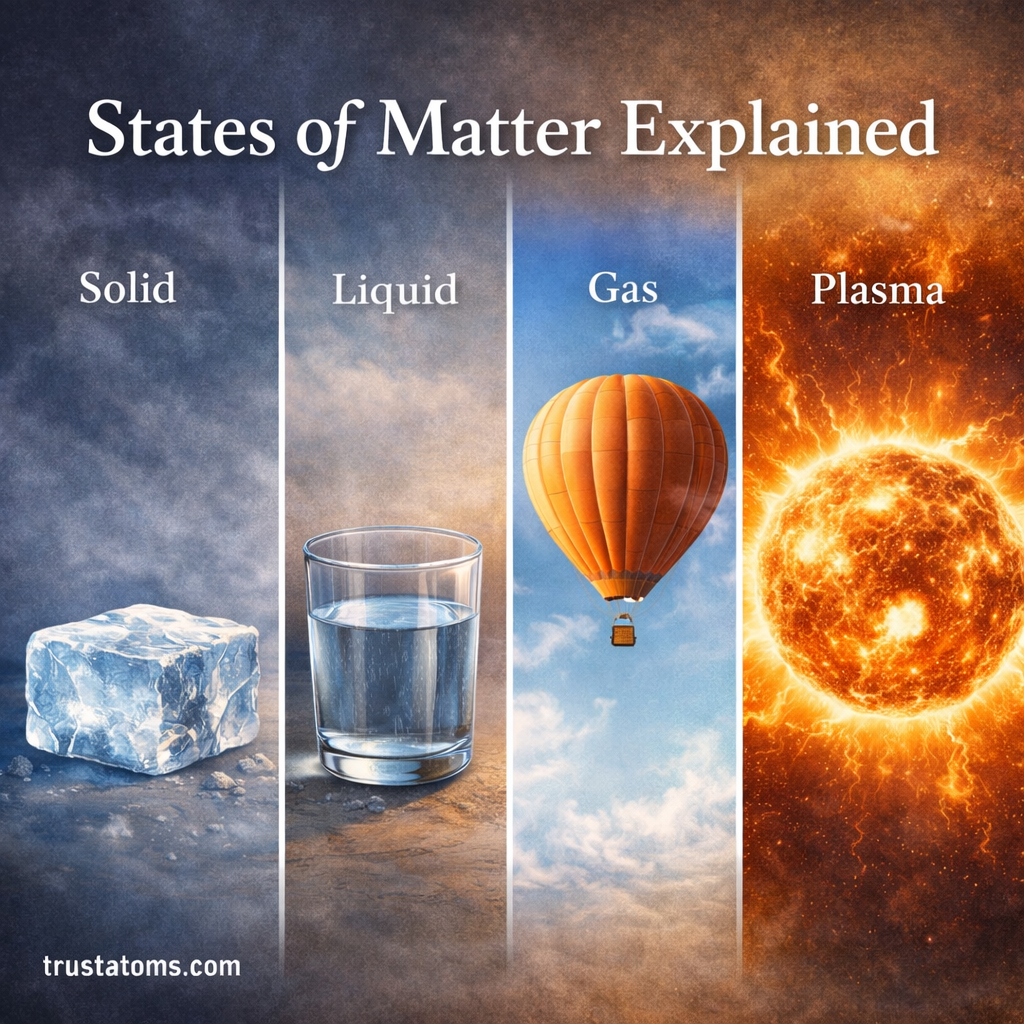
In basic chemistry, scientists commonly study four primary states of matter:
- Solid
- Liquid
- Gas
- Plasma
Each state has distinct characteristics based on particle behavior.
Solids
A solid is a state of matter in which particles are tightly packed and arranged in fixed positions.
Because of this structure, solids maintain both a fixed shape and fixed volume.
Key Properties of Solids
- Definite shape
- Definite volume
- High density
- Particles vibrate but do not move freely
- Strong intermolecular forces
Examples of Solids
Common examples include:
- Ice
- Wood
- Metal
- Glass
- Salt crystals
- Rocks
In many solids, atoms form highly organized structures called crystal lattices.
Liquids
A liquid has a definite volume but does not have a fixed shape. Instead, it takes the shape of its container.
Particles in liquids are close together but can move past one another.
Key Properties of Liquids
- Fixed volume
- No fixed shape
- Moderate density
- Particles flow freely
- Weaker intermolecular forces than solids
Examples of Liquids
Examples include:
- Water
- Milk
- Oil
- Alcohol
- Mercury
Liquids can flow and are often described as fluids because they can be poured or transferred between containers.
Gases
A gas is a state of matter in which particles are widely spaced and move freely in all directions.
Gases do not have a fixed shape or volume. Instead, they expand to fill whatever container they occupy.
Key Properties of Gases
- No fixed shape
- No fixed volume
- Low density
- Particles move rapidly
- Very weak intermolecular forces
Examples of Gases
Common gases include:
- Oxygen
- Nitrogen
- Carbon dioxide
- Helium
- Hydrogen
Air itself is a mixture of gases, primarily nitrogen and oxygen.
Plasma
Plasma is often called the fourth state of matter. It forms when gases become extremely energized and their atoms lose electrons, creating charged particles.
This ionized state allows plasma to conduct electricity and respond to magnetic fields.
Key Properties of Plasma
- Highly energized particles
- Electrically conductive
- Influenced by magnetic fields
- Found at extremely high temperatures
Examples of Plasma
Plasma is less common on Earth but abundant in the universe.
Examples include:
- The Sun and other stars
- Lightning
- Aurora borealis
- Neon signs
- Plasma televisions
In fact, scientists estimate that most visible matter in the universe exists as plasma.
How Matter Changes Between States
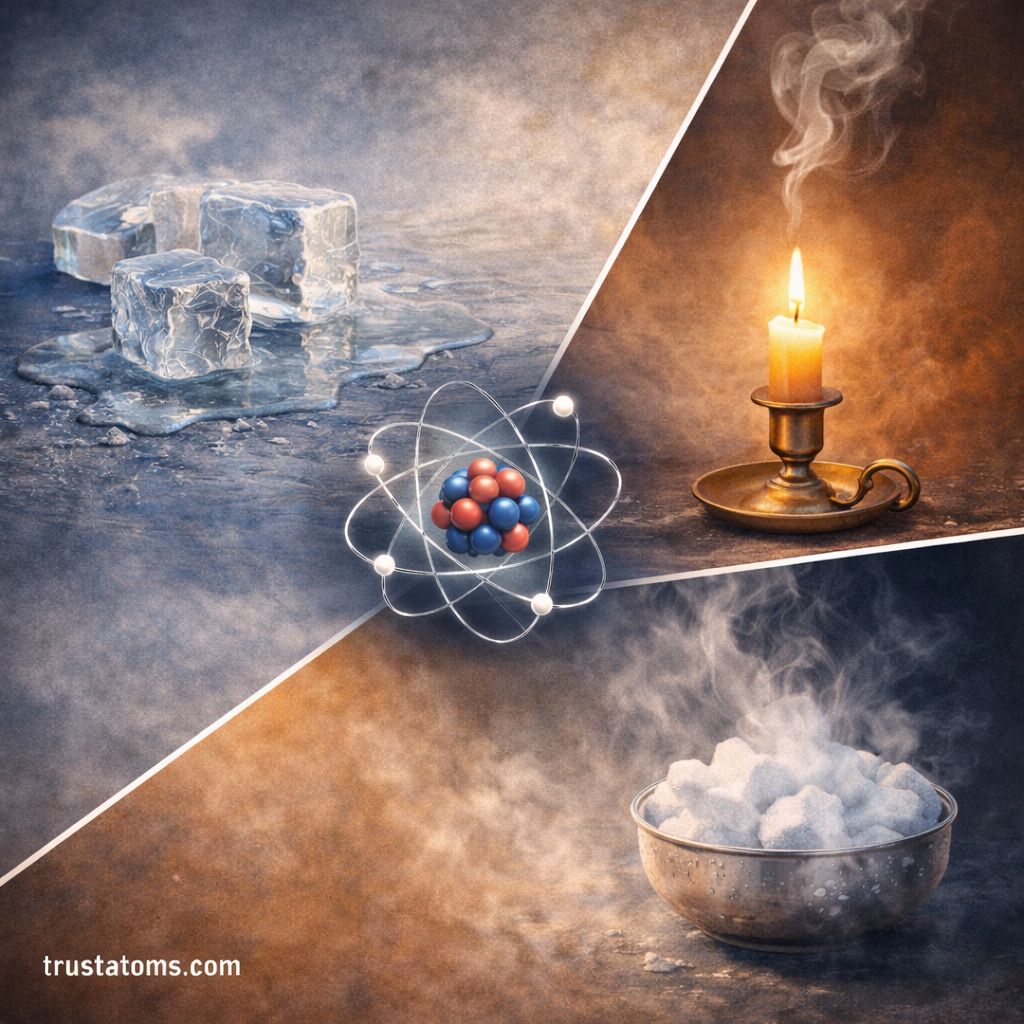
Substances can move between different states of matter through phase changes.
These changes occur when heat energy is added or removed.
Common Phase Changes
- Melting – solid → liquid
- Freezing – liquid → solid
- Evaporation – liquid → gas
- Condensation – gas → liquid
- Sublimation – solid → gas
- Deposition – gas → solid
Each transition involves changes in the motion and spacing of particles.
Why Temperature Affects States of Matter
Temperature plays a major role in determining a substance’s state.
When temperature increases:
- Particles gain energy
- Particle movement speeds up
- Intermolecular forces weaken
This can cause solids to melt or liquids to evaporate.
When temperature decreases:
- Particles lose energy
- Motion slows down
- Intermolecular forces strengthen
This can cause gases to condense or liquids to freeze.
Why States of Matter Matter in Chemistry
The concept of states of matter helps chemists understand:
- How reactions occur
- How materials behave under different conditions
- How substances interact with energy
- How physical changes happen
It also plays an important role in fields such as:
- Materials science
- Environmental chemistry
- Meteorology
- Engineering
- Astronomy
From boiling water in a kitchen to the formation of stars, the behavior of matter in different states shapes many natural and technological processes.
Everyday Examples of States of Matter
States of matter are constantly observed in everyday life.
Examples include:
- Ice melting in a drink
- Water boiling in a kettle
- Steam rising from hot food
- Air filling a balloon
- Frost forming on cold surfaces
These simple observations demonstrate how matter responds to temperature and energy.
Final Thoughts
States of matter describe the different physical forms that substances can take based on particle arrangement and energy levels. The four primary states—solid, liquid, gas, and plasma—each have distinct properties that influence how materials behave.
By understanding how matter moves between these states and how particles interact, scientists can better explain everything from chemical reactions to atmospheric phenomena and even the structure of stars.
The study of states of matter provides a foundation for many areas of chemistry and helps reveal how the physical world operates at both microscopic and cosmic scales.