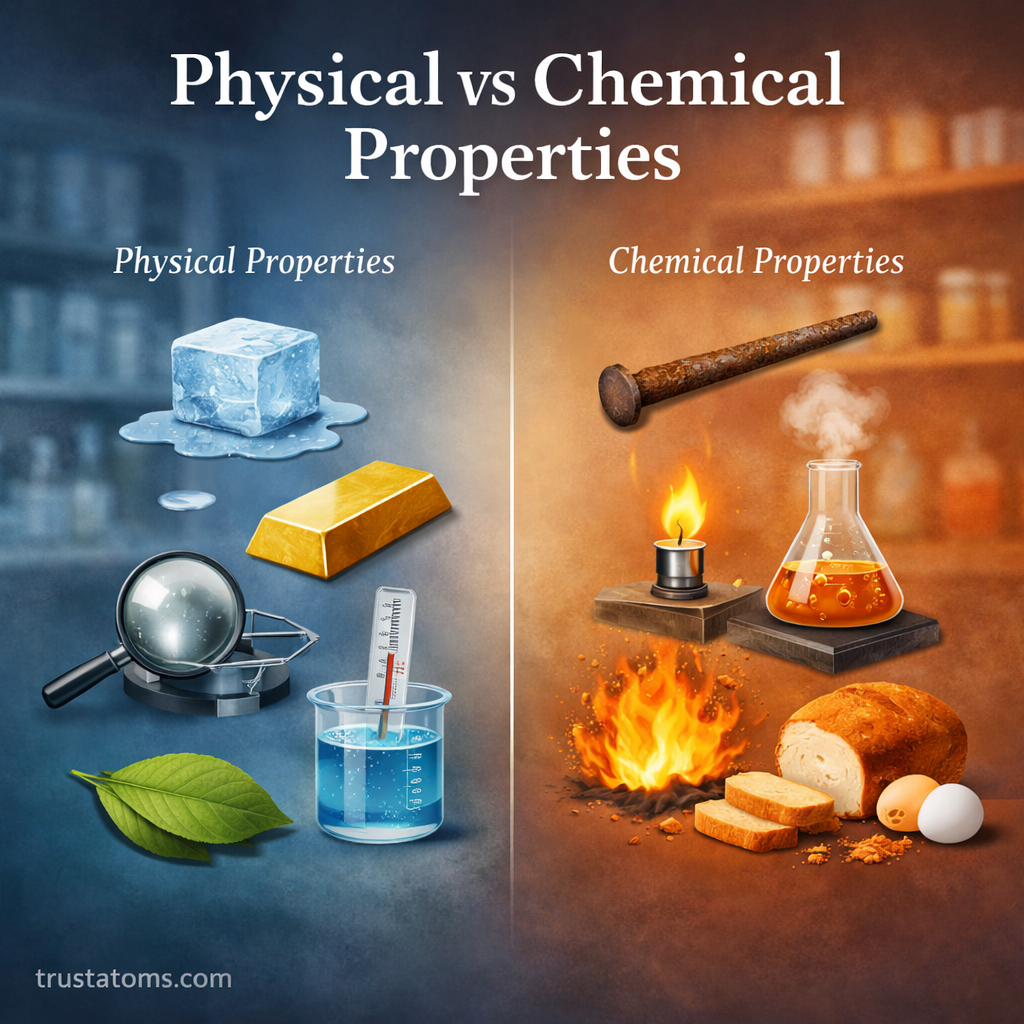
Physical properties are characteristics of a substance that can be observed or measured without changing its chemical identity, while chemical properties describe its ability to undergo reactions that produce new substances. Density, color, and melting point are physical properties; flammability, reactivity with acids, and susceptibility to corrosion are chemical properties.
Understanding the difference between physical and chemical properties is essential in chemistry and chemical reactions. These properties describe how substances behave and how scientists identify, classify, and use different materials. They also help explain the distinction between physical and chemical changes.
For example, copper conducts electricity efficiently, but it can also react with substances in its environment and develop a surface patina. Electrical conductivity is a physical property; the ability to undergo corrosion is a chemical property.
What Are Physical Properties?
Physical properties are characteristics that can be determined without changing a substance into a chemically different material. They help scientists describe, compare, and identify substances.
Scientists frequently use the following physical properties to describe matter and its characteristics:
- Density: Mass per unit volume.
- Melting point: Temperature at which a solid and liquid can coexist in equilibrium at a specified pressure.
- Boiling point: Temperature at which a liquid’s vapor pressure equals the surrounding pressure.
- Solubility: How much of a substance can dissolve in a solvent under specified conditions.
- Electrical conductivity: Ability to carry electric current.
- Hardness: Resistance to scratching or indentation.
- Color and appearance: Observable characteristics that can help distinguish materials.
For example, pure water freezes at approximately 0°C and boils at approximately 100°C under standard atmospheric pressure. These temperatures describe physical properties because water remains H₂O during either phase change.
Intensive and Extensive Physical Properties
Physical properties can also be classified by whether they depend on the amount of material present.
Intensive properties, such as density and melting point, do not depend on sample size for a uniform substance under the same conditions. Extensive properties, such as mass and volume, depend on how much material is present.
A small gold sample and a large gold bar have different masses, but pure gold has approximately the same density in both samples at the same temperature and pressure.
What Are Chemical Properties?
Chemical properties describe how a substance changes into a different substance through a chemical reaction. They describe potential behavior, even when a reaction is not currently taking place.
Common chemical properties include:
- Flammability: Ability to ignite and sustain combustion under suitable conditions.
- Reactivity with oxygen: Tendency to undergo oxidation reactions involving oxygen.
- Reactivity with acids: Ability to react chemically when exposed to particular acids.
- Corrosion susceptibility: Tendency to undergo chemical or electrochemical deterioration.
- Chemical stability: Resistance to decomposition or reaction under specified conditions.
Iron’s susceptibility to corrosion is a chemical property. Rusting in chemistry describes how iron reacts with oxygen and moisture to form hydrated iron oxides and related compounds. The resulting rust is chemically different from metallic iron.
Chemical properties are not limited to dramatic reactions. A substance may react slowly over months or remain stable until exposed to a particular temperature, chemical, or environment.
Physical vs Chemical Properties: Comparison Table

The main difference is whether determining the property requires examining the substance’s ability to form chemically different materials.
| Feature | Physical Property | Chemical Property |
|---|---|---|
| Definition | Characteristic measurable without changing chemical identity | Characteristic describing chemical reactivity |
| Examples | Density, color, melting point | Flammability, corrosion, oxidation and reduction behavior |
| New substance required? | No | A reaction producing new substances demonstrates the property |
| Typical measurements | Mass, temperature, conductivity | Reaction behavior, stability, product formation |
| Practical use | Material identification and selection | Predicting reactions and safe handling |
Properties Versus Changes: An Important Distinction
A property describes a characteristic of a substance. A change describes an event that happens to the substance. These related ideas should not be confused.
For example, the melting point of ice is a physical property, while ice melting is a physical change. Similarly, the flammability of wood is a chemical property, while wood burning is a chemical change.
Observing a property does not always require a large visible transformation. Scientists can measure electrical conductivity without changing chemical composition, while testing flammability requires initiating a reaction in a controlled setting.
How Scientists Identify Substances Using Properties
Scientists often combine several measurements rather than relying on one characteristic. Color alone is rarely enough to identify an unknown substance because many materials look similar.
Consider a metal sample suspected to be pure gold. At approximately room temperature, gold has a density near 19.3 grams per cubic centimeter and a melting point near 1,064°C. These standard physical properties can help distinguish it from many other metals.
However, density alone cannot prove that a sample is gold. Alloys and other materials may have overlapping measurements. Additional tests, including chemical analysis when appropriate, provide stronger evidence.
Chemical behavior can also distinguish materials. For instance, some metals react readily with dilute acids and release hydrogen gas, while others do not react appreciably under the same conditions.
Everyday Uses of Physical and Chemical Properties
Choosing Materials for Buildings
Engineers consider physical properties such as strength, hardness, and thermal conductivity when selecting construction materials. Chemical properties, especially corrosion resistance and chemical stability, influence how those materials perform outdoors.
Cooking and Food Preservation
Food preparation involves both categories. Water’s boiling point is a physical property used during cooking, while the tendency of sugars to caramelize under heating reflects chemical reactivity. Food preservation also depends on controlling reactions that cause spoilage.
Handling Household Chemicals
Knowing whether a product is flammable, reactive with acids, or chemically unstable helps determine safe storage and handling. Physical properties such as volatility and solubility also influence exposure risks and cleanup procedures.
How to Classify an Unfamiliar Property
Use three questions when deciding whether a characteristic is physical or chemical:
- Can the characteristic be determined without changing the substance’s chemical identity?
- Does it describe how the substance reacts with another material or decomposes?
- Would demonstrating the characteristic involve forming new chemical substances?
If the first answer is yes, the characteristic is generally physical. If the characteristic describes reaction behavior or chemical transformation, it is chemical. Remember that temperature, pressure, and surrounding conditions can affect either type of property.
Frequently Asked Questions
Is density a physical or chemical property?
Density is a physical property because it measures mass per unit volume without requiring a change in chemical identity. For a uniform material, density depends on conditions such as temperature and pressure.
Is flammability a physical or chemical property?
Flammability is a chemical property because it describes a substance’s ability to undergo combustion. Burning produces chemically different substances through reactions with an oxidizing agent, usually oxygen.
Can one substance have both physical and chemical properties?
Yes. Every substance has physical characteristics and chemical behavior. Iron, for example, has measurable density and electrical conductivity, while its tendency to rust describes a chemical property.
Physical properties help identify materials through measurements such as density, melting point, and conductivity, while chemical properties reveal how those materials react or remain stable. Examining both gives scientists and engineers a more complete picture of a substance, whether they are identifying a metal sample, selecting construction materials, or evaluating chemical safety.
Sources: Chemistry 2e, OpenStax; Chemistry: The Central Science, Pearson; IUPAC Gold Book, International Union of Pure and Applied Chemistry.