To balance a chemical equation, adjust the coefficients in front of chemical formulas until each element has the same number of atoms on both sides. Never change the subscripts within a formula, because doing so changes the chemical substances involved in the reaction.
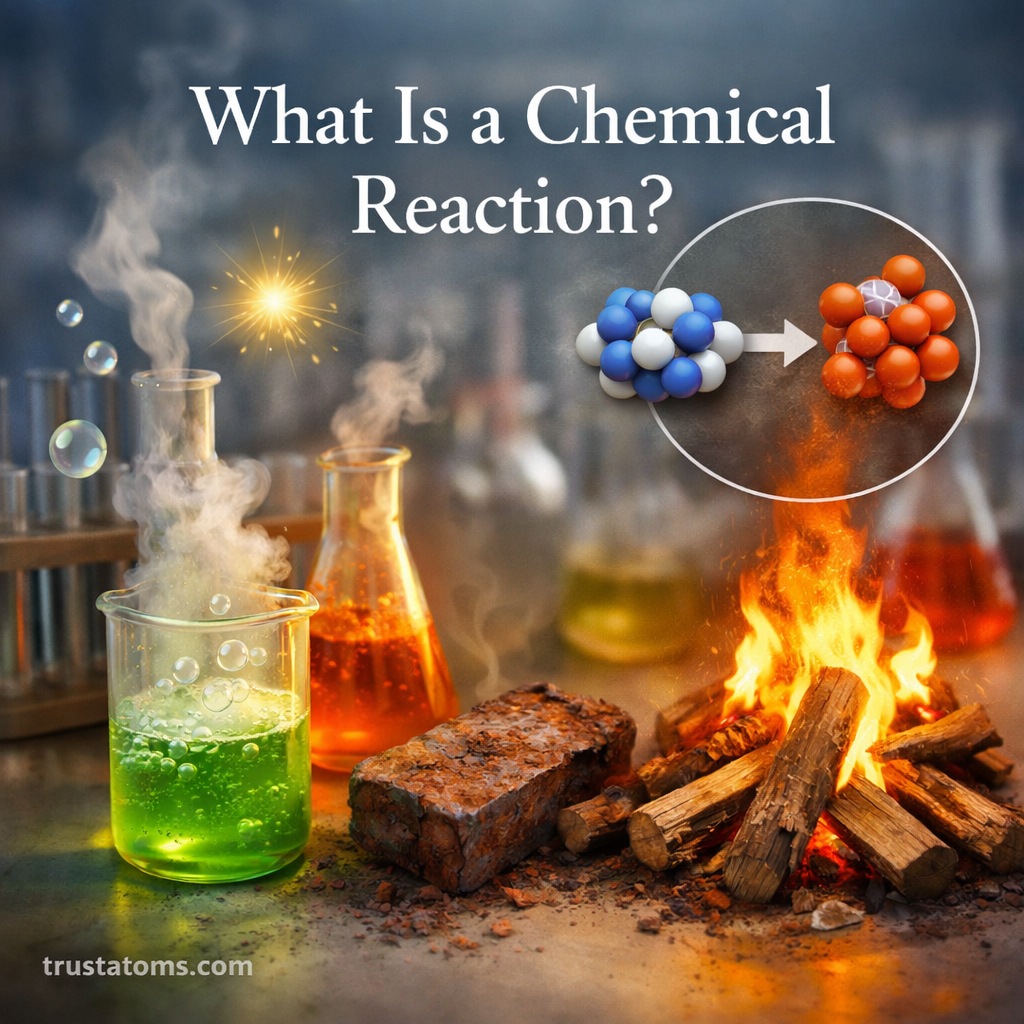
Balancing equations is a fundamental skill in chemistry because it follows the law of conservation of mass. Chemical reactions describe how substances transform into new substances. Chemists represent these reactions using chemical equations, which show the reactants (starting materials) and the products (new substances formed).
What Does It Mean to Balance a Chemical Equation?
A balanced chemical equation contains equal numbers of atoms of every element on the reactant and product sides. During an ordinary chemical reaction, atoms are rearranged into new combinations rather than created or destroyed.
Consider the unbalanced equation for hydrogen reacting with oxygen to form water:
H₂ + O₂ → H₂O
The reactant side contains two hydrogen atoms and two oxygen atoms. The product side contains two hydrogen atoms but only one oxygen atom. To correct this, place coefficients in front of the formulas:
2H₂ + O₂ → 2H₂O
Both sides now contain four hydrogen atoms and two oxygen atoms. The coefficient 2 before H₂O means two water molecules, while the subscript 2 in H₂ means two hydrogen atoms per molecule.
These coefficients also establish the mole ratios used in stoichiometric calculations to predict quantities of reactants and products.
Basic Rules for Balancing Chemical Equations
Before working through an equation, follow these practical rules:
- Change coefficients only, never the subscripts in chemical formulas.
- Balance one element at a time and keep track of atom counts.
- Begin with an element that appears in only one formula on each side when possible.
- Consider leaving hydrogen and oxygen until later when they appear in several compounds.
- Reduce coefficients to the smallest possible whole-number ratio.
- Verify every element after making the final adjustment.
How to Balance Chemical Equations Step by Step
Consider iron reacting with oxygen to form iron(III) oxide, a compound associated with rust formation.
Step 1: Write the Unbalanced Equation
Fe + O₂ → Fe₂O₃
Identify the elements present: iron (Fe) and oxygen (O).
Step 2: Count the Atoms on Each Side
| Element | Reactants | Products |
|---|---|---|
| Iron (Fe) | 1 | 2 |
| Oxygen (O) | 2 | 3 |
Neither element is balanced. The oxygen counts of two and three suggest finding a common multiple.
Step 3: Balance Oxygen
The smallest common multiple of two and three is six. Place a coefficient of 3 before O₂ and 2 before Fe₂O₃:
Fe + 3O₂ → 2Fe₂O₃
Oxygen is now balanced with six atoms on each side. However, the product side contains four iron atoms.
Step 4: Balance Iron and Verify
Place a coefficient of 4 before Fe:
4Fe + 3O₂ → 2Fe₂O₃
| Element | Reactants | Products |
|---|---|---|
| Iron (Fe) | 4 | 4 |
| Oxygen (O) | 6 | 6 |
Both elements now match, and the coefficients 4:3:2 are the smallest whole-number ratio. The equation is balanced.
Worked Example: Balancing Methane Combustion
Methane is a major component of natural gas. When it burns completely in sufficient oxygen, it produces carbon dioxide and water.
Start with the unbalanced equation:
CH₄ + O₂ → CO₂ + H₂O
Carbon is already balanced with one atom on each side. Four hydrogen atoms on the left require two water molecules on the right:
CH₄ + O₂ → CO₂ + 2H₂O
The products now contain four oxygen atoms: two in CO₂ and two in the water molecules. Place a coefficient of 2 before O₂:
CH₄ + 2O₂ → CO₂ + 2H₂O
The balanced equation shows that one mole of methane reacts with two moles of oxygen to produce one mole of carbon dioxide and two moles of water. For example, complete combustion of 2 moles of methane requires 4 moles of oxygen, assuming sufficient oxygen is available and the reaction proceeds completely.
Examples of Balanced Equations by Reaction Type
The same atom-counting method works across different categories of chemical reactions.
Synthesis Reactions
Two or more substances combine to form a compound. For example, sodium reacts with chlorine:
2Na + Cl₂ → 2NaCl
Decomposition Reactions
A compound breaks down into simpler substances. Water can be decomposed by electrolysis:
2H₂O → 2H₂ + O₂
Single Replacement Reactions
One element replaces another in a compound. Zinc reacting with hydrochloric acid is an example:
Zn + 2HCl → ZnCl₂ + H₂
Combustion Reactions
Complete combustion of a hydrocarbon produces carbon dioxide and water. For propane:
C₃H₈ + 5O₂ → 3CO₂ + 4H₂O
Common Mistakes When Balancing Equations
Changing Subscripts Instead of Coefficients
Changing H₂O to H₂O₂ does not balance water formation; it changes water into hydrogen peroxide, a different compound. Keep formulas unchanged and adjust the numbers placed before them.
Forgetting to Multiply Every Atom
A coefficient multiplies every atom in its formula. For example, 3Ca(OH)₂ contains three calcium atoms, six oxygen atoms, and six hydrogen atoms. Parentheses and subscripts must be included when counting.
Failing to Check the Final Equation
Adjusting one coefficient can affect several elements. Recount all atoms at the end, and reduce the coefficients if they share a common factor.
Why Balancing Chemical Equations Is Important
Balanced equations conserve atoms and provide the correct proportions for chemical calculations. Balanced equations are also necessary for stoichiometry, which determines how much of each substance participates in a reaction.
These calculations help chemists plan laboratory experiments, estimate industrial material requirements, and predict product yields. More complex oxidation-reduction reactions may require tracking electron transfer as well as atoms, as explained in redox balancing in chemical equations.
Frequently Asked Questions
What is the easiest way to balance a chemical equation?
Count the atoms of each element on both sides, then adjust coefficients one element at a time. Starting with an element that appears in only one compound on each side often reduces the number of adjustments needed.
Can you use fractions when balancing equations?
Yes. Fractional coefficients can simplify intermediate steps, especially when balancing oxygen. Multiply every coefficient by a common denominator afterward to obtain the smallest whole-number ratio.
How do you know when a chemical equation is balanced?
Count every element on both sides of the equation. If the totals match and the coefficients are in their smallest whole-number ratio, the equation is balanced. For ionic equations, the total electric charge must also match on both sides.
Balancing chemical equations becomes more manageable when you count atoms systematically, change only coefficients, and verify each element after the final adjustment. Whether the reaction involves iron oxidation, water formation, or fuel combustion, the same conservation principle applies. A correctly balanced equation also provides the mole ratios needed to calculate reactant requirements and expected product quantities.
Sources: OpenStax, Chemistry 2e; Brown et al., Chemistry: The Central Science; IUPAC, Compendium of Chemical Terminology (Gold Book).