A suspension is a heterogeneous mixture in which solid particles or liquid droplets are dispersed throughout a fluid without dissolving into it. Unlike a true solution, a suspension contains separate particles that may settle, rise, or otherwise separate over time when the mixture is left undisturbed.
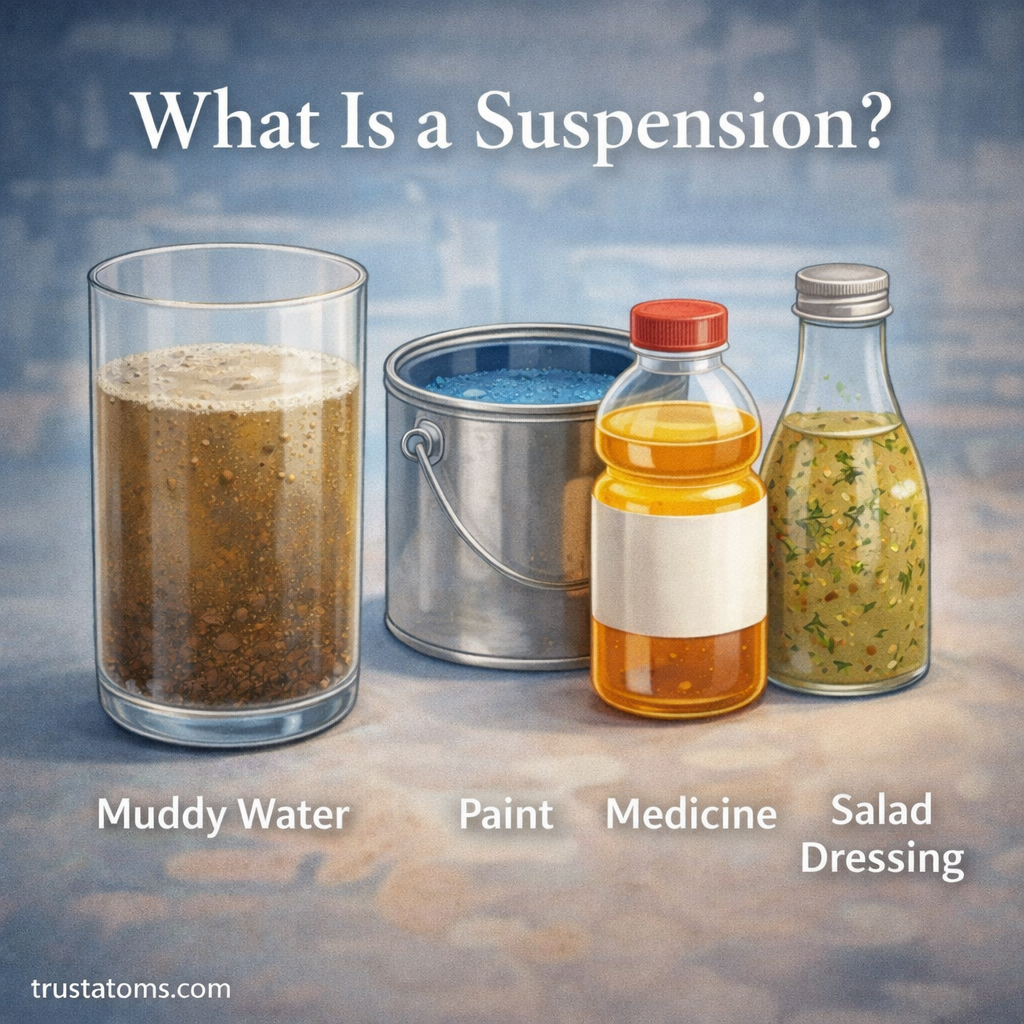
In the study of chemistry, different types of mixtures behave differently depending on particle size, composition, and how their components interact. Muddy water is a familiar suspension: soil particles spread through the water when stirred but can gradually collect at the bottom.
Suspensions also occur in certain medicines, paints, foods, and natural environments. Their behavior becomes clearer when compared with chemical solutions and colloidal mixtures, which contain particles that behave differently.
Definition of a Suspension in Chemistry
A suspension is a heterogeneous mixture in which particles of one substance are dispersed throughout another substance but remain physically distinct from the surrounding medium. In many introductory chemistry examples, the suspended material is a solid and the surrounding medium is a liquid.
The dispersed particles are generally larger than the molecules or ions found in true solutions. Because the particles remain separate, gravity or other forces may eventually cause them to settle or rise, depending on their density and the properties of the surrounding fluid.
Water is often the continuous medium in a liquid suspension. Although water is also a common solvent in chemistry, suspended particles are not considered dissolved solutes simply because they are mixed into water.
Common characteristics of suspensions include:
- Particles remain physically distinct from the surrounding fluid.
- The mixture is heterogeneous at the particle level.
- Particles may scatter light and make the mixture appear cloudy.
- Separation may occur through settling, floating, or other physical processes.
- Filtration, sedimentation, or centrifugation can often separate the components.
Not every suspension separates quickly. Some are deliberately formulated to remain dispersed for long periods, while others settle within minutes. The rate depends on several physical properties rather than particle size alone.
Characteristics of Suspensions and Settling Particles
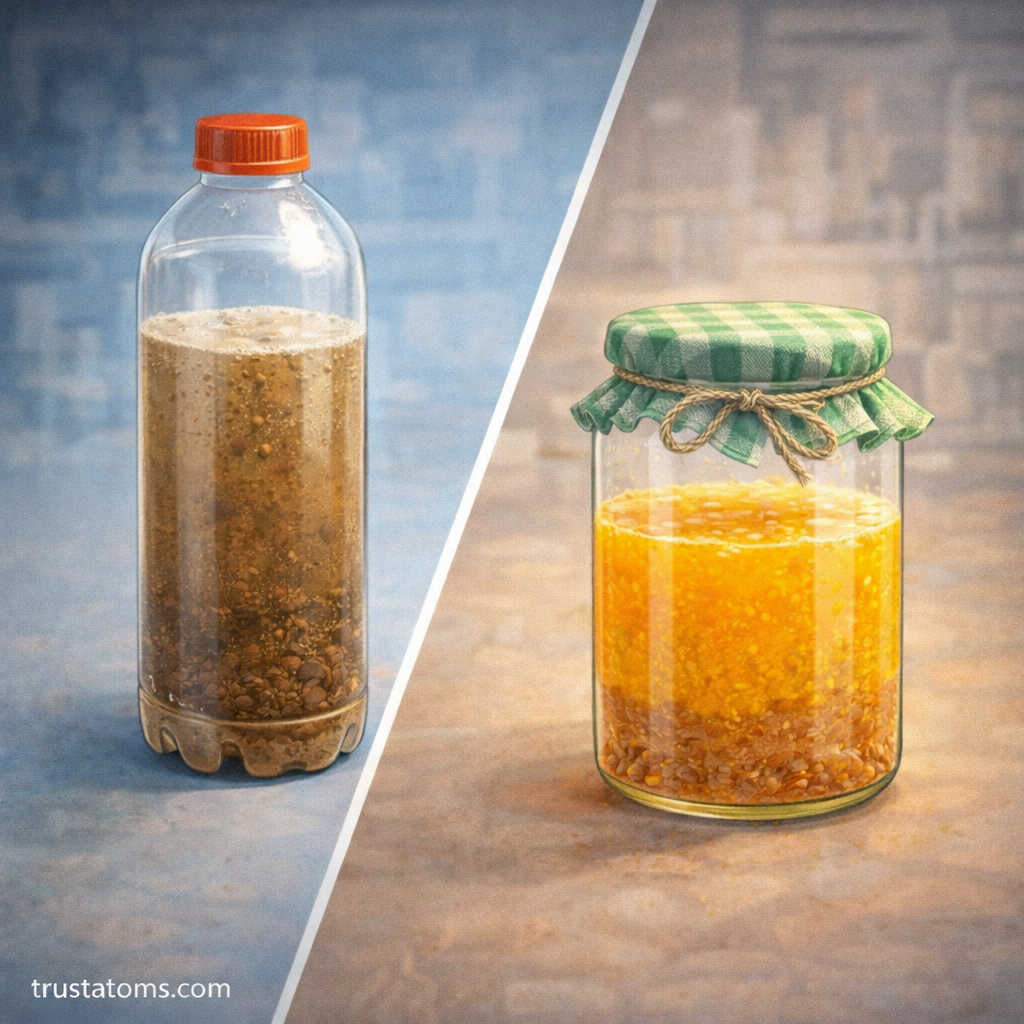
The behavior of a suspension depends on the size and density of its dispersed particles, the viscosity of the fluid, and interactions between particles. These factors influence how the mixture looks and how long it remains mixed.
Particles Remain Undissolved
In a suspension, the dispersed material does not dissolve into individual molecules or ions throughout the fluid. Sand mixed into water, for example, remains as separate solid grains even when stirring temporarily distributes them.
Some suspended particles are visible without magnification, while smaller ones require a microscope. Their presence can make a mixture cloudy because they scatter incoming light.
Particles Can Settle or Float
When particles are denser than the surrounding fluid, gravity tends to pull them downward. Less-dense particles or droplets may instead rise toward the surface.
For example, sediment commonly settles in muddy water, while certain dispersed oil droplets rise through water. Separation is not always immediate, especially when particles are small or the fluid is thick.
Suspensions Can Be Separated Physically
Many suspensions can be separated without changing the chemical identity of their components. A filter may trap suspended solids while allowing the fluid to pass through. Alternatively, particles may be allowed to settle before the clearer liquid is poured away.
Centrifugation speeds separation by applying acceleration that causes particles and the surrounding fluid to separate according to their physical properties.
Everyday Examples of Suspensions
Suspensions are found in natural environments, consumer products, and industrial materials. The following examples illustrate different ways particles can remain dispersed in a fluid.
Muddy Water
Muddy water contains particles of soil, silt, and other materials dispersed in water. Larger particles may settle relatively quickly, while fine particles can remain suspended much longer.
Paint
Many paints contain solid pigment particles dispersed in a liquid formulation. Additives help maintain an even distribution, although some paints may separate during prolonged storage and require mixing before use.
Liquid Medicines
Certain oral medicines contain insoluble drug particles dispersed in a liquid. These pharmaceutical suspensions are formulated to distribute the active ingredient as uniformly as possible when used according to the product instructions.
Some require shaking before each dose. This instruction should be followed carefully because uneven particle distribution can affect the amount of medication delivered.
Pulpy Fruit Juice
Fruit juice containing visible pulp can behave as a suspension because pieces of fruit material remain dispersed rather than dissolving. Over time, pulp may collect near the bottom or top of the container.
Dust in Air
Airborne dust consists of solid particles dispersed in a gas. Depending on particle size and air movement, dust can remain suspended for varying periods before settling or being removed from the air.
Dust is also an example of an aerosol, a broad category of particles dispersed in gases. Some aerosols behave as colloidal dispersions, so the classifications can overlap depending on particle size and behavior.
How Does a Suspension Form?
A suspension forms when particles are introduced into a fluid and distributed without dissolving. Stirring, shaking, flowing water, or moving air can disperse the particles throughout the surrounding medium.
Consider mixing a small amount of clean sand into a glass of water:
- Add the sand to the water. The sand remains as separate solid grains.
- Stir the mixture. Moving water carries many grains through the liquid.
- Stop stirring. Gravity begins pulling the denser sand particles downward.
- Wait for the mixture to settle. Much of the sand collects at the bottom, leaving clearer water above.
- Pour the water through suitable filter paper. The filter traps sand grains that are larger than its pores.
The sand has not dissolved or undergone a chemical reaction. Its distribution changes because of physical movement and separation.
Worked Example: Calculating the Composition of a Suspension
Suppose a laboratory prepares a suspension by mixing 8 grams of insoluble powder with 192 grams of water. Assume no material is lost and that the powder remains undissolved.
The mass percentage of suspended solid can be calculated using the mass of powder divided by the total mixture mass, multiplied by 100.
- Identify the mass of suspended solid: 8 grams.
- Identify the mass of water: 192 grams.
- Calculate the total mixture mass: 8 + 192 = 200 grams.
- Divide the solid mass by the mixture mass: 8 / 200 = 0.04.
- Multiply by 100: 0.04 × 100 = 4% suspended solid by mass.
The freshly mixed suspension contains 4% solid by mass overall. However, if the powder settles, a sample taken near the top may contain much less solid than one taken near the bottom.
This illustrates an important difference between suspensions and homogeneous solutions: the average composition of a suspension does not guarantee that every portion has the same composition at a particular moment.
Suspension vs. Solution vs. Colloid
Solutions, colloids, and suspensions are commonly compared in introductory chemistry because their dispersed particles differ in size, behavior, and stability.
Solutions are homogeneous mixtures where substances dissolve completely at the molecular, ionic, or atomic level. Colloids contain dispersed particles that are generally larger than dissolved molecules but smaller than the particles in many coarse suspensions.
| Property | Solution | Colloid | Suspension |
|---|---|---|---|
| Mixture type | Homogeneous | Microscopically heterogeneous | Heterogeneous |
| Particle form | Dissolved molecules, ions, or atoms | Small dispersed particles or droplets | Relatively large dispersed particles |
| Settling behavior | Does not normally settle | Generally resists settling | May settle or separate |
| Ordinary filtration | Does not remove dissolved substances | Usually does not remove colloidal particles | Often removes suspended solids |
| Example | Saltwater | Milk | Muddy water |
Particle-size boundaries between colloids and suspensions are approximate rather than absolute. Real mixtures may contain a range of particle sizes, making their classification dependent on the properties being studied.
What Controls How Fast Suspended Particles Settle?
Not all suspensions separate at the same rate. Several physical factors determine how quickly dispersed particles move through a fluid.
Particle Size
Larger particles often settle faster than smaller particles when other conditions are similar. Fine clay particles, for example, can remain dispersed in water much longer than coarse sand grains.
Density Difference
Particles denser than the surrounding fluid tend to sink. Particles or droplets less dense than the fluid may rise instead. A greater density difference can increase the rate of separation.
Fluid Viscosity
Viscosity describes a fluid’s resistance to flow. Particles generally move more slowly through a more viscous fluid, which can help a suspension remain dispersed longer.
Particle Interactions
Particles may attract one another and form larger clusters, a process called flocculation. These clusters can settle differently from individual particles. Surface charges and added stabilizing agents can influence whether particles remain separate or aggregate.
How Suspensions Are Separated
Because suspended particles remain physically distinct, they can often be removed using methods based on size, density, or movement through a fluid.
- Filtration: A porous barrier retains particles larger than its effective pore size.
- Sedimentation: Particles settle under gravity when the mixture remains undisturbed.
- Decantation: The clearer upper liquid is carefully poured away after settling.
- Centrifugation: Rapid rotation accelerates separation of particles from the surrounding fluid.
The best method depends on the material being separated. Fine particles may pass through coarse filters, while some stable dispersions require specialized filtration or centrifugation equipment.
How Manufacturers Keep Suspensions Stable
In many products, rapid settling is undesirable. Manufacturers may adjust the formulation so particles remain dispersed long enough for storage, transport, and use.
Common strategies include reducing particle size, increasing the viscosity of the surrounding fluid, and adding suitable dispersing or stabilizing agents. Controlled mixing can also redistribute particles that have begun to settle.
These methods do not necessarily turn a suspension into a true solution. The particles may remain undissolved even when the mixture appears uniform for an extended period.
Applications of Suspensions in Science and Industry
Understanding suspensions helps scientists control particle behavior in products and natural systems.
- Pharmaceuticals: Some medicines contain insoluble active ingredients dispersed in liquid formulations.
- Paints and coatings: Pigments are distributed through liquid materials to produce color and surface coverage.
- Water treatment: Sedimentation and filtration remove suspended solids from water.
- Environmental monitoring: Suspended sediment affects water clarity and the transport of materials through rivers.
- Food production: Products containing pulp, spices, or other dispersed solids may require controlled mixing and stabilization.
In water-quality testing, suspended solids can be measured to assess the amount of particulate material in a sample. This information helps distinguish particulate contamination from substances that are truly dissolved.
Common Misconceptions About Suspensions
Misconception 1: Suspended Particles Are Dissolved
Suspended particles remain physically separate from the surrounding fluid. Dissolved substances are distributed at the molecular, ionic, or atomic level, while suspended particles retain their own distinct boundaries.
Misconception 2: Every Suspension Settles Immediately
Settling can take seconds, hours, or much longer depending on particle size, density, viscosity, and stabilizing interactions. Some engineered suspensions remain dispersed for extended periods.
Misconception 3: All Cloudy Liquids Are Suspensions
Cloudiness can also result from colloidal particles or tiny droplets. Milk, for example, is commonly described as a colloidal emulsion rather than a simple coarse suspension.
Misconception 4: A Suspension Must Contain a Liquid
Suspensions can also involve particles dispersed in gases, as with airborne dust. The defining feature is the presence of distinct dispersed particles within a surrounding medium, not the requirement for water or another liquid.
Frequently Asked Questions
What is a suspension in simple terms?
A suspension is a mixture containing particles that are spread through a fluid without dissolving. Muddy water is a common example because the soil particles can eventually settle to the bottom.
What are five examples of suspensions?
Five examples are muddy water, sand mixed with water, pulpy fruit juice, certain liquid medicines, and some pigment-based paints. Each contains dispersed material that remains physically distinct from its surrounding medium.
What is the difference between a suspension and a solution?
A suspension contains undissolved particles that may separate over time. A true solution contains substances distributed uniformly at the molecular, ionic, or atomic level and does not ordinarily separate through simple settling or filtration.
Can suspensions be separated by filtration?
Many suspensions can be separated by filtration because their particles are large enough to be retained by a suitable filter. Very fine particles may require filters with smaller pores or other separation methods.
Why do suspension medicines need shaking?
Some liquid medicines contain drug particles that settle during storage. Shaking as directed redistributes the particles so the measured dose is more representative of the intended formulation. Always follow the specific medicine’s label instructions.
A suspension is a heterogeneous mixture containing distinct particles dispersed through a fluid rather than dissolved within it. Its behavior depends on particle size, density, fluid viscosity, and interactions that influence settling and stability. Recognizing these properties helps explain how muddy water separates, why certain medicines require shaking, and how filtration and sedimentation work.
Sources: OpenStax Chemistry 2e; Chemistry: The Central Science by Theodore L. Brown and colleagues; IUPAC Compendium of Chemical Terminology (Gold Book); Chemistry by Raymond Chang and Kenneth A. Goldsby.