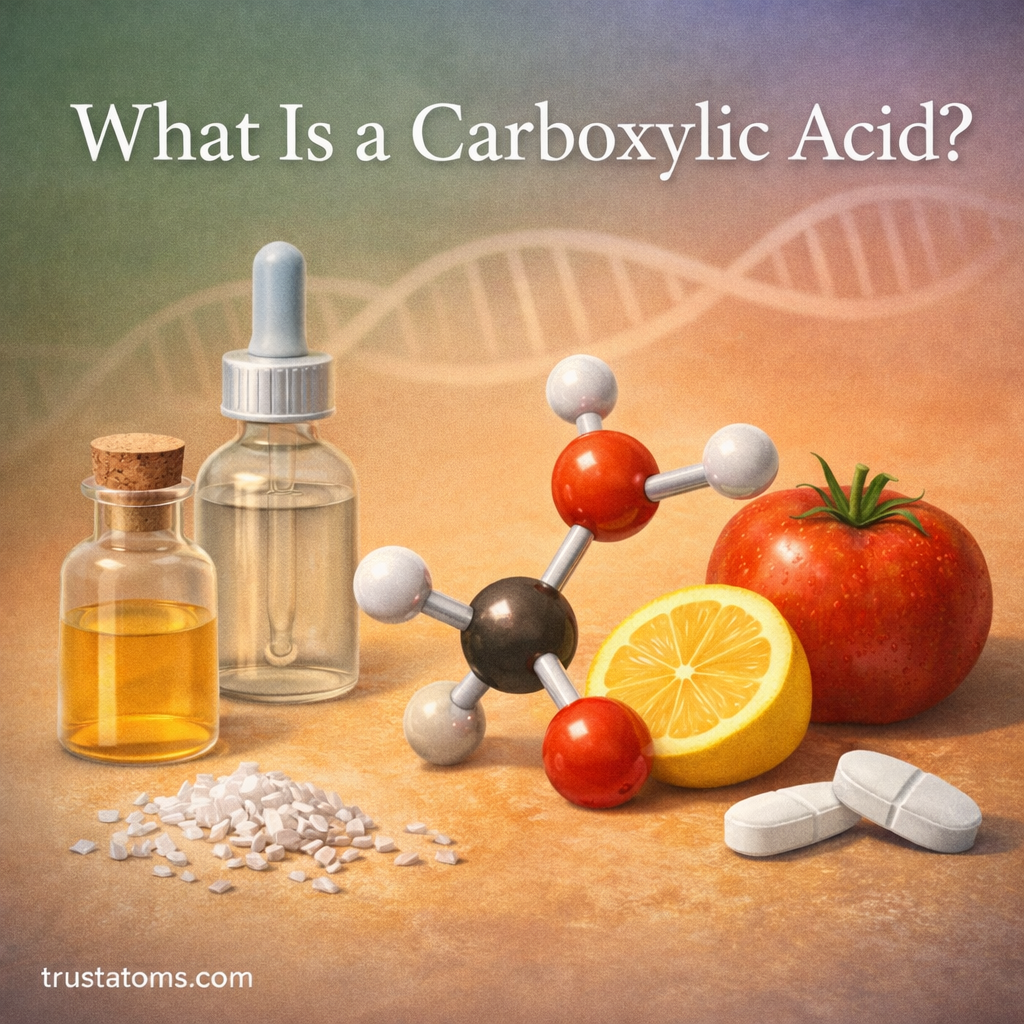
Carboxylic acids are an important class of organic compounds widely found in nature, food, biology, and industrial chemistry. These molecules are defined by the presence of a carboxyl group, a functional group consisting of a carbon atom double-bonded to oxygen and single-bonded to a hydroxyl group.
Carboxylic acids play key roles in many biological and chemical processes. They appear in substances such as vinegar, fatty acids in food, metabolic molecules inside cells, and numerous industrial products.
Understanding carboxylic acids helps explain how acids behave in organic chemistry and why these compounds are so important in both natural systems and chemical manufacturing.
The Basic Structure of a Carboxylic Acid
A carboxylic acid contains a special functional group called the carboxyl group.
The structure can be represented as:
R–COOH
Where:
- R represents a hydrocarbon chain or organic group
- COOH is the carboxyl functional group
The carboxyl group includes two important parts:
- A carbonyl group (C=O)
- A hydroxyl group (–OH)
These two components together give carboxylic acids their acidic properties.
Why Carboxylic Acids Are Considered Acids
Carboxylic acids are classified as acids because they can donate a hydrogen ion (H⁺) when dissolved in water.
When a carboxylic acid loses its hydrogen ion, it forms a negatively charged ion called a carboxylate ion.
Example:
Acetic acid → acetate ion + hydrogen ion
This ability to release hydrogen ions is what gives carboxylic acids their acidic behavior in chemical reactions.
However, carboxylic acids are generally considered weak acids, meaning they do not fully ionize in water.
Common Examples of Carboxylic Acids
Many carboxylic acids occur naturally in foods and biological systems.
Acetic Acid
Acetic acid is the main component of vinegar and gives vinegar its sharp taste and smell.
Uses include:
- Food preservation
- Cooking
- Chemical manufacturing
Citric Acid
Citric acid is found naturally in citrus fruits such as lemons and oranges.
It is widely used in:
- Food flavoring
- Soft drinks
- Preservatives
Formic Acid
Formic acid occurs naturally in ant venom and some plant stings.
It has industrial uses in:
- Leather processing
- Textile production
- Agriculture
Fatty Acids
Fatty acids are long-chain carboxylic acids found in fats and oils. They play critical roles in:
- Energy storage
- Cell membranes
- Metabolism
Where Carboxylic Acids Are Found in Nature
Carboxylic acids are extremely common in biological systems.
Metabolism
Many metabolic processes rely on carboxylic acids. For example:
- The citric acid cycle is central to cellular energy production.
- Several amino acids and metabolic intermediates contain carboxyl groups.
Food and Flavor
Carboxylic acids contribute to the taste of many foods.
Examples include:
- Vinegar (acetic acid)
- Citrus fruits (citric acid)
- Yogurt and fermented foods (lactic acid)
Biological Molecules
Carboxylic acids are part of many important biomolecules, including:
- Amino acids (building blocks of proteins)
- Fatty acids
- Some hormones and vitamins
Chemical Properties of Carboxylic Acids
Carboxylic acids share several characteristic chemical properties.
Key Properties
- Usually have sour or sharp tastes
- Often form hydrogen bonds
- Have relatively high boiling points
- Can dissolve in water when the carbon chain is short
- Become less soluble as the carbon chain grows longer
These properties come largely from the polar nature of the carboxyl group.
Reactions Involving Carboxylic Acids
Carboxylic acids participate in many important chemical reactions.
1. Ester Formation
Carboxylic acids can react with alcohols to form esters, which often have fruity aromas.
This reaction is called esterification.
2. Salt Formation
When carboxylic acids react with bases, they form carboxylate salts.
Example:
Acetic acid + sodium hydroxide → sodium acetate
3. Reduction Reactions
Carboxylic acids can be chemically reduced to produce alcohols.
4. Amide Formation
Carboxylic acids can react with ammonia or amines to produce amides, an important group of compounds found in proteins and synthetic materials.
How Carboxylic Acids Are Named
Chemists follow specific rules when naming carboxylic acids.
The typical naming pattern replaces the ending -e of an alkane with -oic acid.
Examples
- Methane → methanoic acid
- Ethane → ethanoic acid (acetic acid)
- Propane → propanoic acid
Some compounds also have widely used common names, such as acetic acid instead of ethanoic acid.
Industrial Uses of Carboxylic Acids
Carboxylic acids are widely used in industry and manufacturing.
Common Applications
- Food preservation and flavoring
- Pharmaceutical production
- Plastic and polymer manufacturing
- Soap and detergent production
- Textile and leather processing
Fatty acids, for example, are used to make soaps through a reaction called saponification.
Why Carboxylic Acids Matter in Chemistry
Carboxylic acids are foundational molecules in organic chemistry. Their structure allows them to participate in many types of reactions, making them useful building blocks for more complex molecules.
They connect several major areas of chemistry:
- Organic synthesis
- Biochemistry
- Food chemistry
- Industrial chemical production
Because they are found in both natural biological systems and large-scale manufacturing processes, carboxylic acids are one of the most widely studied functional groups in chemistry.
Final Thoughts
A carboxylic acid is an organic compound defined by the presence of the carboxyl functional group (–COOH). This group gives the molecule its acidic properties and allows it to participate in a wide range of chemical reactions.
From vinegar in the kitchen to metabolic processes in living cells, carboxylic acids appear in many familiar places. Their ability to form esters, salts, and other compounds makes them essential in fields ranging from food science to pharmaceuticals and industrial chemistry.
Understanding carboxylic acids provides an important foundation for studying organic chemistry and the chemical processes that shape the natural and manufactured world.