Crystal structure is a fundamental concept in chemistry and materials science that describes how atoms, ions, or molecules are arranged in a solid. In crystalline materials, these particles are organized in a repeating three-dimensional pattern, forming a highly ordered structure that extends throughout the entire crystal.
Understanding crystal structure helps chemists explain many physical properties of materials, including hardness, melting point, electrical conductivity, and optical behavior.
In simple terms, crystal structure is the geometric arrangement of particles inside a crystal.
What Is a Crystal?
A crystal is a solid material whose particles are arranged in a regular, repeating pattern called a crystal lattice. This pattern repeats in all directions, giving the material a consistent internal structure.
Examples of crystalline materials include:
- Table salt (sodium chloride)
- Quartz
- Diamond
- Sugar crystals
- Metals such as copper or aluminum
Because of their orderly structure, crystals often form distinct geometric shapes with flat surfaces.
The Crystal Lattice
The crystal lattice is the framework that describes how particles repeat in space. It is an imaginary grid showing the positions of atoms, ions, or molecules within the crystal.
Each point in the lattice represents a particle or a group of particles.
Key characteristics of a crystal lattice include:
- Regular repetition of particle positions
- A three-dimensional pattern
- Consistent spacing between particles
This repeating pattern gives crystals their structural stability and unique physical properties.
The Unit Cell
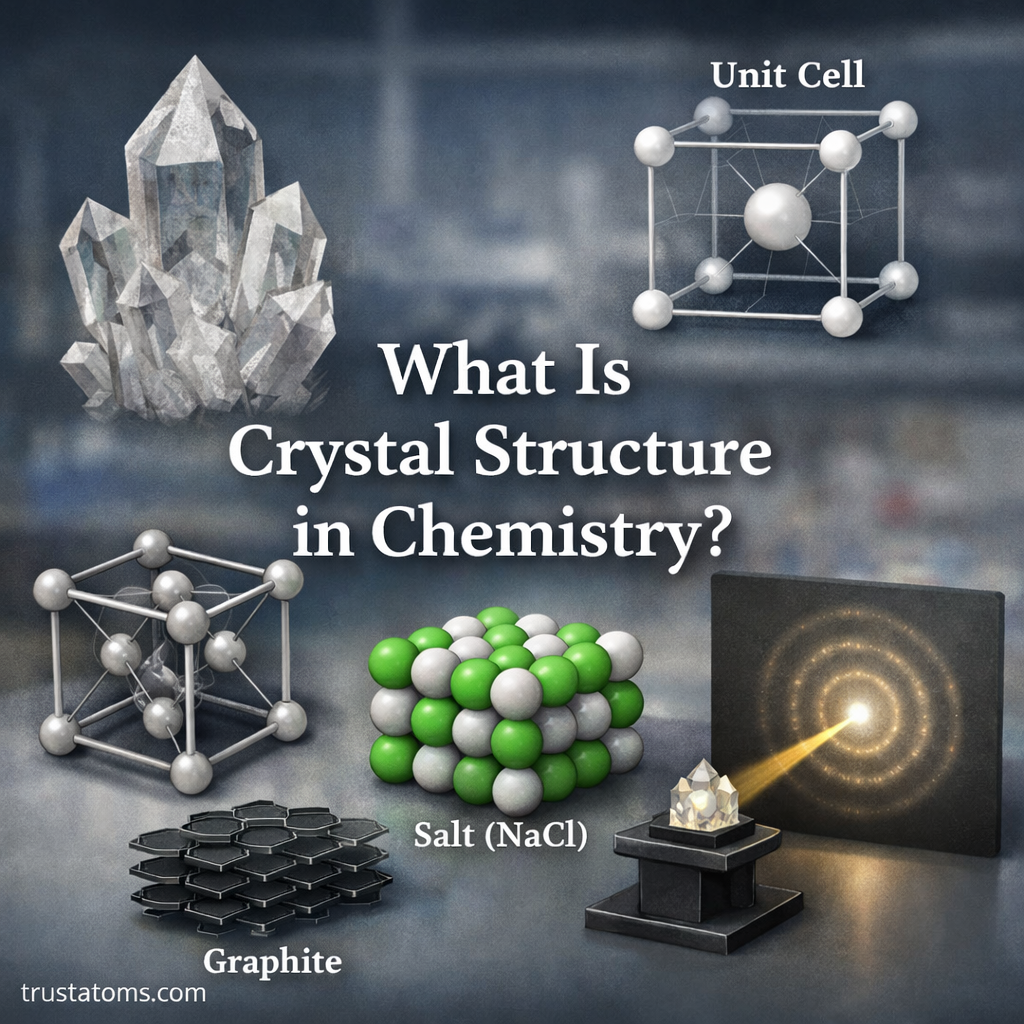
The smallest repeating section of a crystal lattice is called the unit cell.
A unit cell acts like a building block. When repeated many times in three dimensions, it recreates the entire crystal structure.
A unit cell contains:
- Specific particle positions
- Defined edge lengths
- Fixed angles between edges
Chemists study unit cells to understand the overall structure of crystalline materials.
Common characteristics of unit cells include:
- Edge lengths (a, b, c)
- Angles between edges (α, β, γ)
- Number of particles contained within the cell
Types of Crystal Structures
Different materials form different crystal structures depending on how their particles pack together.
Some of the most common crystal structures include:
Cubic Crystal Structure
In cubic structures, particles are arranged in a cube-shaped unit cell.
Examples include:
- Sodium chloride (NaCl)
- Copper
- Iron (at certain temperatures)
There are three major cubic structures:
- Simple cubic
- Body-centered cubic (BCC)
- Face-centered cubic (FCC)
These structures differ in where atoms are located within the cube.
Hexagonal Crystal Structure
Hexagonal structures have a unit cell shaped like a hexagonal prism.
Common examples include:
- Magnesium
- Zinc
- Graphite
This structure forms layers of atoms arranged in hexagonal patterns.
Tetragonal Crystal Structure
Tetragonal crystals resemble cubic structures but have one axis that is longer than the others.
Examples include:
- Tin
- Titanium dioxide
This slight distortion changes the way atoms interact within the crystal.
Why Crystal Structure Matters
Crystal structure strongly influences the properties of materials.
Important properties affected by crystal structure include:
- Mechanical strength
- Hardness
- Electrical conductivity
- Thermal conductivity
- Optical properties
- Chemical reactivity
For example:
- Diamond is extremely hard because its carbon atoms form a strong three-dimensional crystal network.
- Graphite, which also contains carbon, is soft because its atoms form layered crystal structures that slide easily.
Even though both substances contain the same element, their different crystal structures create completely different properties.
Crystal Structure vs Amorphous Solids
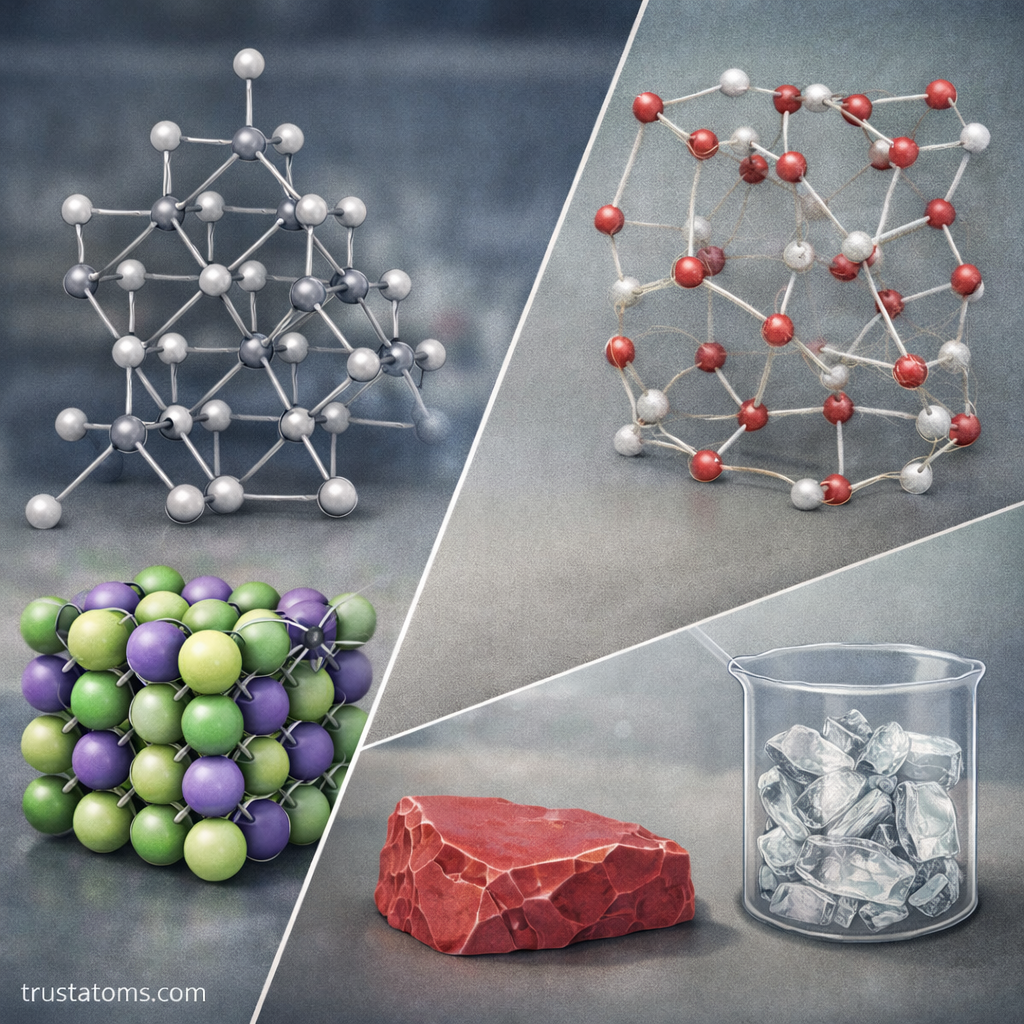
Not all solids have crystal structures.
Solids can be classified into two main categories:
Crystalline Solids
Characteristics include:
- Regular repeating structure
- Sharp melting point
- Well-defined geometric shape
Examples:
- Salt
- Sugar
- Quartz
Amorphous Solids
Amorphous solids lack long-range order.
Characteristics include:
- Irregular particle arrangement
- No repeating lattice pattern
- Gradual softening instead of a sharp melting point
Examples include:
- Glass
- Plastic
- Rubber
How Scientists Study Crystal Structure
Chemists and physicists use several techniques to determine how atoms are arranged inside crystals.
Common methods include:
X-ray Crystallography
This is the most important technique for studying crystal structure.
X-rays are directed at a crystal, and the way they scatter reveals the arrangement of atoms.
This method has been used to determine structures such as:
- DNA
- Proteins
- Minerals
- Metal alloys
Electron Diffraction
Electron beams interact with crystal lattices to produce patterns that reveal atomic spacing.
Neutron Diffraction
Neutrons can penetrate deeper into materials and help determine positions of light atoms such as hydrogen.
Real-World Applications of Crystal Structure
Understanding crystal structure is essential in many scientific and technological fields.
Applications include:
Materials Engineering
Crystal structures determine the strength and durability of materials used in:
- Buildings
- Aircraft
- Electronics
Pharmaceuticals
Drug molecules often form crystals. Their structure affects:
- Solubility
- Stability
- Absorption in the body
Electronics and Semiconductors
The crystal structure of materials like silicon is critical for:
- Computer chips
- Solar panels
- Electronic devices
Geology and Mineralogy
Minerals are classified partly by their crystal structure.
Key Takeaways
Crystal structure describes how atoms, ions, or molecules are arranged in a repeating pattern inside a crystalline solid.
Important points to remember:
- Crystals contain ordered, repeating particle arrangements
- The crystal lattice represents the repeating framework
- The unit cell is the smallest repeating portion of the structure
- Different structures lead to different material properties
- Techniques like X-ray crystallography reveal atomic arrangements
Understanding crystal structure allows scientists to design better materials, develop medicines, and explore the fundamental behavior of matter.