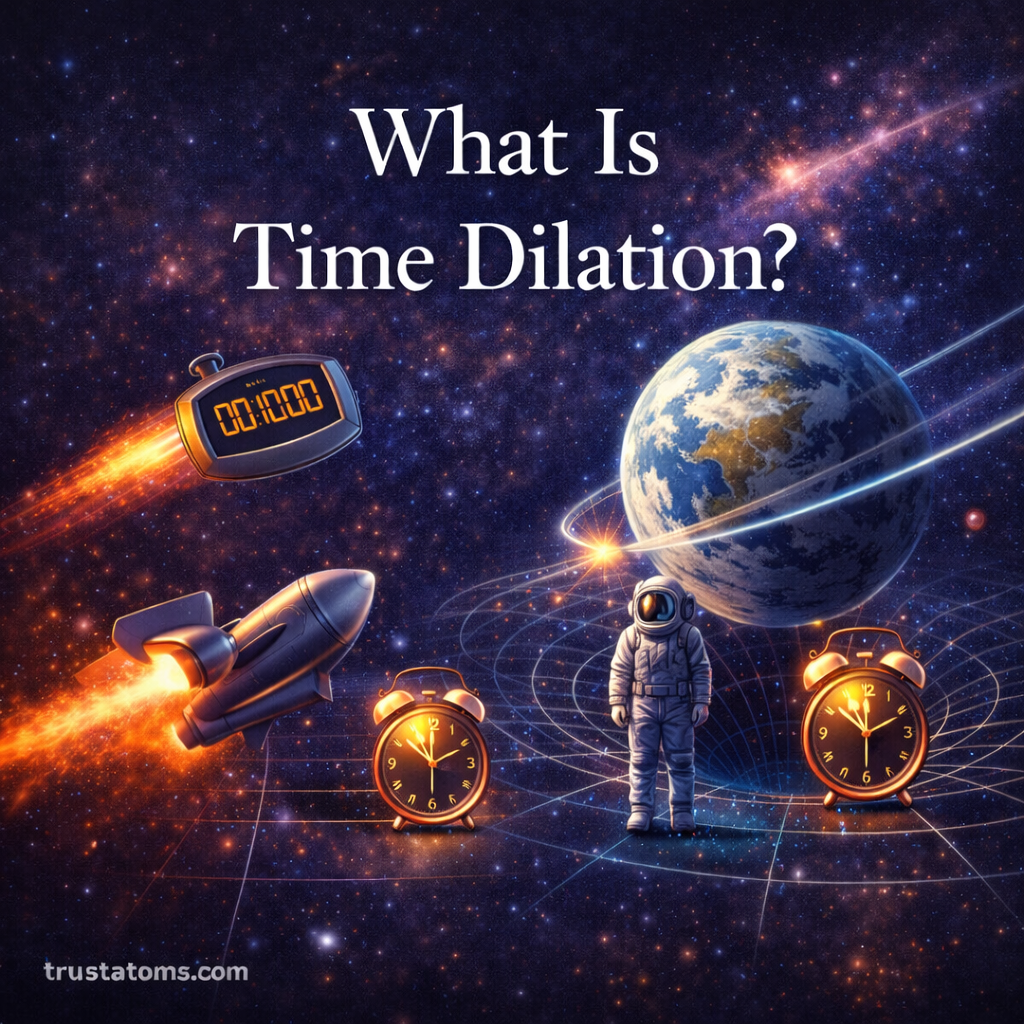
Time dilation is a phenomenon in physics where time passes at different rates depending on speed or gravity.
In everyday life, time feels constant. A second is always a second. But according to modern physics, time is not absolute. Under certain conditions — especially at very high speeds or near massive objects — time can slow down.
Time dilation is a key prediction of relativity and has been confirmed through experiments.
What Is Time Dilation in Simple Terms?
Time dilation means that time can move more slowly for one observer compared to another.
There are two main types:
- Velocity Time Dilation (from special relativity)
- Gravitational Time Dilation (from general relativity)
Both show that time depends on motion and gravity.
Velocity Time Dilation
Velocity time dilation occurs when an object moves at very high speeds — especially speeds close to the speed of light.
The faster something moves, the slower time passes for it relative to a stationary observer.
Example: The Space Traveler
Imagine an astronaut traveling near the speed of light for several years.
When the astronaut returns to Earth:
- Less time has passed for the astronaut.
- More time has passed for people on Earth.
The astronaut would have aged more slowly.
This effect is not science fiction — it is a measurable physical reality.
Why Does Speed Affect Time?
According to special relativity:
- The speed of light is constant for all observers.
- To keep this constant, space and time must adjust.
As an object moves faster:
- Time slows down.
- Length in the direction of motion contracts.
These changes preserve the consistency of physical laws.
Gravitational Time Dilation

Gravitational time dilation occurs when time passes more slowly in stronger gravitational fields.
The stronger the gravity:
- The slower time moves.
Example: Clocks Near a Planet
A clock placed near the surface of a massive planet will tick more slowly than a clock far away in space.
The difference may be tiny, but it is measurable.
Near extremely dense objects like black holes, the effect becomes dramatic.
Why Does Gravity Affect Time?
General relativity explains gravity as the curvature of spacetime.
Massive objects bend spacetime around them.
Since time is part of spacetime:
- When spacetime curves, time itself is affected.
- The deeper you are in a gravitational field, the slower time passes.
Real-World Evidence of Time Dilation
Time dilation has been confirmed through multiple experiments.
Atomic Clocks on Airplanes
Highly accurate clocks flown on airplanes show slight time differences compared to clocks left on Earth.
GPS Satellites
Global Positioning System satellites experience both:
- Velocity time dilation (due to orbital speed)
- Gravitational time dilation (due to weaker gravity at altitude)
Without correcting for time dilation, GPS systems would quickly become inaccurate.
Particle Experiments
Fast-moving subatomic particles created in accelerators live longer than expected due to time dilation.
Time Dilation vs. Everyday Experience
In normal daily life:
- Speeds are far below the speed of light.
- Gravitational differences are small.
As a result, time dilation effects are extremely tiny and go unnoticed.
But at extreme speeds or near massive objects, time dilation becomes significant.
Common Misconceptions About Time Dilation
Time dilation does not mean:
- Time stops completely (except at theoretical limits).
- You feel time slowing down yourself.
- Time travel to the past becomes possible.
For someone moving at high speed, time feels normal. It only appears slowed relative to another observer.
Why Time Dilation Matters
Time dilation reshapes our understanding of time itself.
It shows that:
- Time is not universal.
- Time depends on motion and gravity.
- Space and time are deeply connected.
It also plays a practical role in:
- Satellite technology
- Space travel research
- High-energy physics
Without understanding time dilation, modern navigation and astrophysics would not function correctly.
Final Thoughts
Time dilation is the slowing of time due to high speed or strong gravity.
It arises from the principles of relativity and has been confirmed through precise experiments. Although its effects are small in everyday life, time dilation becomes powerful under extreme conditions.
This phenomenon reveals that time is not fixed or absolute — it is flexible and shaped by the structure of spacetime itself.
Understanding time dilation helps us grasp one of the most fascinating truths of modern physics: time depends on where you are and how fast you move.