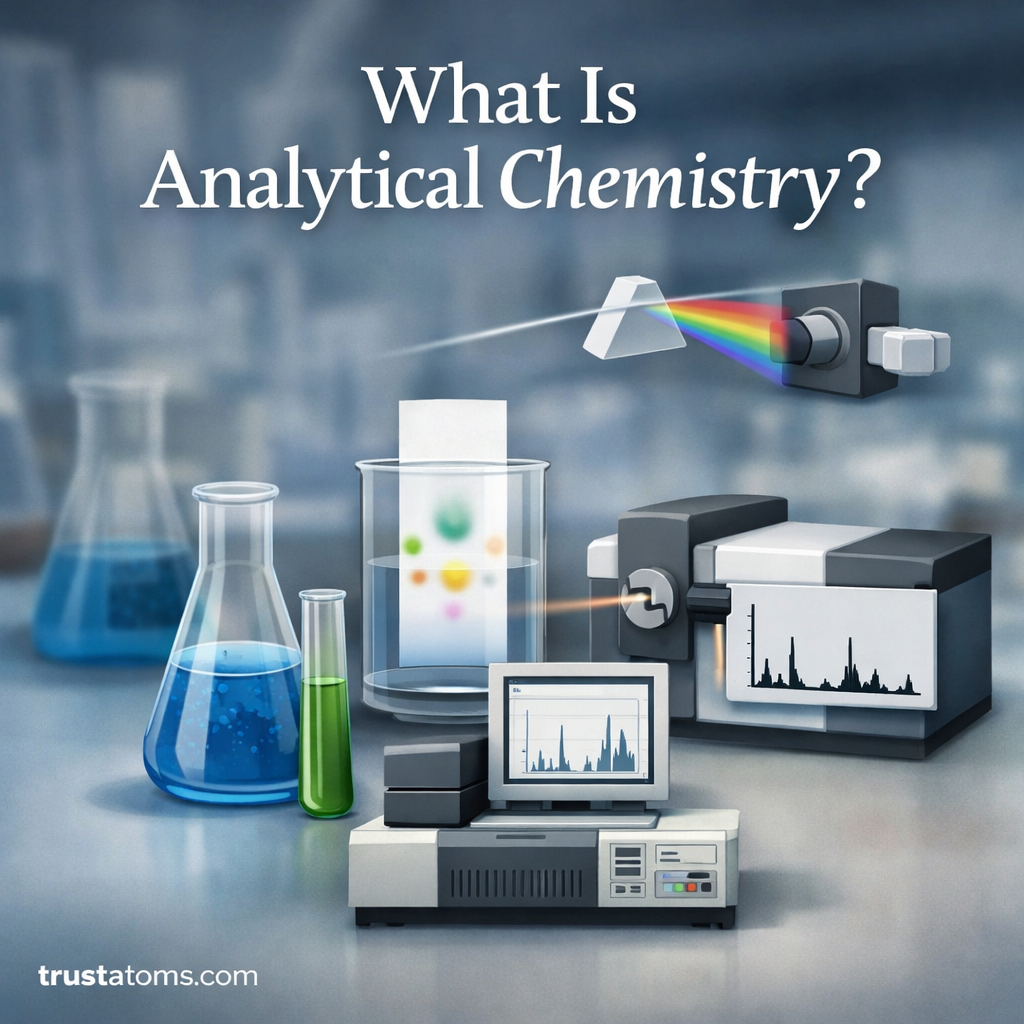
Analytical chemistry is the branch of chemistry focused on identifying, separating, and measuring the chemical components of substances. Instead of creating new compounds or studying reactions alone, analytical chemists concentrate on determining what substances are present and how much of each exists in a sample.
This field plays a crucial role across science, medicine, environmental monitoring, manufacturing, and forensic investigations. Whether scientists are testing drinking water, analyzing blood samples, or checking the purity of pharmaceuticals, analytical chemistry provides the methods that make accurate measurements possible.
Understanding Analytical Chemistry
Analytical chemistry involves techniques and instruments used to examine the chemical composition of matter. The goal is to determine the identity and quantity of substances within a sample.
In simple terms, analytical chemistry answers two fundamental questions:
- What substances are present? (Qualitative analysis)
- How much of each substance is present? (Quantitative analysis)
Because many samples contain extremely small amounts of chemicals, analytical chemists often work with highly sensitive instruments capable of detecting trace concentrations.
For example, a laboratory might analyze:
- Metals in soil samples
- Drug concentrations in blood
- Pollutants in air or water
- Nutrients in food
- Chemical compounds in pharmaceuticals
The results help scientists understand chemical systems and ensure safety, quality, and accuracy in countless applications.
The Two Main Types of Analytical Chemistry
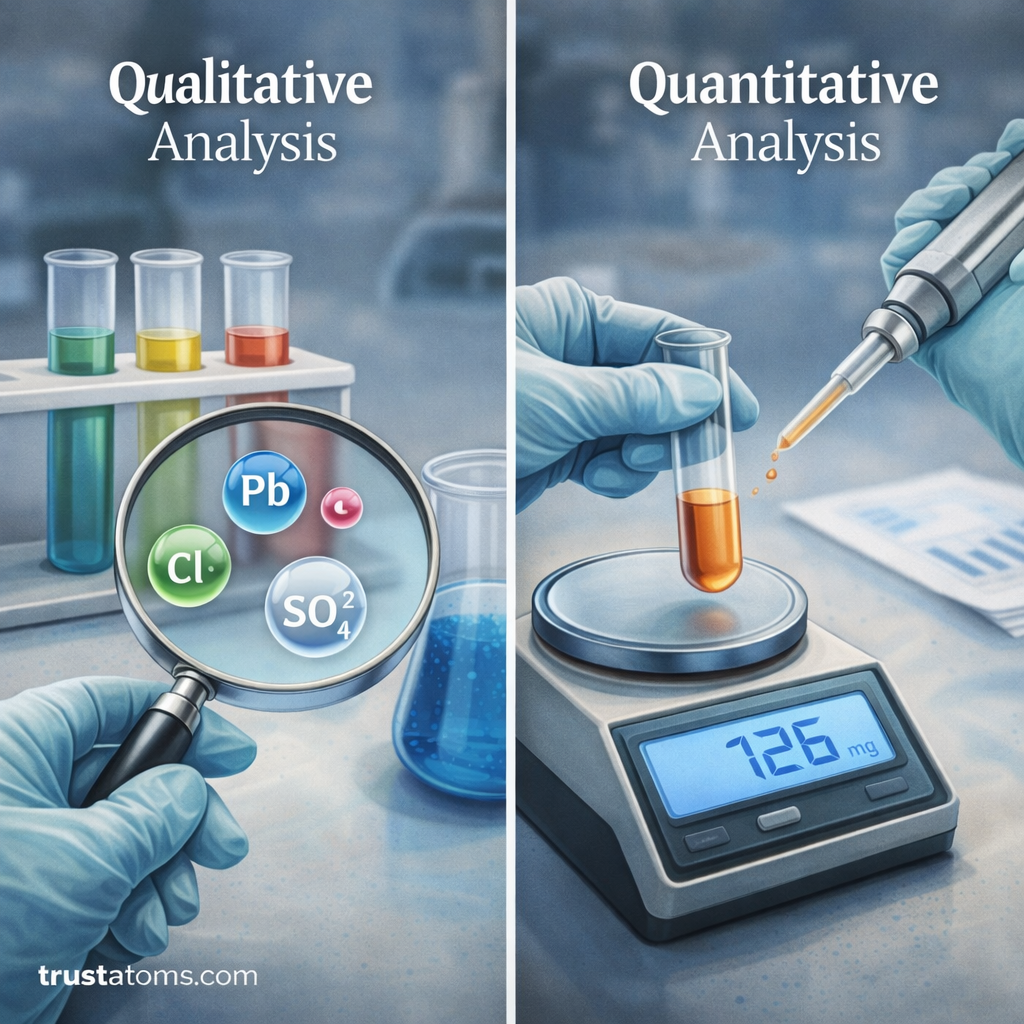
Analytical chemistry is generally divided into qualitative analysis and quantitative analysis.
Qualitative Analysis
Qualitative analysis determines which substances are present in a sample.
Rather than measuring exact amounts, this type of analysis focuses on identification.
Examples include:
- Detecting whether a water sample contains lead
- Identifying the presence of a drug in a forensic test
- Determining which ions exist in a chemical solution
Common techniques used for qualitative analysis include spectroscopy and chromatography.
Quantitative Analysis
Quantitative analysis measures how much of a substance is present.
This type of analysis provides numerical data such as concentration, mass, or percentage composition.
Examples include:
- Measuring the sugar content in beverages
- Determining cholesterol levels in blood
- Calculating the concentration of a pollutant in air
Quantitative analysis often relies on precise laboratory instruments and mathematical calculations to produce accurate results.
Common Techniques Used in Analytical Chemistry
Analytical chemists rely on a variety of methods to examine substances. Each technique works differently depending on the type of sample and the information needed.
Spectroscopy
Spectroscopy studies how matter interacts with electromagnetic radiation, such as visible light or infrared radiation.
By observing how a substance absorbs or emits light, scientists can determine its chemical identity.
Examples include:
- UV–visible spectroscopy
- Infrared spectroscopy
- Atomic absorption spectroscopy
Spectroscopy is widely used in environmental science, pharmaceutical analysis, and materials research.
Chromatography
Chromatography separates the components of a mixture so they can be identified and measured.
In this technique, substances move through a stationary material while carried by a liquid or gas. Different chemicals travel at different speeds, causing them to separate.
Common forms include:
- Gas chromatography (GC)
- High-performance liquid chromatography (HPLC)
- Thin-layer chromatography (TLC)
Chromatography is essential in fields like drug testing, food safety, and forensic science.
Titration
Titration is a classic laboratory method used to determine the concentration of a solution.
In this process:
- A solution of known concentration is slowly added to a sample.
- A chemical reaction occurs between the two substances.
- The reaction endpoint reveals the concentration of the unknown solution.
Titration is commonly used in chemical education and industrial laboratories.
Mass Spectrometry
Mass spectrometry measures the masses of molecules and fragments produced from them.
This technique provides extremely detailed information about a compound’s molecular structure and composition.
Mass spectrometry is widely used in:
- Drug development
- Proteomics and biological research
- Environmental chemical analysis
Instruments Used in Analytical Chemistry
Modern analytical chemistry depends heavily on advanced instruments designed to detect tiny chemical signals.
Some commonly used instruments include:
- Spectrophotometers
- Gas chromatographs
- Liquid chromatographs
- Mass spectrometers
- Electrochemical analyzers
These tools allow scientists to detect substances at concentrations as low as parts per billion (ppb) or even parts per trillion (ppt).
Because of this sensitivity, analytical chemistry can uncover chemical traces that would otherwise remain invisible.
Applications of Analytical Chemistry
Analytical chemistry has a wide range of practical uses across many industries and scientific fields.
Environmental Monitoring
Analytical chemists analyze soil, water, and air samples to detect pollutants and monitor environmental health.
Examples include:
- Measuring heavy metals in drinking water
- Detecting pesticides in soil
- Monitoring carbon dioxide levels in the atmosphere
These analyses help protect ecosystems and human health.
Medical and Clinical Testing
Many medical tests rely on analytical chemistry techniques.
Examples include:
- Blood glucose measurements
- Hormone analysis
- Drug concentration testing
Clinical laboratories use highly automated instruments to analyze patient samples quickly and accurately.
Pharmaceutical Development
Before medications reach the market, they must undergo extensive chemical analysis.
Analytical chemistry helps scientists:
- Verify drug purity
- Measure dosage levels
- Detect impurities or contaminants
- Study drug stability over time
These analyses ensure that medicines are safe and effective.
Food Safety and Quality Control
Food producers use analytical chemistry to monitor ingredients, nutritional content, and contamination risks.
Common tests include:
- Measuring vitamin content
- Detecting harmful bacteria
- Checking pesticide residues
- Verifying product labeling accuracy
This ensures food products meet regulatory standards and remain safe for consumers.
Forensic Science
Analytical chemistry is a key component of forensic investigations.
Techniques are used to analyze:
- Drugs and toxins
- Trace evidence such as fibers or residues
- Explosive materials
- Biological samples
These analyses can provide critical evidence in criminal cases.
Why Analytical Chemistry Is Important
Analytical chemistry is essential because accurate measurement is fundamental to science and technology.
Without reliable analytical techniques, scientists would not be able to:
- Verify experimental results
- Monitor environmental pollution
- Ensure pharmaceutical safety
- Diagnose medical conditions
- Maintain quality standards in manufacturing
In many ways, analytical chemistry serves as the measurement foundation of modern science.
By providing tools to identify and quantify substances, it supports progress across chemistry, biology, medicine, engineering, and environmental science.
Analytical Chemistry in Modern Research
Advances in technology continue to expand the capabilities of analytical chemistry.
Modern research areas include:
- Nanotechnology analysis
- Environmental trace detection
- Proteomics and metabolomics
- High-resolution spectroscopy
- Automated chemical sensors
New instruments can now analyze extremely small samples with remarkable speed and precision.
As scientific questions become more complex, analytical chemistry remains central to discovering answers.
Final Thoughts
Analytical chemistry is the scientific discipline dedicated to determining the composition of substances. By identifying and measuring chemical components, it provides the data scientists rely on to understand the world at a molecular level.
From medical diagnostics and environmental protection to food safety and forensic investigations, analytical chemistry supports countless applications that impact daily life.
As measurement technology continues to improve, analytical chemistry will remain one of the most important tools for advancing scientific knowledge and ensuring accuracy in modern research.