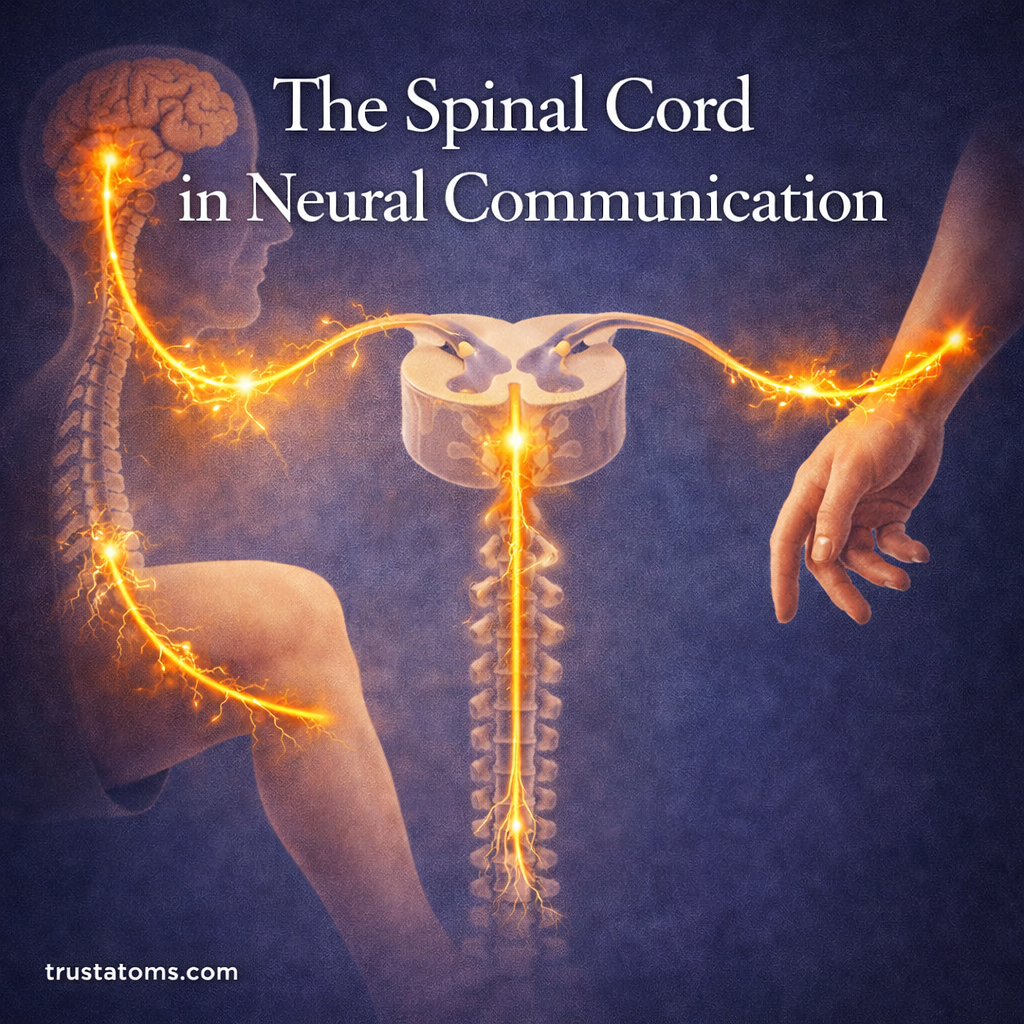
The spinal cord is one of the most important structures in the human nervous system. It serves as the primary communication highway between the brain and the rest of the body. Every voluntary movement, reflex action, and sensory signal relies on the spinal cord to transmit information efficiently.
Located within the protective vertebral column, the spinal cord connects the brain to peripheral nerves that reach muscles, organs, and sensory receptors throughout the body. Through this network, the spinal cord allows the brain to send instructions and receive sensory feedback.
Understanding how the spinal cord functions reveals how the nervous system coordinates movement, sensation, and rapid protective responses.
What Is the Spinal Cord?
The spinal cord is a long, cylindrical structure of nervous tissue that extends from the base of the brain down through the vertebral column.
It forms a central part of the central nervous system (CNS) along with the brain.
The spinal cord has two main functions:
- Transmitting signals between the brain and the body
- Coordinating reflex actions
Through these roles, the spinal cord allows the body to maintain communication between the brain and peripheral systems.
Location and Structure of the Spinal Cord
The spinal cord begins at the brainstem, specifically the medulla oblongata, and extends down the back through the vertebral canal.
Although the vertebral column continues to the lower back, the spinal cord typically ends around the first or second lumbar vertebra in adults.
Protective Structures
The spinal cord is protected by several layers:
- Vertebrae – the bones of the spine that surround the cord
- Meninges – protective membranes that cover the brain and spinal cord
- Cerebrospinal fluid (CSF) – fluid that cushions and nourishes nervous tissue
These structures protect the spinal cord from injury and help maintain stable conditions for neural function.
Internal Organization of the Spinal Cord
The spinal cord has a distinct internal structure designed to support communication between neurons.
Gray Matter
The central region of the spinal cord contains gray matter, which consists mainly of neuron cell bodies and interneurons.
Gray matter forms an H-shaped or butterfly-shaped pattern in cross-section.
Its primary functions include:
- Processing neural information
- Coordinating reflexes
- Integrating sensory and motor signals
White Matter
Surrounding the gray matter is white matter, which contains bundles of axons.
These axons form ascending and descending tracts that transmit signals between the brain and the body.
White matter allows information to travel quickly through the nervous system.
Spinal Nerves and Their Functions
The spinal cord connects to the rest of the body through 31 pairs of spinal nerves.
These nerves branch off at regular intervals along the spinal cord.
The spinal nerves include:
- 8 cervical nerves
- 12 thoracic nerves
- 5 lumbar nerves
- 5 sacral nerves
- 1 coccygeal nerve
Each pair of spinal nerves serves a specific region of the body.
These nerves contain both:
- Sensory fibers, which carry signals from receptors to the spinal cord
- Motor fibers, which carry commands from the spinal cord to muscles and glands
How the Spinal Cord Transmits Signals
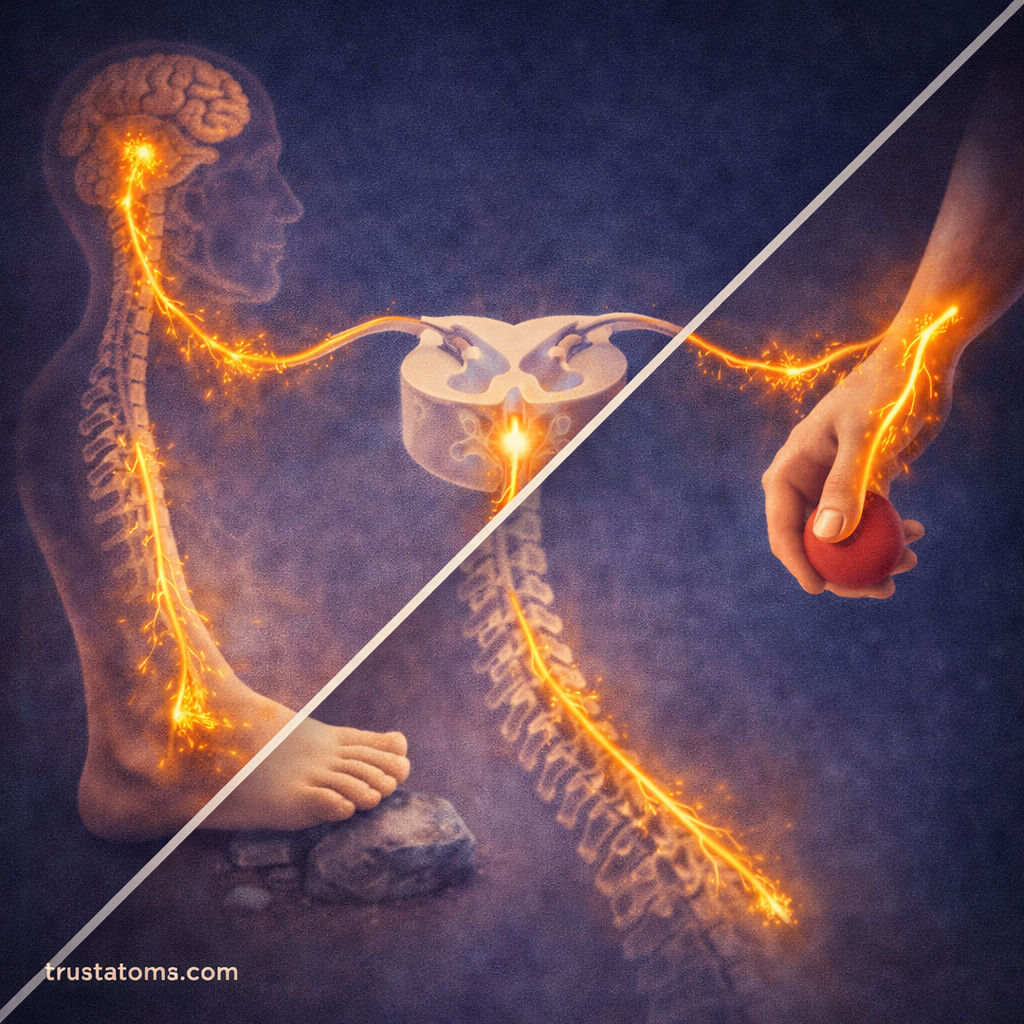
The spinal cord functions as a communication pathway through specialized neural tracts.
Ascending Pathways
Ascending pathways carry sensory information from the body to the brain.
Examples of sensory signals include:
- Touch
- Pain
- Temperature
- Body position
These signals travel from sensory receptors through spinal nerves into the spinal cord and up to the brain.
Descending Pathways
Descending pathways carry motor commands from the brain to the body.
These signals control voluntary movements such as:
- Walking
- Grasping objects
- Facial expressions
- Coordinated muscle activity
The spinal cord delivers these instructions to motor neurons that activate muscles.
The Role of the Spinal Cord in Reflexes
One of the most important roles of the spinal cord is coordinating reflex actions.
Reflexes are rapid responses that help protect the body from harm.
Instead of sending signals all the way to the brain for processing, the spinal cord can process some signals directly.
A typical reflex pathway involves:
- A sensory receptor detecting a stimulus
- A sensory neuron sending the signal to the spinal cord
- Interneurons processing the signal
- Motor neurons activating a muscle response
This process allows the body to react quickly, often before the brain becomes aware of the stimulus.
Communication Between the Brain and the Body
The spinal cord continuously transmits information in both directions between the brain and peripheral nerves.
This two-way communication allows the body to:
- Respond to environmental changes
- Coordinate voluntary movement
- Maintain posture and balance
- Monitor internal body conditions
For example, when walking:
- The brain sends motor commands through the spinal cord to leg muscles.
- Sensory feedback from the legs travels back through the spinal cord to the brain.
This feedback loop allows movements to remain smooth and coordinated.
Segments of the Spinal Cord
The spinal cord is divided into segments that correspond to specific spinal nerves.
Each segment controls particular areas of the body.
Cervical Region
The cervical region controls signals related to:
- Neck
- Arms
- Hands
- Diaphragm (breathing)
Thoracic Region
The thoracic region primarily connects to:
- Chest muscles
- Upper back
- Rib cage
Lumbar Region
The lumbar region controls:
- Lower back
- Hips
- Legs
Sacral Region
The sacral region manages:
- Pelvic organs
- Lower limbs
- Bladder and bowel function
The Importance of Sensory Feedback
The spinal cord constantly receives sensory information from the body.
This information allows the nervous system to adjust movements and maintain coordination.
Examples include:
- Detecting body position during walking
- Adjusting grip strength while holding objects
- Maintaining balance while standing
Without this feedback, precise control of movement would be extremely difficult.
Spinal Cord Injuries and Their Effects
Damage to the spinal cord can disrupt communication between the brain and the body.
The effects depend on the location and severity of the injury.
Possible consequences include:
- Loss of movement (paralysis)
- Loss of sensation
- Reduced reflex control
- Impaired organ function
Injuries higher in the spinal cord generally affect larger portions of the body.
For example:
- Cervical injuries may affect both arms and legs
- Lumbar injuries may primarily affect the lower body
Research in neuroscience and medicine continues to explore treatments that may restore function after spinal cord injuries.
Why the Spinal Cord Is Essential
The spinal cord plays a critical role in the nervous system’s ability to coordinate and control the body.
It enables:
- Communication between the brain and peripheral nerves
- Rapid reflex responses
- Integration of sensory and motor information
- Coordination of movement and posture
Without the spinal cord, the brain would not be able to send instructions to muscles or receive information from sensory receptors.
Final Thoughts
The spinal cord is a central component of neural communication in the human body. Acting as both a signal relay and a processing center, it connects the brain to the peripheral nervous system and enables the rapid transmission of sensory and motor signals.
Through its organized structure, spinal nerves, and reflex pathways, the spinal cord allows the body to react quickly, move efficiently, and maintain constant awareness of internal and external conditions. Its role in neural communication highlights the remarkable coordination of the human nervous system.