Attention is the brain’s ability to focus on relevant information while filtering out distractions. Whether you’re reading, driving, or having a conversation, your brain is constantly selecting what matters most at any given moment.
This process is not controlled by a single brain region. Instead, it relies on interconnected systems known as attention networks. These networks work together to manage focus, shift awareness, and maintain concentration.
What Are Attention Networks?
Attention networks are groups of brain regions that coordinate to control different aspects of attention.
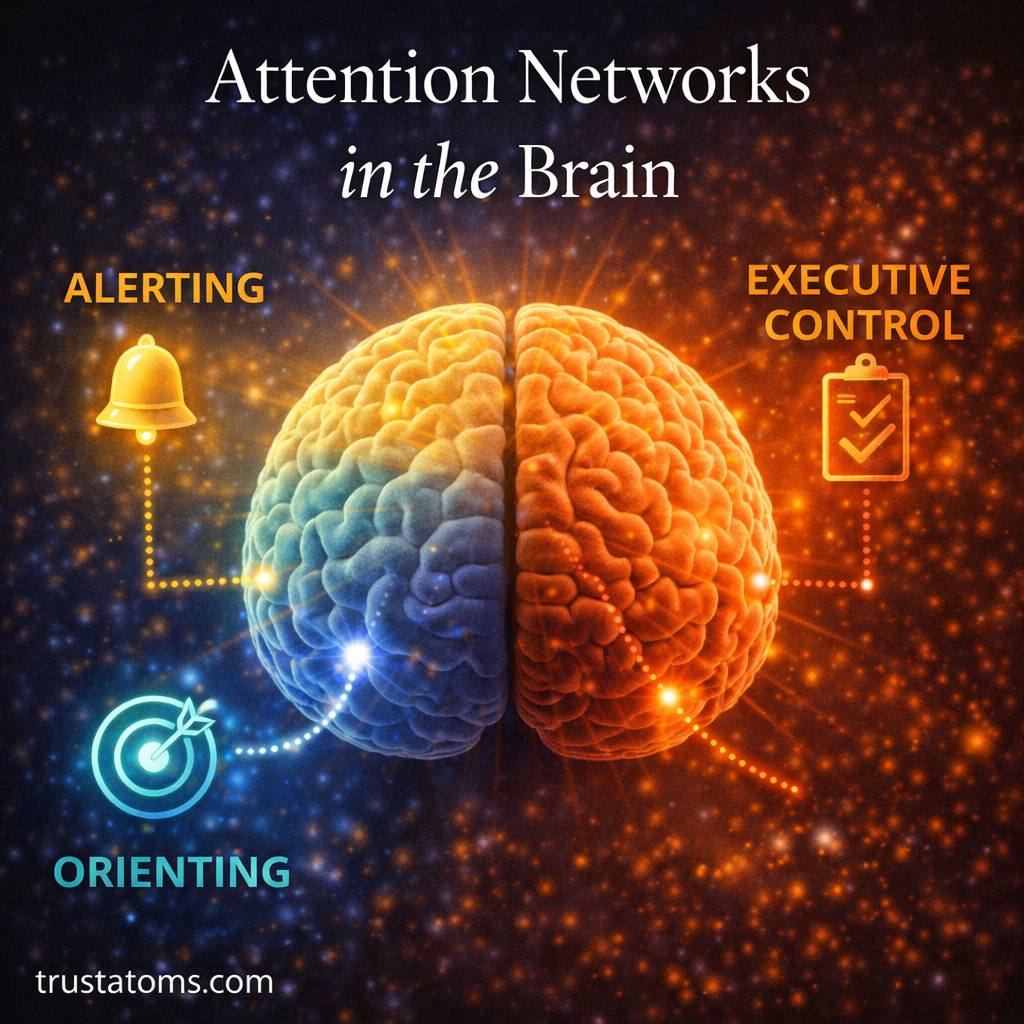
Rather than acting as a single system, attention is divided into specialized networks that handle:
- Alertness (being ready to respond)
- Orientation (directing attention to specific stimuli)
- Executive control (managing focus and resolving conflicts)
Each network plays a distinct role but works in coordination with the others.
The Three Main Attention Networks
Researchers commonly divide attention into three primary networks.
Alerting Network
The alerting network is responsible for maintaining a state of readiness.
Key functions:
- Sustaining alertness over time
- Preparing the brain for incoming stimuli
- Responding quickly to changes in the environment
Brain regions involved:
- Frontal cortex
- Parietal regions
- Brainstem (especially areas related to arousal)
This network is influenced by neurotransmitters such as norepinephrine.
Orienting Network
The orienting network directs attention toward specific locations or stimuli.
Key functions:
- Shifting attention between objects or locations
- Enhancing sensory processing for selected inputs
- Ignoring irrelevant information
Brain regions involved:
- Parietal lobe
- Superior colliculus
- Thalamus
For example, when you turn your head toward a sudden sound, the orienting network is at work.
Executive Control Network
The executive control network manages higher-level attention processes.
Key functions:
- Resolving conflicts between competing stimuli
- Maintaining focus on goals
- Inhibiting distractions
Brain regions involved:
- Prefrontal cortex
- Anterior cingulate cortex
This network is essential for tasks that require concentration, decision-making, and self-control.
How Attention Networks Work Together

Although each network has a specific role, they operate as an integrated system.
Example:
When studying in a noisy environment:
- The alerting network keeps you awake and attentive
- The orienting network directs focus to your book
- The executive network helps ignore background noise
This coordination allows you to maintain focus despite distractions.
Neural Mechanisms Behind Attention
Attention relies on both electrical activity and chemical signaling in the brain.
Key mechanisms include:
- Selective amplification: Enhancing signals related to important stimuli
- Inhibition: Suppressing irrelevant information
- Synchronization: Coordinating activity across brain regions
These processes help the brain prioritize what matters most.
Types of Attention
Attention is not a single process—it includes several distinct forms.
Sustained Attention
- Maintaining focus over long periods
- Example: Listening to a lecture
Selective Attention
- Focusing on one stimulus while ignoring others
- Example: Reading in a crowded room
Divided Attention
- Handling multiple tasks at once
- Example: Talking while driving
Alternating Attention
- Switching focus between tasks
- Example: Moving between emails and a report
Each type relies on different combinations of attention networks.
Neurotransmitters and Attention
Chemical signals in the brain play a major role in regulating attention.
Important neurotransmitters:
- Dopamine: Supports motivation and focus
- Norepinephrine: Enhances alertness
- Acetylcholine: Improves signal clarity and learning
Balanced levels of these chemicals are essential for effective attention.
Attention and Sensory Processing
Attention enhances how the brain processes sensory information.
How it works:
- Boosts activity in relevant sensory areas
- Reduces processing of irrelevant inputs
- Improves perception and reaction time
For example, focusing on a single voice in a crowded room becomes possible through selective attention.
Development of Attention Networks
Attention networks develop over time and continue to mature into adulthood.
Key stages:
- Early childhood: Basic alerting and orienting abilities
- Adolescence: Improved executive control
- Adulthood: Fully developed coordination between networks
Experience, learning, and environment all influence this development.
When Attention Networks Are Disrupted
Impairments in attention networks can affect daily functioning.
Common conditions:
- ADHD (Attention-Deficit/Hyperactivity Disorder): Difficulty sustaining attention and controlling impulses
- Traumatic brain injury: Disrupted attention and focus
- Anxiety disorders: Overactive attention to threats
- Depression: Reduced focus and cognitive control
Understanding attention networks helps guide treatment and support strategies.
Improving Attention and Focus
While attention is biologically based, it can be strengthened with practice and habits.
Practical strategies:
- Break tasks into smaller steps
- Minimize distractions in your environment
- Take regular breaks to avoid fatigue
- Practice mindfulness or focused attention exercises
- Maintain good sleep and nutrition
These habits support healthy brain function and attention control.
Common Misconceptions About Attention
Myth 1: Multitasking Improves Productivity
- Dividing attention often reduces performance and accuracy
Myth 2: Attention Is Fixed
- Attention can improve with training and practice
Myth 3: Distractions Only Come from the Environment
- Internal thoughts can also disrupt focus
Why Attention Networks Matter
Attention networks are essential for:
- Learning and memory
- Decision-making
- Problem-solving
- Everyday functioning
Without effective attention, even simple tasks can become difficult.
Final Thoughts
Attention networks in the brain demonstrate how complex and coordinated our cognitive processes are. By dividing responsibilities across alerting, orienting, and executive systems, the brain efficiently manages focus in a constantly changing environment.
Understanding how these networks work not only provides insight into human cognition but also offers practical ways to improve focus, productivity, and mental clarity.