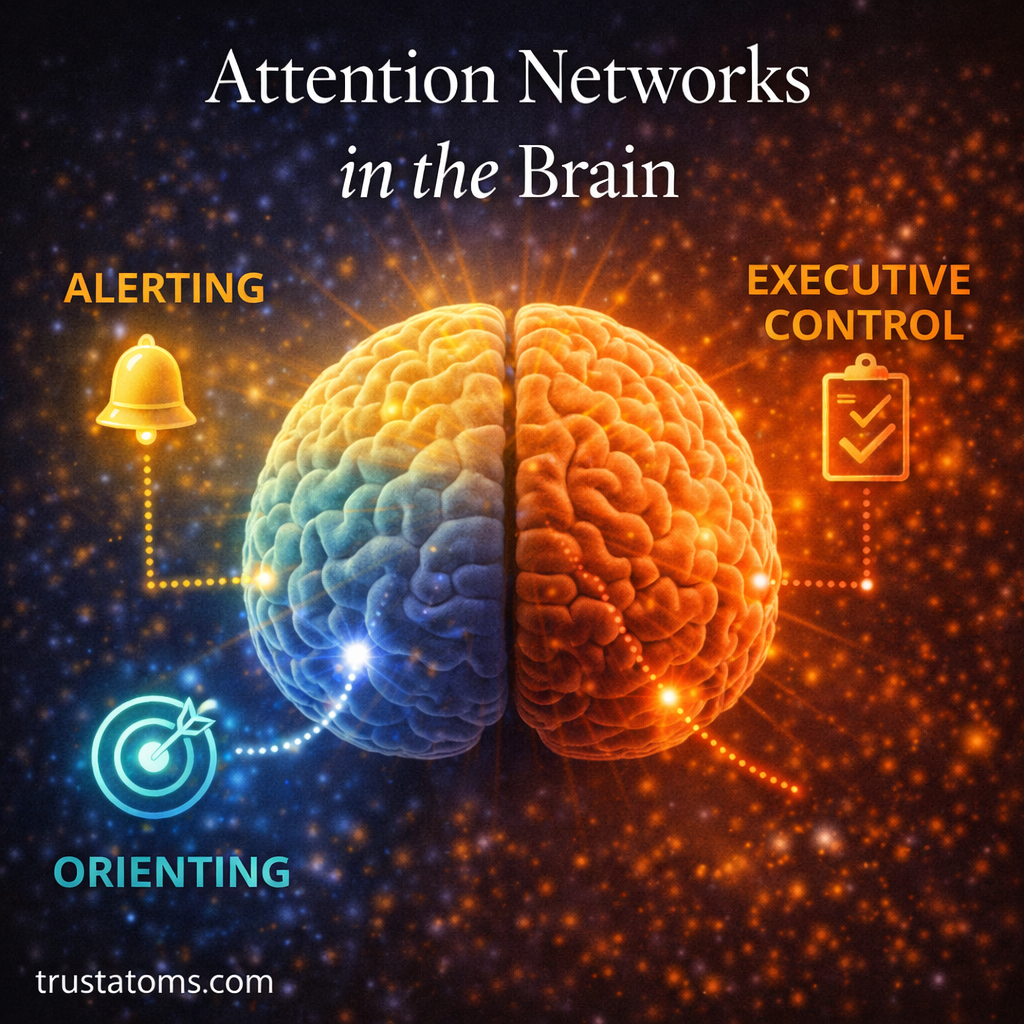
Attention networks are interconnected brain systems that regulate alertness, direct awareness toward relevant information, and help control distractions. Researchers commonly describe three major attention networks—alerting, orienting, and executive control—that work together to support concentration and goal-directed behavior.
These networks explain how someone can notice a sudden sound, return to reading, or concentrate during a difficult conversation. Studying their organization connects human anatomy with neuroscience by showing how different brain regions cooperate to produce attention.
What Are Attention Networks?
Attention networks are groups of connected brain regions that coordinate different aspects of selecting and processing information. Attention is not located in one isolated brain structure. Instead, distributed neural circuits help determine what receives priority and how mental resources are allocated.
A widely used model separates attention into three interacting functions:
- Alerting: Establishing and maintaining readiness to respond.
- Orienting: Selecting a location, object, or sensory signal for further processing.
- Executive control: Resolving competing responses, maintaining goals, and managing interference.
These categories describe functions rather than three completely separate anatomical systems. Some brain regions participate in multiple attention-related processes.
The Three Main Attention Networks
Alerting Network: Preparing the Brain to Respond
The alerting network regulates readiness for incoming information. It supports both sustained alertness over time and temporary increases in readiness following a warning signal.
Associated structures include frontal and parietal regions, along with arousal systems in the brainstem. Norepinephrine signaling, particularly from the locus coeruleus, contributes to the regulation of alertness.
For example, hearing a starting signal before a race can briefly increase readiness to react. Remaining attentive throughout a long lecture involves maintaining alertness over a much longer period.
Orienting Network: Selecting What Receives Attention
The orienting network shifts attention toward particular locations or stimuli. It helps prioritize information from the senses, whether attention moves voluntarily or is captured by an unexpected event.
Important regions include areas of the parietal cortex, the frontal eye fields, the superior colliculus, and parts of the thalamus. Their coordinated activity supports shifts in visual and spatial attention.
Looking toward a flashing light is one example. Attention can also shift without eye movement, such as when you monitor something at the edge of your vision while looking straight ahead.
Executive Control Network: Managing Conflict and Distractions
Executive attention helps maintain task goals, detect competing responses, and control behavior when distractions interfere. It becomes especially relevant when an automatic response conflicts with what a task requires.
The anterior cingulate cortex and regions of the prefrontal cortex are commonly associated with these functions. They interact with broader control networks rather than operating independently.
For instance, answering a difficult question while ignoring an incoming phone notification requires maintaining the question as the current goal and resisting a competing response.
How Attention Networks Work Together

Consider driving along a familiar road when a pedestrian approaches a crossing. Several attention functions contribute to the response:
- Alerting: The brain maintains readiness to detect changes in traffic conditions.
- Orienting: Attention shifts toward the pedestrian and the crossing.
- Executive control: The driver prioritizes slowing down rather than continuing automatically.
These processes overlap in time. The brain does not necessarily complete one network’s activity before another begins. Effective attention emerges from their coordination with sensory, motor, and decision-making systems.
Neural Mechanisms Behind Attention
Attention depends on electrical signaling, chemical communication, and coordinated activity across neural circuits. Neurons influence one another through connections that can strengthen the processing of relevant information or reduce interference from competing signals.
Three mechanisms are especially useful for understanding this process:
- Selective enhancement: Increasing neural responses to information relevant to the current task.
- Suppression: Reducing the influence of competing or irrelevant signals.
- Coordination: Organizing activity among regions that must exchange information.
Neural Connectivity and Network Organization explains how connections support communication among distributed brain regions. The timing of that communication is explored in Neural Timing and Signal Synchronization.
Brain rhythms may also influence how information is selected and processed. Neural Oscillations and Brain Rhythms examines these patterns, although their exact contributions to attention depend on the task and neural system involved.
Different Types of Attention
The three-network model describes major control functions, while other classifications describe the demands of everyday tasks.
| Type | Function | Example |
|---|---|---|
| Sustained | Maintaining attention over time | Following a long presentation |
| Selective | Prioritizing one source of information | Listening to a friend in a noisy room |
| Divided | Allocating attention across simultaneous demands | Walking while holding a conversation |
| Alternating | Switching attention between tasks | Moving between a spreadsheet and written instructions |
Dividing attention does not mean the brain processes every task equally well. When two demanding activities compete for limited processing resources, performance may become slower or less accurate.
Neurotransmitters That Influence Attention
Neurotransmitters are chemical messengers that modify communication between neurons. Several systems influence attention in different ways.
- Norepinephrine: Helps regulate arousal, vigilance, and readiness to respond.
- Acetylcholine: Contributes to sensory selection and the modulation of attention-related processing.
- Dopamine: Influences motivation, working memory, and aspects of cognitive control.
Their effects depend on receptor types, brain regions, and patterns of activity. More neurotransmitter activity does not automatically produce better concentration.
Attention and Sensory Processing
Attention changes how sensory information is processed. When someone concentrates on a particular voice, relevant auditory signals may receive enhanced processing while competing sounds receive less priority.
This selection is not perfect. A loud or unexpected sound can still capture attention, even when someone is concentrating intensely. The interaction between sensory pathways and brain-wide processing is explored further in Sensory Integration.
How Attention Changes Across the Lifespan
Attention abilities develop throughout childhood and adolescence as neural circuits mature and experience shapes behavior. Basic orienting responses appear early, while more demanding executive functions generally improve over a longer developmental period.
Development does not end at a single age. Adults continue adapting attention strategies through learning and experience, while aging may affect some attention functions differently from others. Neural Development Across the Lifespan provides broader context for these changes.
When Attention Systems Function Differently
Changes in attention can occur with sleep deprivation, stress, neurological injury, and certain health conditions. Attention difficulties are not specific to one brain network or diagnosis.
For example, attention-deficit/hyperactivity disorder (ADHD) can involve difficulties regulating attention and inhibiting responses. Traumatic brain injury may disrupt attention through damage to neural structures or their connections. Anxiety and depression can also affect concentration, although their effects vary considerably.
Researchers use behavioral tests and brain-imaging methods to investigate these differences. However, an individual attention problem cannot be diagnosed simply by identifying one supposedly underactive network.
Practical Ways to Support Concentration
Attention fluctuates with task demands, fatigue, motivation, and environmental conditions. Several practical habits can make sustained concentration easier:
- Reduce unnecessary notifications and competing background distractions.
- Divide complex assignments into manageable stages with clear goals.
- Allow breaks during extended periods of mentally demanding work.
- Maintain adequate sleep and regular physical activity.
- Use focused-attention or mindfulness exercises when they are helpful and comfortable.
These strategies can improve the conditions for concentration, but they do not guarantee permanent changes to attention networks or replace assessment when difficulties are persistent.
Frequently Asked Questions
Is attention controlled by one part of the brain?
No. Attention depends on interactions among frontal, parietal, subcortical, and brainstem systems. Different tasks recruit overlapping combinations of these regions.
Can attention networks work at the same time?
Yes. Alerting, orienting, and executive control can operate simultaneously. Their interaction allows someone to remain ready for new information while selecting relevant signals and managing competing responses.
Can attention improve with practice?
Practice can improve performance on particular attention-demanding tasks, and strategies may help people manage distractions. However, improvements do not always transfer broadly to unrelated activities, and results vary between individuals.
The brain’s attention networks provide a useful framework for understanding how alertness, sensory selection, and cognitive control interact. From noticing a pedestrian to concentrating on a difficult assignment, attention depends on coordinated activity across multiple neural systems. Recognizing these distinct functions helps explain both the flexibility of human attention and its limits when tasks compete for mental resources.
This article is for general education and is not medical advice. Talk to a qualified health professional about any medical concern.
Sources: Posner and Petersen, The Attention System of the Human Brain, Annual Review of Neuroscience; Purves and colleagues, Neuroscience, Oxford University Press; National Institute of Neurological Disorders and Stroke.