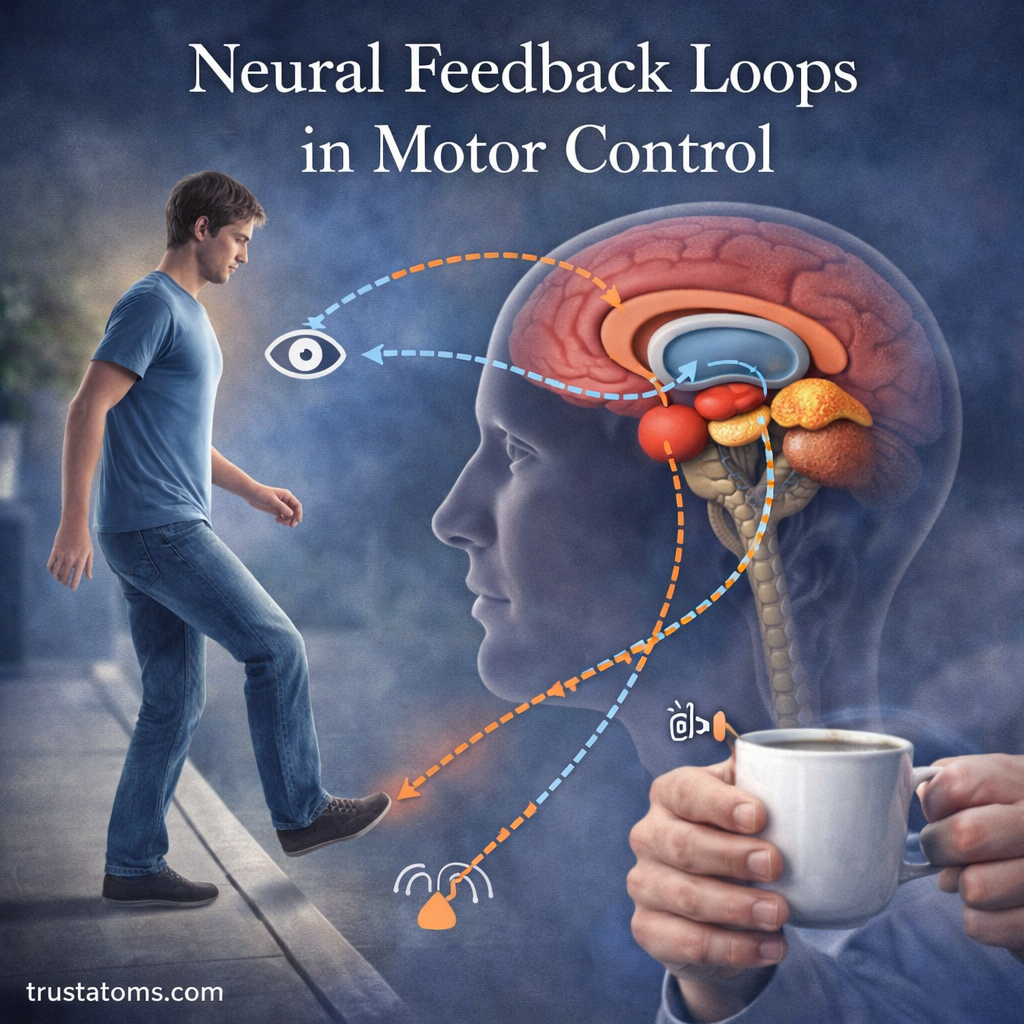
Every movement you make—whether it’s picking up a cup or walking across a room—relies on constant communication between the brain and body. This communication happens through neural feedback loops, which allow the nervous system to monitor, adjust, and refine movement in real time.
Rather than sending a single command and hoping for the best, the brain continuously receives feedback and updates its instructions. This dynamic process is what makes movement smooth, accurate, and adaptable.
What Are Neural Feedback Loops?
Neural feedback loops are continuous cycles of information exchange between the brain, spinal cord, and body.
They involve three key steps:
- A movement command is sent from the brain
- Sensory information is returned from the body
- The brain adjusts the movement based on that feedback
This loop repeats rapidly—often within milliseconds—during any action.
Types of Feedback in Motor Control
Sensory Feedback
Sensory receptors in muscles, joints, and skin provide information about:
- Position (proprioception)
- Movement speed
- Force and tension
- Touch and pressure
This feedback helps the brain understand what the body is doing at any moment.
Visual Feedback
Vision plays a major role in guiding movement.
Examples include:
- Reaching for an object accurately
- Adjusting posture based on surroundings
- Coordinating hand-eye movements
Visual input allows for real-time corrections during tasks.
Vestibular Feedback
The vestibular system (inner ear) provides information about balance and head position.
It helps with:
- Maintaining posture
- Stabilizing gaze
- Coordinating body orientation
Key Components of Motor Feedback Loops
Motor Cortex: Initiating Movement
The motor cortex sends the initial command to muscles.
Its role includes:
- Planning voluntary movement
- Sending signals through descending pathways
- Adjusting commands based on incoming feedback
Cerebellum: Error Detection and Correction
The cerebellum is critical for refining movement.
It:
- Compares intended movement with actual performance
- Detects errors in timing and coordination
- Sends corrective signals to improve accuracy
This makes movements smoother and more precise.
Basal Ganglia: Movement Regulation
The basal ganglia help regulate movement patterns.
They:
- Select appropriate movements
- Suppress unwanted actions
- Support movement consistency
They work alongside feedback loops to ensure controlled execution.
Spinal Cord: Rapid Reflex Processing
The spinal cord plays a key role in fast feedback loops, especially reflexes.
Functions include:
- Processing sensory input quickly
- Generating immediate motor responses
- Relaying information to and from the brain
Closed-Loop vs. Open-Loop Control
Closed-Loop Control
Closed-loop systems rely on continuous feedback.
Characteristics:
- Real-time adjustments
- High accuracy
- Slower than reflexive responses
Example: Adjusting your grip while holding a fragile object.
Open-Loop Control
Open-loop systems operate without feedback during execution.
Characteristics:
- Pre-planned movement
- Faster execution
- Less adaptable
Example: Throwing a ball quickly, where feedback comes after the action.
Reflex Arcs: The Fastest Feedback Loops
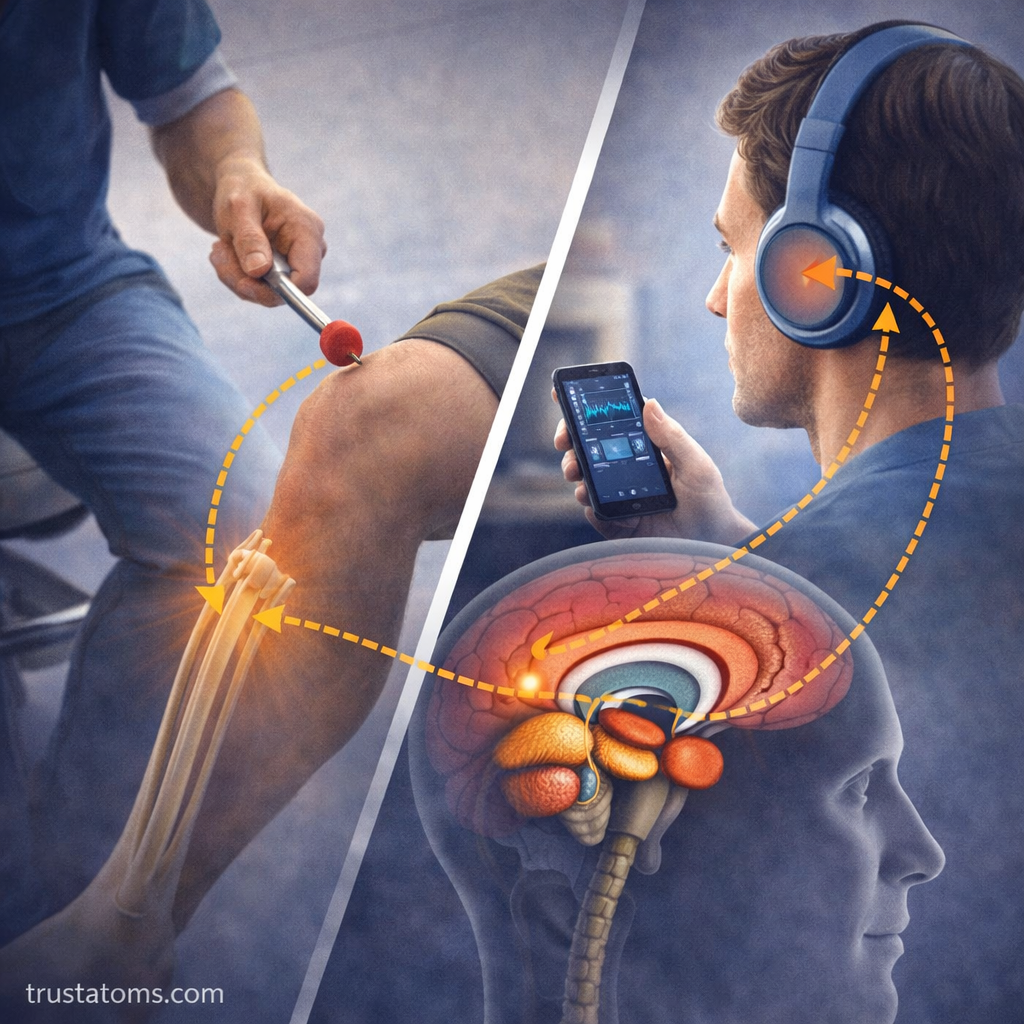
Reflexes are the simplest and fastest type of neural feedback loop.
How Reflex Arcs Work
- A stimulus activates sensory receptors
- Signals travel to the spinal cord
- A motor response is generated immediately
- The brain is informed after the action
This allows for rapid responses, such as pulling your hand away from a hot surface.
Role of Proprioception in Feedback
Proprioception is the body’s ability to sense its own position and movement.
It relies on specialized receptors in:
- Muscles
- Tendons
- Joints
Proprioceptive feedback allows you to:
- Move without constantly looking
- Maintain balance and coordination
- Adjust movements automatically
Continuous Adjustment in Everyday Movement
Neural feedback loops are active in all types of movement, including:
- Walking on uneven surfaces
- Typing on a keyboard
- Maintaining posture while standing
- Playing sports or instruments
Even simple actions involve constant corrections based on incoming sensory data.
Motor Learning and Feedback Loops
Feedback loops are essential for learning new skills.
They help:
- Identify movement errors
- Reinforce successful patterns
- Improve coordination over time
Practice and Adaptation
With repeated practice:
- Movements become more efficient
- Fewer corrections are needed
- Skills become more automatic
This process is key to mastering complex tasks.
Neural Plasticity and Feedback
The brain’s ability to adapt—known as neuroplasticity—is closely tied to feedback loops.
Through repeated feedback:
- Neural pathways are strengthened
- Motor skills improve
- Recovery after injury becomes possible
This is why rehabilitation exercises rely heavily on repetition and feedback.
Common Disruptions in Feedback Loops
When neural feedback systems are impaired, movement can become less accurate or coordinated.
Examples include:
- Cerebellar disorders (poor coordination)
- Peripheral nerve damage (reduced sensation)
- Vestibular dysfunction (balance issues)
These disruptions highlight how essential feedback is for normal movement.
Key Takeaways
- Neural feedback loops allow continuous communication between brain and body
- They enable real-time movement correction and precision
- Sensory, visual, and vestibular inputs all contribute to feedback
- The cerebellum plays a key role in error detection
- Feedback loops support motor learning and adaptation
Final Thoughts
Neural feedback loops are the foundation of coordinated movement. By constantly monitoring and adjusting actions, they ensure that movements are accurate, efficient, and adaptable to changing conditions.
From reflexive responses to complex motor skills, these loops allow the body to function smoothly in a dynamic environment. Understanding how they work provides valuable insight into both everyday movement and the processes behind learning and recovery.