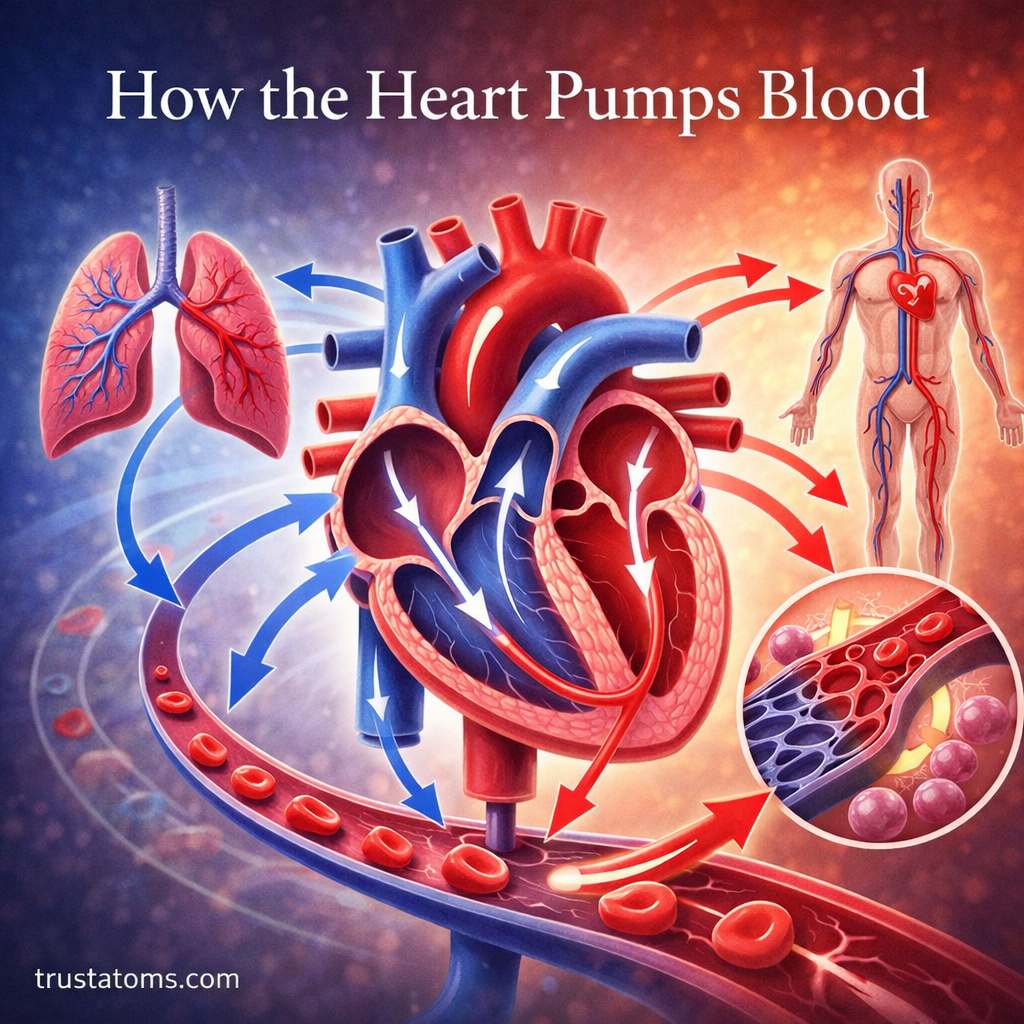
The heart is a powerful muscular pump that keeps blood moving throughout the body. Every beat pushes oxygen-rich blood to tissues and returns oxygen-poor blood to the lungs for reoxygenation.
Understanding how the heart pumps blood helps explain how the body maintains energy, removes waste, and supports every organ system.
Overview of Heart Function
The heart works as a double pump, handling two main tasks at the same time:
- Sending oxygen-poor blood to the lungs (pulmonary circulation)
- Pumping oxygen-rich blood to the body (systemic circulation)
This continuous cycle ensures that cells receive the oxygen and nutrients they need to function.
The Role of the Four Chambers
The heart is divided into four chambers that coordinate blood flow.
Right Side of the Heart
- Right atrium: Receives oxygen-poor blood from the body
- Right ventricle: Pumps blood to the lungs
Left Side of the Heart
- Left atrium: Receives oxygen-rich blood from the lungs
- Left ventricle: Pumps blood to the body
The separation of these chambers prevents mixing of oxygen-rich and oxygen-poor blood.
The Cardiac Cycle Explained
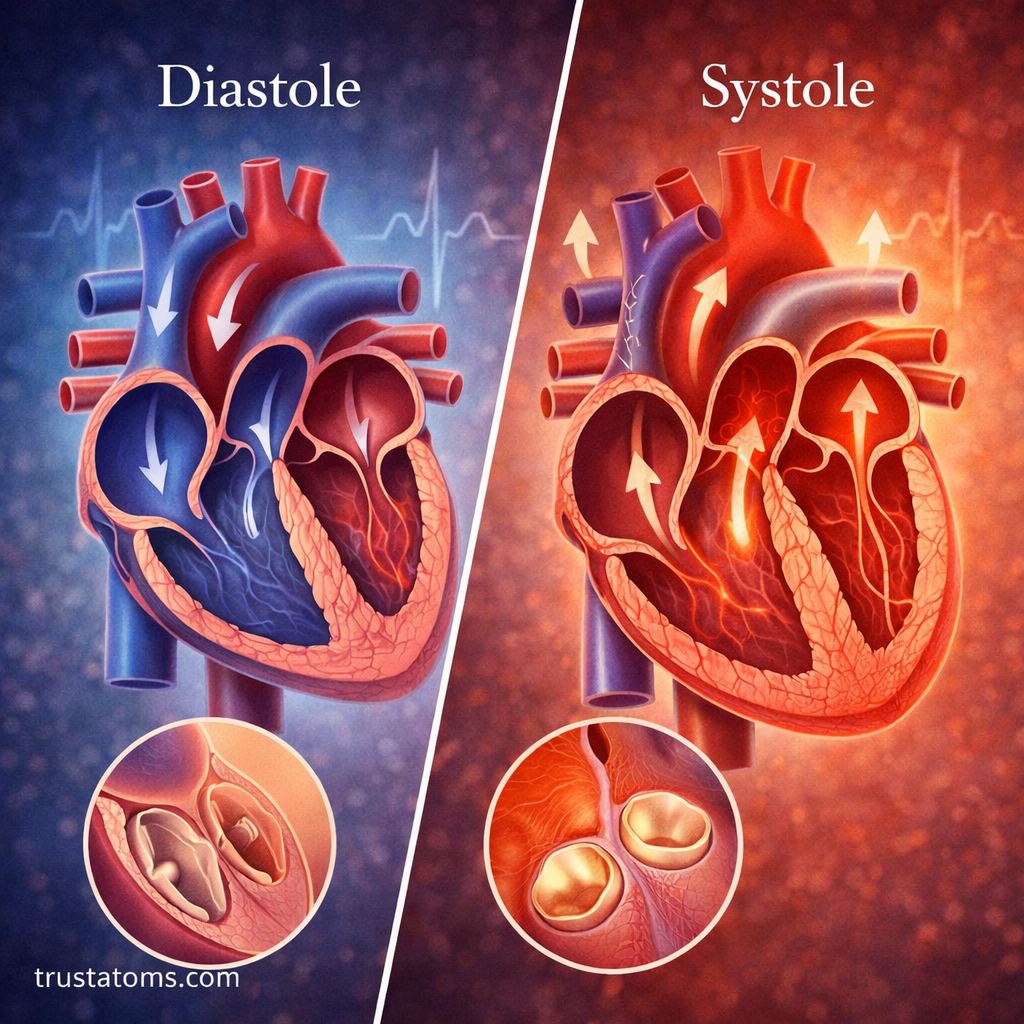
The cardiac cycle is the sequence of events that occurs during one heartbeat. It consists of two main phases:
1. Diastole (Filling Phase)
- Heart muscles relax
- Chambers fill with blood
- Atrioventricular (AV) valves are open
2. Systole (Pumping Phase)
- Ventricles contract
- Blood is pushed out of the heart
- Semilunar valves (aortic and pulmonary) open
This cycle repeats with every heartbeat, typically 60–100 times per minute at rest.
Step-by-Step: How Blood Moves Through the Heart
Blood follows a precise pathway during each heartbeat.
Blood Flow Sequence
- Oxygen-poor blood enters the right atrium from the body
- Blood flows through the tricuspid valve into the right ventricle
- The right ventricle pumps blood through the pulmonary valve into the pulmonary artery
- Blood travels to the lungs, where it picks up oxygen
- Oxygen-rich blood returns to the left atrium via the pulmonary veins
- Blood passes through the mitral valve into the left ventricle
- The left ventricle pumps blood through the aortic valve into the aorta
- Blood is distributed throughout the body
This loop runs continuously to maintain circulation.
The Role of Heart Valves
Heart valves ensure that blood flows in one direction.
Key Valves
- Tricuspid valve: Right atrium to right ventricle
- Pulmonary valve: Right ventricle to pulmonary artery
- Mitral valve: Left atrium to left ventricle
- Aortic valve: Left ventricle to aorta
Valves open and close based on pressure changes, preventing backflow.
Electrical Signals That Control the Heartbeat
The heart has its own electrical system that controls when it beats.
Key Components
- Sinoatrial (SA) node: Initiates the heartbeat (natural pacemaker)
- Atrioventricular (AV) node: Delays signals to allow ventricles to fill
- Bundle of His and Purkinje fibers: Spread signals through the ventricles
These signals coordinate contraction so the heart pumps efficiently.
How Pressure Drives Blood Flow
Blood moves through the heart due to pressure differences.
How It Works
- When the heart contracts, pressure increases and pushes blood forward
- When the heart relaxes, pressure decreases, allowing chambers to fill
This pressure-based system ensures continuous and smooth blood movement.
Stroke Volume and Cardiac Output
The efficiency of the heart’s pumping is measured using two key concepts.
Stroke Volume
- The amount of blood pumped by one ventricle per beat
Cardiac Output
- The total amount of blood pumped per minute
Formula (conceptual)
- Cardiac Output = Heart Rate × Stroke Volume
Higher cardiac output means more oxygen and nutrients are delivered to the body.
How the Heart Adapts to Activity
The heart adjusts its pumping based on the body’s needs.
During Exercise
- Heart rate increases
- Stroke volume increases
- Blood flow is redirected to muscles
During Rest
- Heart rate slows
- Energy demand decreases
These adjustments are controlled by the autonomic nervous system.
Why Efficient Pumping Matters
The heart’s ability to pump blood effectively is essential for survival.
Key Benefits
- Delivers oxygen and nutrients to tissues
- Removes carbon dioxide and waste
- Maintains blood pressure
- Supports organ function
Even small disruptions in pumping can affect overall health.
Common Problems With Heart Pumping
When the heart cannot pump efficiently, health issues can occur.
Examples
- Heart failure: Reduced ability to pump blood
- Valve disorders: Disrupt normal blood flow
- Arrhythmias: Irregular heart rhythms
- Hypertension: Increased workload on the heart
Understanding how the heart pumps blood helps explain these conditions.
Final Thoughts
The heart is a remarkable organ that works tirelessly to keep blood circulating throughout the body. Through coordinated contractions, precise valve function, and electrical signaling, it ensures that every cell receives what it needs.
By understanding how the heart pumps blood, you gain insight into one of the most vital processes that sustain life.