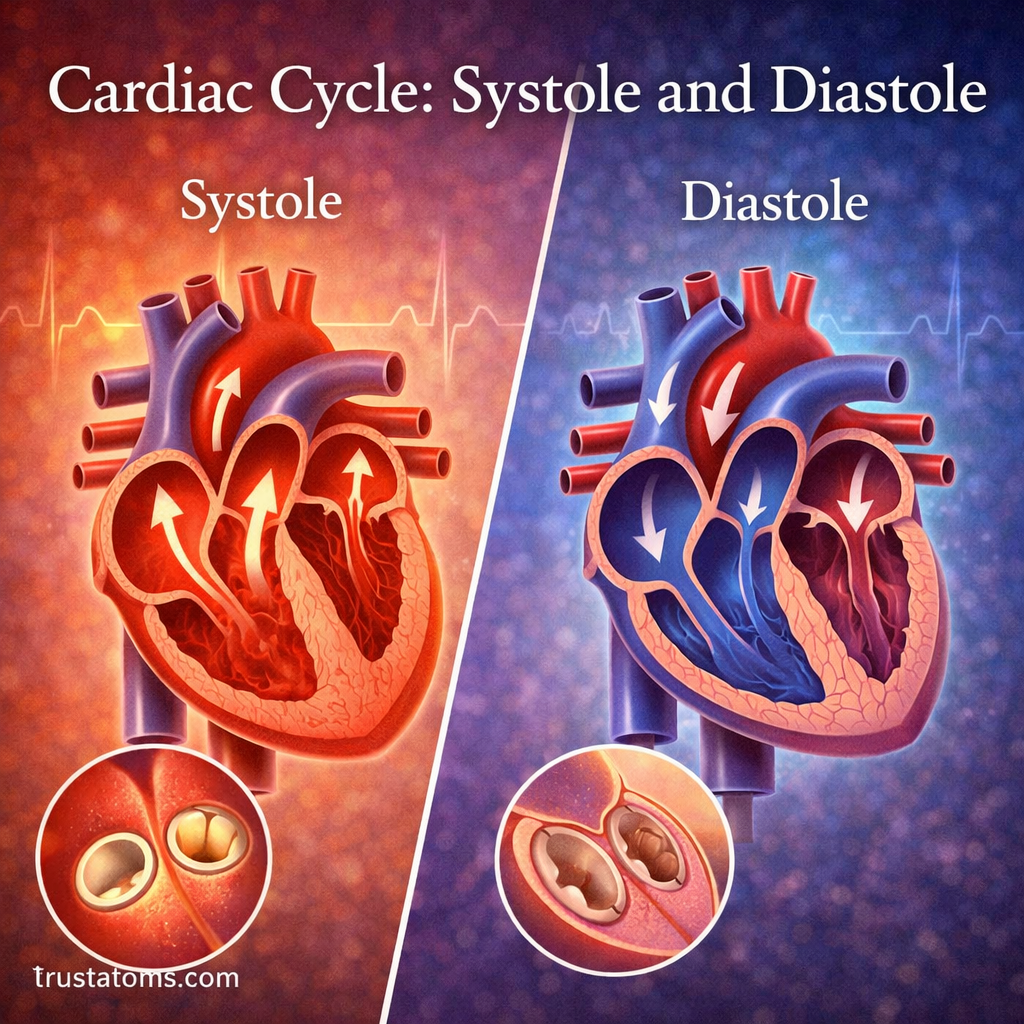
The cardiac cycle is the sequence of events that occurs during one complete heartbeat. It includes two main phases—systole and diastole—that work together to pump blood efficiently through the heart and throughout the body.
Every heartbeat follows this cycle, ensuring a continuous supply of oxygen and nutrients while removing waste products.
What Is the Cardiac Cycle?
The cardiac cycle refers to the repeated pattern of contraction and relaxation of the heart muscles.
Key Purpose
- Move blood through the heart chambers
- Maintain steady circulation
- Ensure proper timing of valve opening and closing
This cycle happens automatically and continuously, typically 60–100 times per minute at rest.
Overview of Systole and Diastole
The cardiac cycle is divided into two primary phases:
Systole (Contraction Phase)
- The heart muscles contract
- Blood is pumped out of the ventricles
- Pressure inside the heart increases
Diastole (Relaxation Phase)
- The heart muscles relax
- Chambers fill with blood
- Pressure inside the heart decreases
These two phases alternate with every heartbeat.
Diastole: The Filling Phase
Diastole is when the heart relaxes and prepares to fill with blood.
What Happens During Diastole
- Blood flows from the veins into the atria
- Atrioventricular (AV) valves open
- Blood moves into the ventricles
Key Features
- Low pressure inside the heart
- Ventricles expand to accommodate blood
- Most ventricular filling occurs passively
Toward the end of diastole, the atria contract slightly to push additional blood into the ventricles (atrial systole).
Systole: The Pumping Phase
Systole is when the ventricles contract to push blood out of the heart.
What Happens During Systole
- Ventricles contract forcefully
- AV valves close to prevent backflow
- Semilunar valves (aortic and pulmonary) open
- Blood is ejected into the arteries
Key Features
- High pressure inside the ventricles
- Blood is propelled to the lungs and body
- Efficient one-way flow is maintained
Step-by-Step Cardiac Cycle
The cardiac cycle follows a precise sequence:
Full Cycle Breakdown
- Blood enters the atria from the body and lungs
- The heart is in diastole (relaxed state)
- AV valves open, allowing blood into the ventricles
- Atria contract to complete ventricular filling
- Ventricles begin systole (contraction starts)
- AV valves close (first heart sound “lub”)
- Semilunar valves open, and blood is ejected
- Ventricles relax after contraction
- Semilunar valves close (second heart sound “dub”)
- The cycle repeats
This coordinated process ensures efficient circulation.
Role of Heart Valves in the Cycle
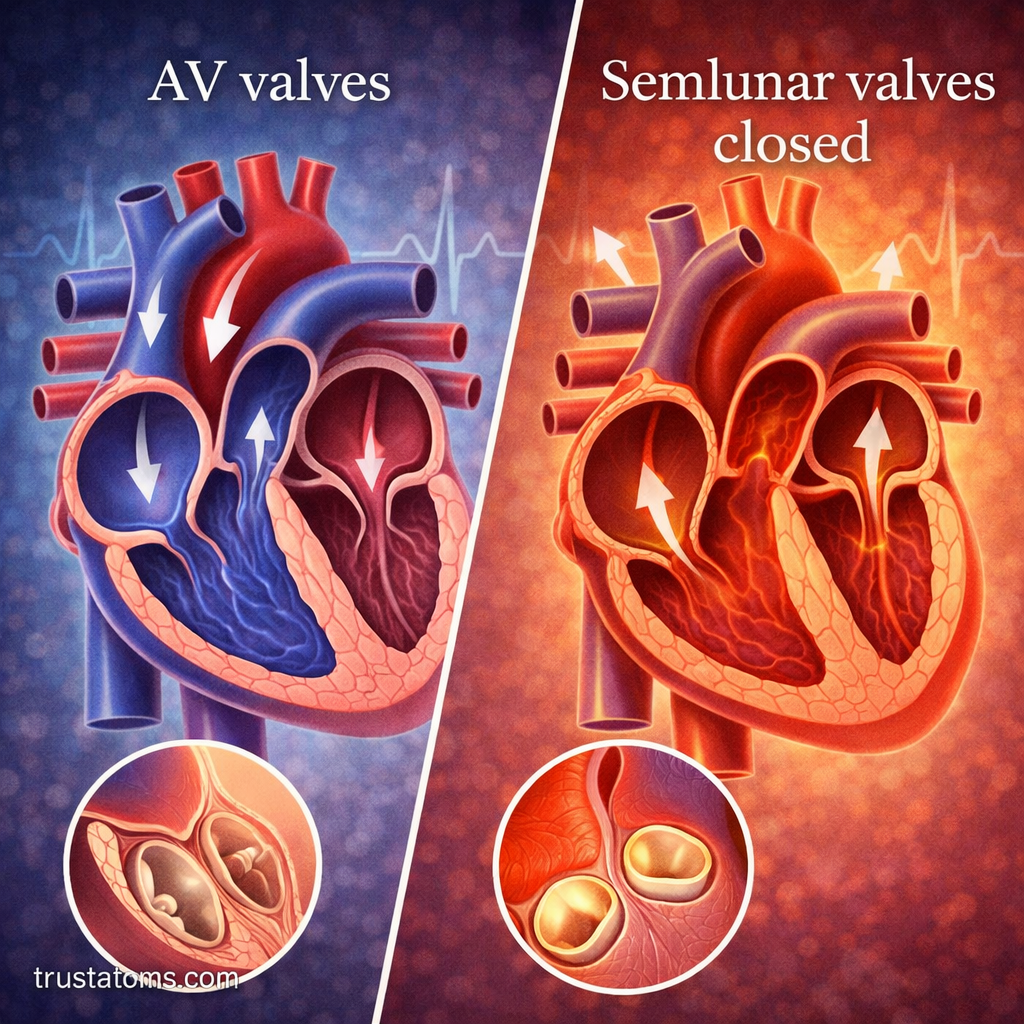
Valves play a crucial role in directing blood flow during the cardiac cycle.
Valve Function
- Prevent backward flow of blood
- Open and close based on pressure differences
- Ensure one-way movement through the heart
Valve Timing
- AV valves open during diastole
- AV valves close at the start of systole
- Semilunar valves open during systole
- Semilunar valves close during diastole
This precise timing is essential for proper heart function.
Electrical Control of the Cardiac Cycle
The cardiac cycle is regulated by the heart’s electrical system.
Key Components
- Sinoatrial (SA) node: Initiates the heartbeat
- Atrioventricular (AV) node: Delays signal for proper filling
- Bundle of His and Purkinje fibers: Spread signals to ventricles
This system ensures that atria contract before ventricles, optimizing blood flow.
Pressure Changes During the Cardiac Cycle
Pressure differences drive the movement of blood.
During Diastole
- Pressure in ventricles is low
- Blood flows into the heart
During Systole
- Ventricular pressure rises
- Blood is forced out into arteries
These pressure changes control valve activity and blood direction.
Heart Sounds: “Lub-Dub”
The familiar “lub-dub” sound of the heartbeat is caused by valve closure.
What the Sounds Mean
- “Lub” (S1): Closure of AV valves at the start of systole
- “Dub” (S2): Closure of semilunar valves at the end of systole
These sounds are important indicators of heart function.
Why the Cardiac Cycle Matters
The cardiac cycle is essential for maintaining life and overall health.
Key Functions
- Ensures continuous blood circulation
- Delivers oxygen and nutrients to tissues
- Removes carbon dioxide and waste
- Maintains blood pressure and organ function
Any disruption in the cycle can affect the entire body.
Common Issues Related to the Cardiac Cycle
Problems in the cardiac cycle can lead to serious conditions.
Examples
- Arrhythmias: Irregular heart rhythm
- Valve disorders: Improper opening or closing
- Heart failure: Reduced pumping efficiency
- Hypertension: Increased pressure affecting heart function
Understanding the cardiac cycle helps in diagnosing and managing these conditions.
Final Thoughts
The cardiac cycle—through systole and diastole—is a finely tuned process that keeps blood moving efficiently through the heart and body. Each phase plays a critical role, from filling the chambers to pumping blood out with force.
By understanding how this cycle works, you gain a clearer picture of how the heart supports life every second of every day.