Pressure in physics is the amount of force applied over a given area.
In simple terms, pressure tells us how concentrated a force is. The same force applied over a small area produces more pressure than when spread over a large area.
Pressure plays a crucial role in fluid dynamics, weather systems, engineering, and even everyday experiences like walking in snow or using a knife.
The Basic Definition of Pressure

Pressure is defined as:
Force divided by area.
This means:
- More force → more pressure (if area stays the same)
- Smaller area → more pressure (if force stays the same)
For example:
- A sharp knife cuts easily because the force is concentrated on a very small edge.
- Snowshoes prevent sinking because they spread your weight over a larger area.
Units of Pressure
In physics, pressure is measured in pascals (Pa).
One pascal equals one unit of force applied over one square meter.
Other common units include:
- Atmospheres (atm) — often used for air pressure
- Bars — used in meteorology
- Pounds per square inch (psi) — used in tire pressure
Each unit measures the same concept but in different scales.
Pressure in Solids vs. Fluids
Pressure behaves differently depending on the type of material involved.
Pressure in Solids
In solids, pressure depends on:
- The applied force
- The contact area
Examples include:
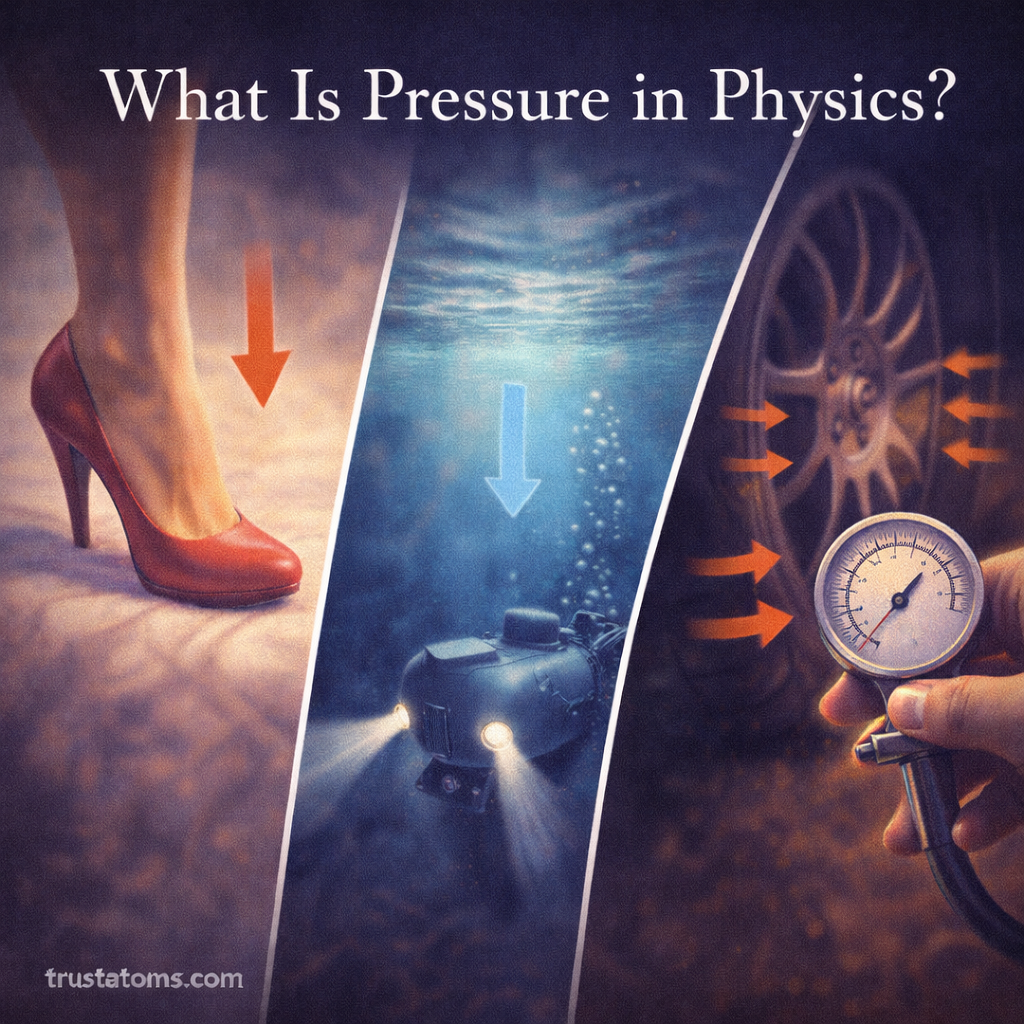
- High heels creating more pressure than sneakers
- Nails penetrating wood due to small contact area
Pressure in Fluids
Fluids (liquids and gases) transmit pressure differently.
In fluids:
- Pressure acts in all directions.
- Pressure increases with depth.
- Pressure depends on density and gravity.
This explains why:
- Deep-sea divers experience enormous pressure.
- Dams are thicker at the bottom.
Atmospheric Pressure
The air around us has weight, and that weight creates atmospheric pressure.
At sea level:
- The atmosphere presses down with significant force.
- We don’t feel it because our bodies are adapted to it.
Changes in atmospheric pressure cause:
- Weather patterns
- Wind formation
- Storm systems
Low-pressure systems often bring clouds and rain, while high-pressure systems bring clearer skies.
Pressure and Depth in Liquids
In liquids, pressure increases as depth increases.
Why?
Because the deeper you go, the more fluid is above you, adding weight.
This is why:
- Your ears pop when diving underwater.
- Submarines must be built to withstand intense pressure.
The relationship between depth and pressure is crucial in oceanography and engineering.
Pressure and Gas Behavior
In gases, pressure is related to particle motion.
Gas pressure results from:
- Collisions of gas particles with container walls
- The speed of those particles
- The number of particles present
If you:
- Increase temperature → particles move faster → pressure increases.
- Compress a gas → particles collide more often → pressure increases.
This behavior is described by gas laws in physics.
Pascal’s Principle
Pascal’s Principle states that pressure applied to a confined fluid is transmitted equally in all directions.
This principle allows hydraulic systems to work.
Examples include:
- Hydraulic car lifts
- Braking systems
- Heavy machinery
A small force applied in one area can produce a larger force elsewhere if the area changes.
Real-World Examples of Pressure
Pressure influences many aspects of daily life.
Examples include:
- Tire pressure keeping vehicles stable
- Blood pressure circulating oxygen
- Water pressure in plumbing systems
- Air pressure in weather systems
Even cooking at high altitudes is affected by pressure changes.
Why Pressure Matters in Physics
Pressure connects force and area into a single measurable quantity.
It helps explain:
- Structural design
- Fluid motion
- Weather systems
- Gas behavior
- Mechanical systems
From the smallest syringe to the largest ocean trench, pressure shapes the physical world.
The Big Picture
Pressure in physics is the amount of force distributed over an area.
It:
- Increases with greater force
- Increases when area decreases
- Acts in all directions in fluids
- Changes with depth and temperature
Understanding pressure helps explain everyday experiences, engineering systems, and natural phenomena.
It is one of the most fundamental and practical concepts in physics.