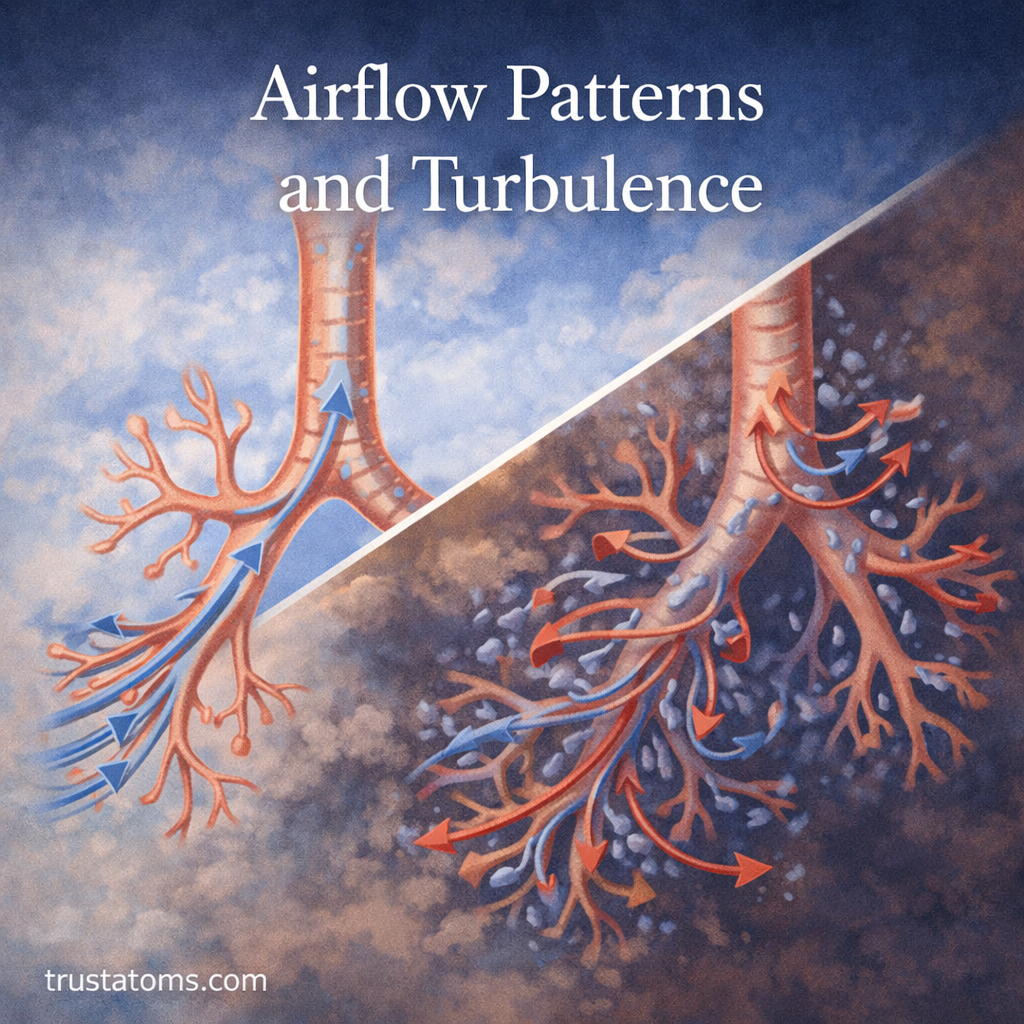
Air moves through your respiratory system with every breath, but it doesn’t always flow in the same way. Depending on factors like speed, airway size, and resistance, airflow can be smooth and orderly—or chaotic and turbulent.
Understanding airflow patterns and turbulence is essential in human anatomy, especially when studying breathing efficiency, lung health, and respiratory disorders.
What Are Airflow Patterns?
Airflow patterns describe how air travels through the respiratory tract—from the nose and mouth down to the lungs.
There are two primary types:
- Laminar flow (smooth and orderly)
- Turbulent flow (irregular and chaotic)
These patterns affect how efficiently oxygen is delivered and how much energy the body uses to breathe.
Laminar Flow: Smooth and Efficient
Laminar flow occurs when air moves in parallel layers with minimal disruption.
Key Characteristics
- Smooth, streamlined movement
- Minimal resistance
- Energy-efficient
Where It Occurs
Laminar flow is most common in:
- Smaller airways (bronchioles)
- Lower regions of the lungs
Why It Matters
This type of airflow allows:
- Efficient oxygen delivery
- Reduced work of breathing
- Optimal gas exchange in alveoli
Turbulent Flow: Chaotic and Energy-Intensive
Turbulent flow occurs when air moves irregularly, creating eddies and swirls.
Key Characteristics
- Disorganized airflow
- Increased resistance
- Higher energy demand
Where It Occurs
Turbulence is more likely in:
- Larger airways (trachea and bronchi)
- Areas with sharp bends or obstructions
- During high breathing rates (e.g., exercise)
Why It Matters
Turbulent airflow:
- Increases the effort required to breathe
- Can reduce airflow efficiency
- Is often associated with respiratory sounds like wheezing
Factors That Influence Airflow Patterns
Several variables determine whether airflow is laminar or turbulent.
1. Air Velocity
- Faster airflow increases the likelihood of turbulence
- Occurs during exercise or heavy breathing
2. Airway Diameter
- Narrower airways increase resistance
- Can lead to turbulence in conditions like asthma
3. Airway Shape and Structure
- Irregular or branching pathways promote turbulence
- The upper respiratory tract naturally has more turbulence
4. Air Density and Viscosity
- Denser air increases resistance
- Changes in environmental conditions can affect airflow
The Reynolds Number in Respiration
Scientists use a concept called the Reynolds number to predict airflow patterns.
It depends on:
- Air velocity
- Airway diameter
- Air density
- Air viscosity
Interpretation
- Low Reynolds number → Laminar flow
- High Reynolds number → Turbulent flow
In the respiratory system, airflow often transitions between both types depending on conditions.
Transition Between Laminar and Turbulent Flow
Airflow in the lungs is not always purely laminar or turbulent—it often exists in a transitional state.
Example During Exercise
- At rest → Mostly laminar in lower airways
- During exercise → Increased turbulence in upper airways
Why This Happens
- Increased breathing rate raises airflow speed
- Air encounters structural changes in the airway
This dynamic shift allows the body to adapt to changing oxygen demands.
Clinical Significance of Airflow Turbulence
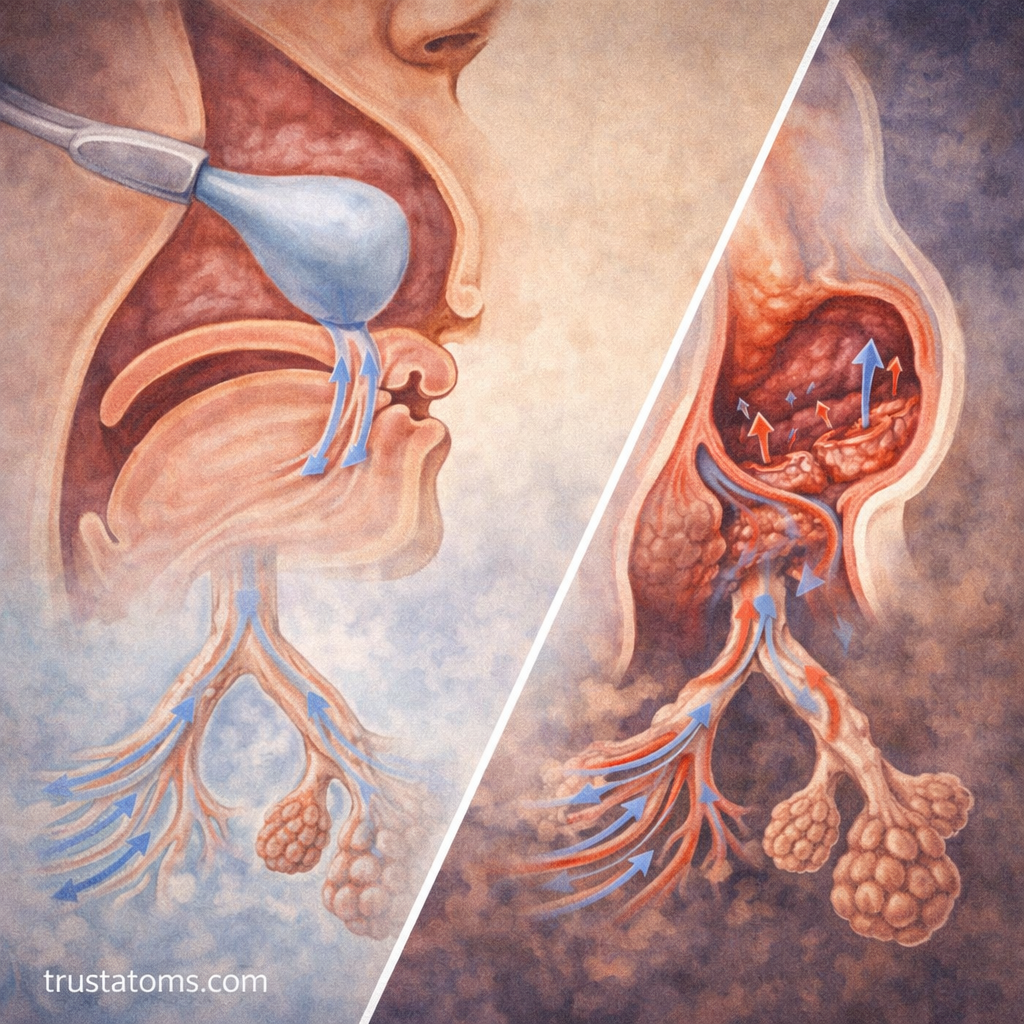
Airflow patterns are important in diagnosing and understanding respiratory conditions.
Asthma
- Narrowed airways increase turbulence
- Causes wheezing and difficulty breathing
Chronic Obstructive Pulmonary Disease (COPD)
- Airflow obstruction leads to inefficient breathing
- Increased turbulence and air trapping
Upper Airway Obstructions
- Tumors, swelling, or foreign objects disrupt airflow
- Can cause noisy breathing (stridor)
Airflow and Respiratory Sounds
Turbulence is directly linked to the sounds we hear during breathing.
Normal Breath Sounds
- Soft and quiet due to mostly laminar flow
Abnormal Sounds
- Wheezing → Narrowed airways
- Crackles → Fluid in the lungs
- Stridor → Upper airway obstruction
These sounds help clinicians assess airflow disturbances.
How the Body Minimizes Turbulence
The respiratory system is designed to optimize airflow.
Structural Adaptations
- Gradual branching of airways reduces abrupt changes
- Smooth lining minimizes friction
Functional Adjustments
- Controlled breathing patterns
- Regulation of airway diameter through muscle contraction
These features help maintain efficient airflow under normal conditions.
Why Airflow Patterns Matter
Understanding airflow patterns and turbulence helps:
- Improve respiratory efficiency
- Diagnose lung conditions
- Optimize athletic performance
- Guide medical treatments
It highlights how physics and biology work together in the human body.
Final Thoughts
Airflow in the respiratory system is more complex than it may seem. From smooth laminar flow deep in the lungs to turbulent patterns in larger airways, the body continuously balances efficiency and adaptability.
By understanding these airflow dynamics, we gain deeper insight into breathing mechanics, respiratory health, and the remarkable design of the human body.