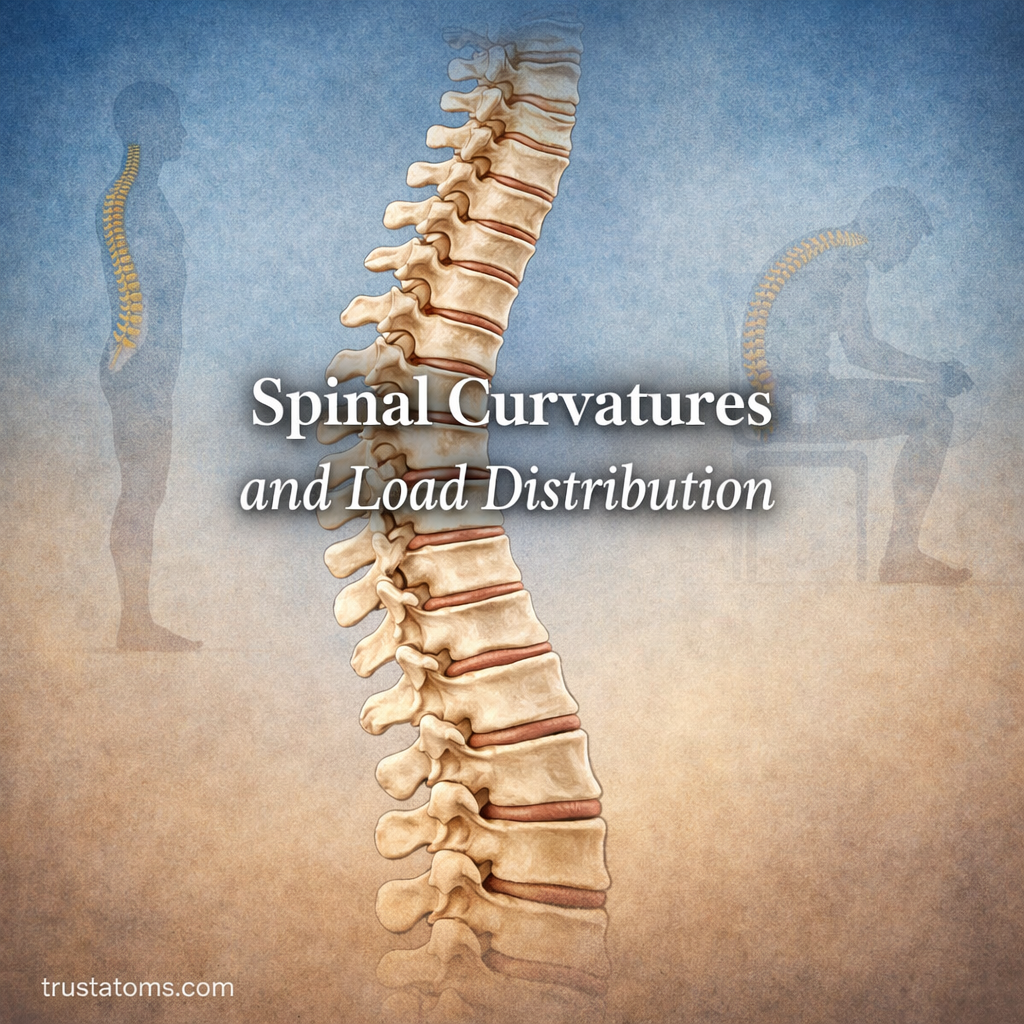
Spinal curvatures help distribute body weight and mechanical forces across the vertebrae, intervertebral discs, joints, and supporting muscles. The spine’s natural S-shaped profile also supports balance, flexibility, and shock absorption during everyday activities such as walking, sitting, and lifting.
These curves are a normal feature of human anatomy, not a sign that the back is misaligned. Understanding how they interact with muscles, discs, and posture helps explain why the forces acting on the spine change with movement and body position.
The Four Natural Curves of the Human Spine
When viewed from the side, the vertebral column has four normal curves. Two curve forward, called lordotic curves, and two curve backward, called kyphotic curves. Together, they create the characteristic S-shaped spinal profile.
| Spinal Region | Curve | Main Function |
|---|---|---|
| Cervical (neck) | Lordotic, curves forward | Supports the head and helps position it over the trunk |
| Thoracic (upper and middle back) | Kyphotic, curves backward | Supports the rib cage and contributes to trunk stability |
| Lumbar (lower back) | Lordotic, curves forward | Helps support upper-body weight and transfer forces toward the pelvis |
| Sacral (base of spine) | Kyphotic, curves backward | Helps transmit loads between the spine and pelvis |
The thoracic and sacral curves develop before birth, while the cervical and lumbar curves become more pronounced as infants begin lifting their heads, sitting, standing, and walking.
Normal curvature varies between individuals. A healthy spine does not need to match one exact angle or shape, and a visible curve alone does not indicate a medical problem.
How Spinal Curvatures Support Load Distribution
Load distribution describes how forces are shared among the structures of the spine. These forces come from body weight, muscle contractions, movement, and external objects being carried or lifted.
The spinal curves help position the body’s center of mass over its supporting base. They also influence how compressive forces, bending forces, and shear forces act on different vertebral levels.
Rather than spreading every force equally, the spine transfers loads through a combination of structures:
- Vertebral bodies: Bear substantial compressive loads.
- Intervertebral discs: Distribute pressure and permit controlled movement between vertebrae.
- Facet joints: Guide movement and share loads, particularly in certain positions.
- Muscles and ligaments: Stabilize the spine and resist excessive motion.
The relationship between these structures is examined further in load bearing in the spine.
Load transfer continues below the spine through the pelvis, legs, and feet. Arch support and load transfer explains how the foot helps manage forces where the body contacts the ground.
How Intervertebral Discs Distribute Pressure
Between most adjacent vertebrae are intervertebral discs, which act as cushions and play a major role in load distribution.
Each disc has two main components:
- Annulus fibrosus: A strong outer ring made of layered fibrous tissue that helps resist tension and twisting.
- Nucleus pulposus: A water-rich central region that helps distribute compressive pressure within the disc.
When the spine bears weight, discs deform slightly and transmit forces to neighboring vertebrae. Their ability to retain water and distribute pressure contributes to the spine’s resistance to compression.
Disc loading changes with posture. Bending, twisting, lifting, and sustained positions can alter pressure within a disc and the forces experienced by its outer fibers.
How Sitting, Standing, and Lifting Change Spinal Loads
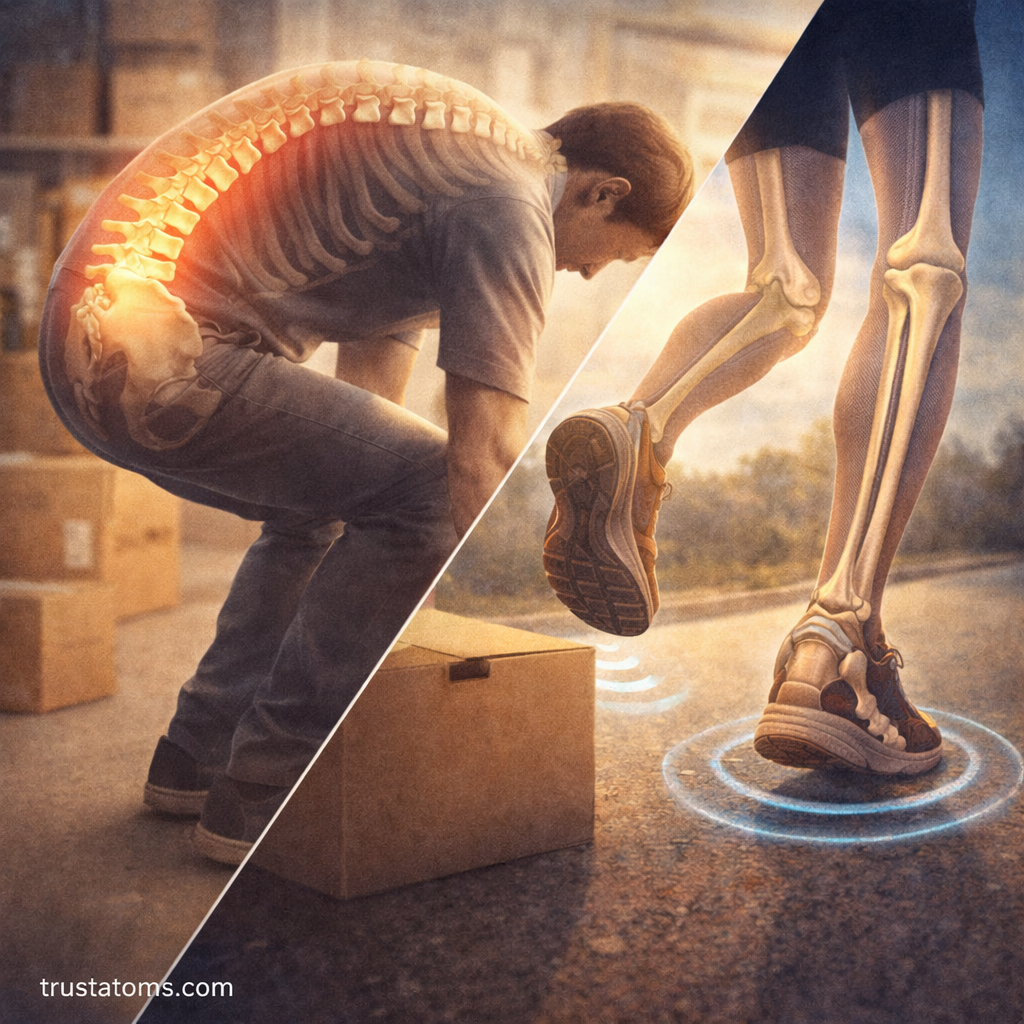
The spine experiences different combinations of compression, bending, and muscular force depending on the activity. There is no single posture that produces the lowest load on every spinal structure.
Standing and Walking
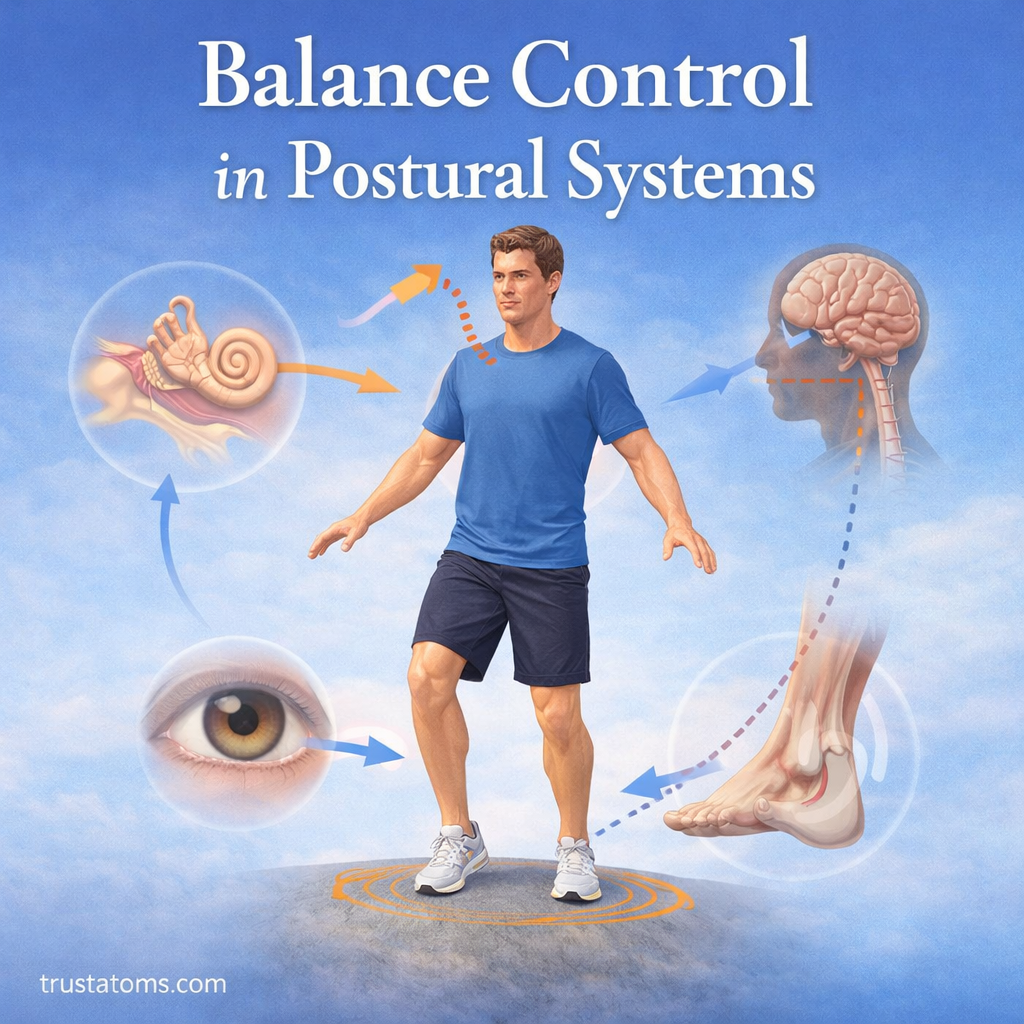
During standing, body weight passes through the spine toward the pelvis and legs. Muscles make continuous small adjustments to maintain balance.
Walking adds repeated changes in force as weight shifts between the legs. The spine and trunk muscles coordinate with the hips and pelvis to stabilize the upper body.
Sitting and Forward Bending
Sitting changes pelvic position and often alters lumbar curvature. Depending on posture and support, this can redistribute forces among discs, joints, and muscles.
Forward bending increases the mechanical demands on some spinal structures, especially when combined with an external load. However, bending itself is a normal movement, and the spine is designed to move through a range of positions.
Lifting an Object
Imagine lifting a 10-kilogram box from the floor. Holding it close to the body generally reduces the bending moment acting on the lower back compared with holding the same box at arm’s length.
This happens because the distance between the load and the spine influences the torque that back and hip muscles must resist. A heavier object or a greater distance usually increases muscular demand.
For many lifting tasks, keeping the load close, using a stable stance, and coordinating movement through the hips and knees can make the task easier to control.
Why Posture and Core Stability Matter
Posture describes the arrangement of body segments during a particular activity. The spine’s natural curves contribute to balance, but healthy posture is not one rigid position that must be maintained throughout the day.
The abdominal muscles, back muscles, diaphragm, and pelvic floor help regulate trunk stability. Their coordinated activity can limit unwanted movement while allowing the spine to bend, rotate, and extend when needed.
The relationship between muscle coordination and alignment is explored in posture control and core stability.
Remaining in one position for long periods may contribute to discomfort or fatigue. Changing positions, taking movement breaks, and developing strength and endurance can improve tolerance for everyday activities.
How the Spine Absorbs Shock During Movement
When the foot contacts the ground during walking or running, impact forces travel through the lower limbs toward the pelvis and trunk. The body manages these forces through coordinated movement rather than relying on the spinal curves alone.
Several structures contribute:
- Foot, ankle, knee, and hip joints flex and extend to manage landing forces.
- Muscles absorb and generate mechanical energy through controlled contractions.
- Intervertebral discs deform under changing compression.
- Spinal curves and trunk muscles influence how forces pass through the vertebral column.
The spine is part of the axial skeleton, which provides structural support for the head and trunk while protecting the spinal cord and supporting the rib cage.
When Spinal Curvature Becomes Abnormal
Spinal curvature varies naturally, but some conditions involve structural changes that may affect movement, balance, or comfort.
- Hyperkyphosis: An excessive backward curvature, usually in the thoracic region.
- Hyperlordosis: An exaggerated forward curvature, commonly discussed in the lumbar region.
- Scoliosis: A three-dimensional spinal deformity involving sideways curvature and vertebral rotation.
These conditions can alter mechanical loading, but their effects depend on severity, flexibility, symptoms, and individual anatomy. Not everyone with an unusual spinal curve experiences pain or functional limitations.
Supporting Healthy Spinal Movement
Everyday habits can help the muscles and joints tolerate the forces associated with movement:
- Stay physically active with activities appropriate for your abilities.
- Strengthen the trunk, hips, and legs to support lifting and movement.
- Change sitting and standing positions regularly rather than remaining rigid.
- Keep heavy objects close to the body when practical.
- Increase physical demands gradually to allow tissues to adapt.
Frequently Asked Questions
Why does the spine have an S-shaped curve?
The spine’s alternating curves help position the head and trunk over the pelvis while allowing flexibility and supporting the transfer of mechanical forces. They work with discs, joints, and muscles to maintain balance during movement.
Does sitting put more pressure on the spine than standing?
Some sitting positions can increase pressure within lumbar discs compared with relaxed standing, but the effect depends on posture, support, and muscle activity. Spinal loading cannot be judged from sitting or standing alone.
Can abnormal spinal curvature cause back pain?
Some spinal curvature conditions can contribute to pain, fatigue, or movement limitations, particularly when the changes are pronounced. However, many people with altered spinal curves have few or no symptoms, and back pain has numerous possible causes.
The spine’s natural curves help balance the body and influence how forces are transferred through vertebrae, discs, joints, and muscles. Their mechanical behavior changes with posture, movement, and external loads rather than remaining fixed. Understanding these relationships explains why spinal health depends on coordinated movement and tissue strength, not simply maintaining one ideal posture.
This article is for general education and is not medical advice. Talk to a qualified health professional about any medical concern.
Sources: OpenStax, Anatomy and Physiology 2e; Neumann, Kinesiology of the Musculoskeletal System: Foundations for Rehabilitation; American Academy of Orthopaedic Surgeons.