The human body is an efficient mechanical system that uses levers to produce movement, generate force, and maintain balance. These levers are formed by bones, joints, and muscles working together to perform everything from lifting objects to running and jumping.
Understanding the biomechanics of levers helps explain how the body moves and why certain movements feel easier or more powerful than others.
What Is a Lever in Biomechanics?
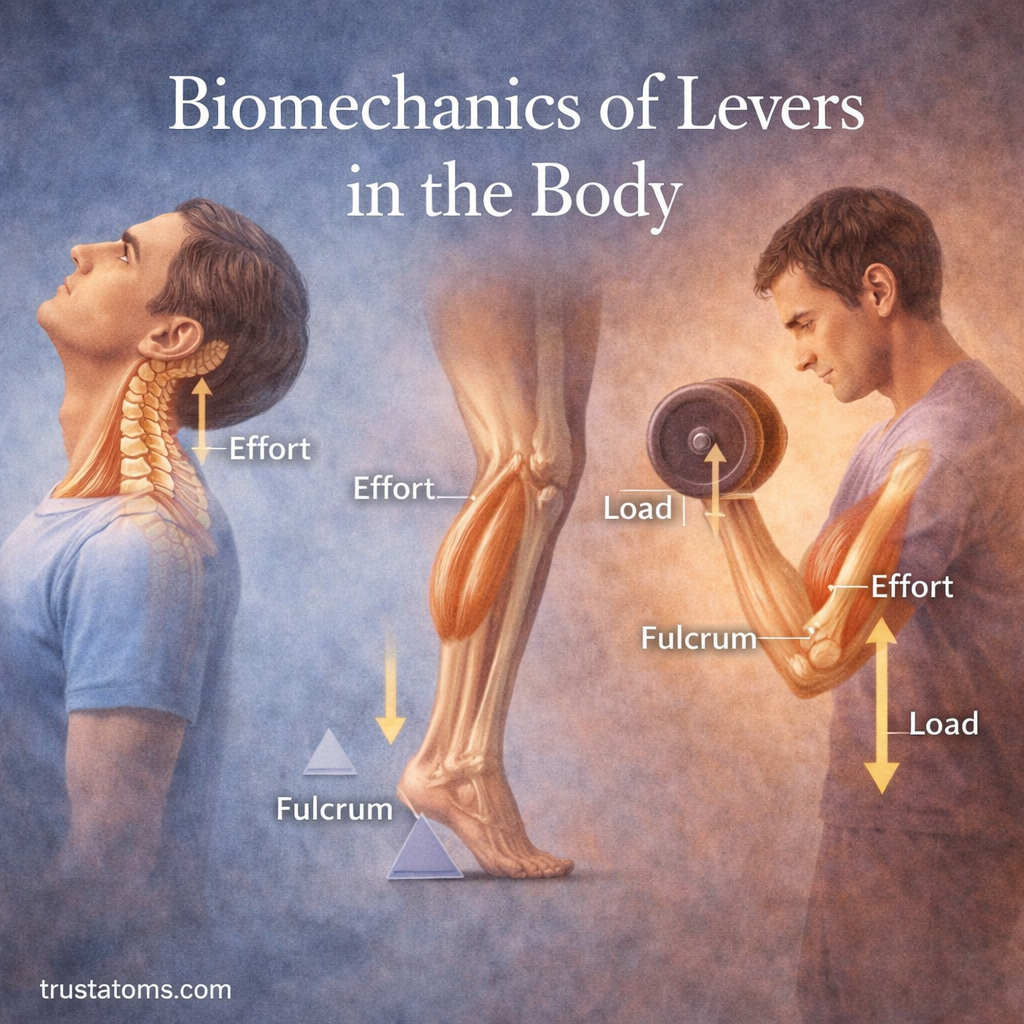
A lever is a rigid structure that rotates around a fixed point to move a load. In the human body:
- Bones act as the lever
- Joints act as the fulcrum (pivot point)
- Muscles provide the effort (force)
- Body weight or objects act as the load (resistance)
Basic Components of a Lever
- Fulcrum (F): the pivot point
- Effort (E): the force applied by muscles
- Load (L): the resistance being moved
This system allows the body to convert muscle contractions into movement.
Types of Levers in the Human Body
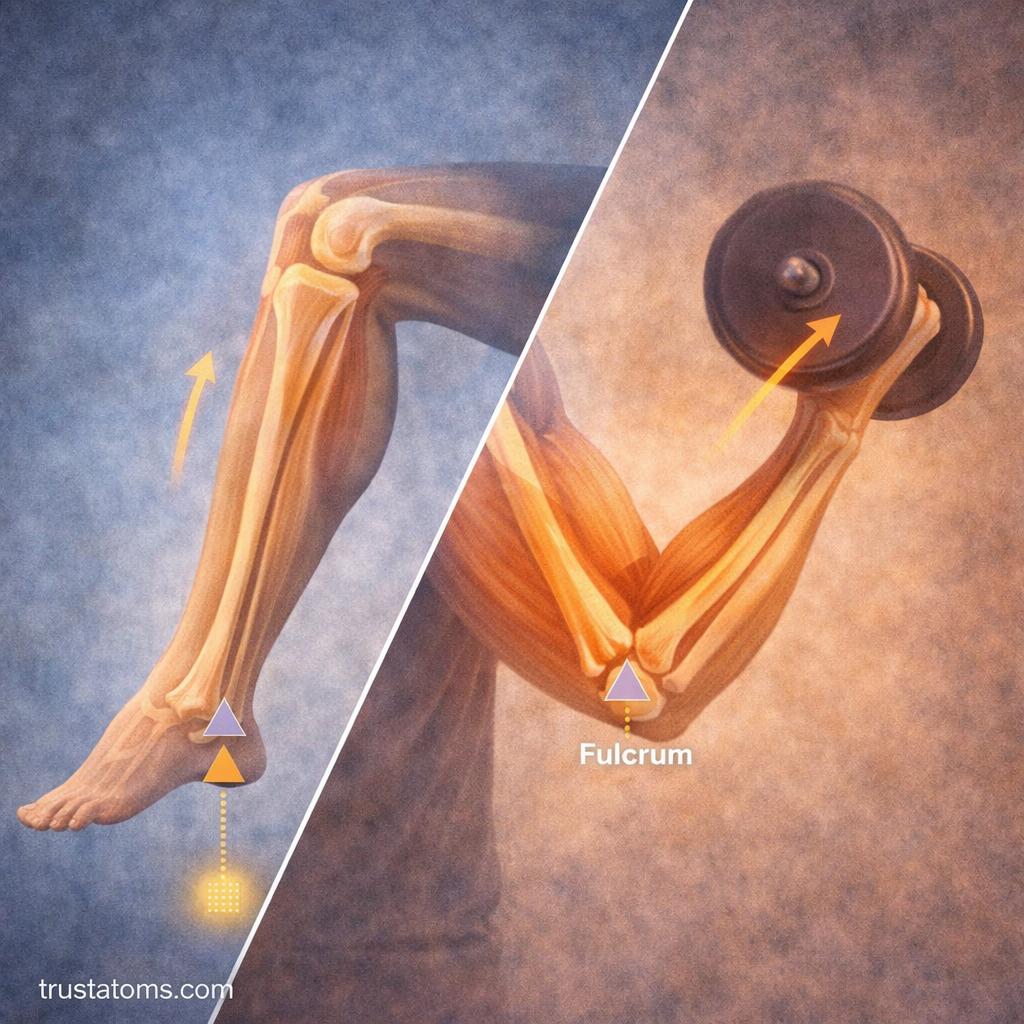
There are three main classes of levers, each with a different arrangement of fulcrum, effort, and load.
First-Class Levers
In a first-class lever, the fulcrum is located between the effort and the load.
Structure
Effort — Fulcrum — Load
Example in the Body
- The neck joint when nodding the head
How It Works
- Muscles at the back of the neck apply effort
- The atlanto-occipital joint acts as the fulcrum
- The weight of the head is the load
Key Advantage
- Can balance forces or change direction of movement
Second-Class Levers
In a second-class lever, the load is located between the fulcrum and the effort.
Structure
Fulcrum — Load — Effort
Example in the Body
- Standing on tiptoes
How It Works
- The ball of the foot acts as the fulcrum
- Body weight is the load
- Calf muscles provide the effort
Key Advantage
- Maximizes force output (power)
- Efficient for lifting heavy loads
Third-Class Levers
In a third-class lever, the effort is located between the fulcrum and the load.
Structure
Fulcrum — Effort — Load
Example in the Body
- Bending the elbow (biceps curl)
How It Works
- Elbow joint acts as the fulcrum
- Biceps apply effort
- The weight in the hand is the load
Key Advantage
- Maximizes speed and range of motion
- Most common lever type in the human body
Why Third-Class Levers Are Most Common
Although third-class levers are less efficient for force, they provide important benefits.
Benefits
- Faster limb movement
- Greater control and precision
- Larger range of motion
Trade-Off
- Requires more muscle force to move a load
- Prioritizes speed over strength
This is why many everyday movements, like throwing or reaching, rely on third-class levers.
Mechanical Advantage in the Body
Mechanical advantage refers to how efficiently a lever system amplifies force.
Two Types
- Force advantage: easier to lift heavy loads
- Speed advantage: faster movement with greater distance
In the Human Body
- Second-class levers → force advantage
- Third-class levers → speed and mobility advantage
The body sacrifices force efficiency in many cases to gain speed and flexibility.
How Muscles and Bones Work Together
Muscles do not push—they only pull. Levers allow this pulling force to create movement.
Key Interactions
- Muscles contract and shorten
- Tendons connect muscles to bones
- Bones move around joints
Example: Biceps and Triceps
- Biceps contract to bend the elbow
- Triceps contract to straighten it
- They work as opposing muscle pairs
This coordination ensures smooth and controlled movement.
Real-World Applications of Biomechanics
Understanding levers in the body has practical benefits in many areas.
Sports and Fitness
- Improves performance and technique
- Helps optimize strength and speed
- Reduces injury risk
Rehabilitation and Physical Therapy
- Guides recovery exercises
- Improves movement efficiency
- Restores balance and function
Everyday Activities
- Lifting objects safely
- Maintaining proper posture
- Performing repetitive tasks efficiently
Common Misconceptions About Levers
Many people assume the body is designed for maximum strength, but this is not always the case.
Clarifications
- The body prioritizes movement efficiency and versatility over raw power
- Most joints favor speed and control, not force
- Muscle placement affects how force is applied
Why Lever Systems Are Essential
Levers allow the human body to perform complex movements with relatively small muscle contractions.
Key Takeaways
- Bones act as levers, joints as fulcrums, and muscles as force
- There are three types of levers in the body
- Third-class levers are the most common
- The body balances force, speed, and control
- Lever systems make movement efficient and adaptable
Final Thoughts
The biomechanics of levers reveals how the human body transforms simple muscle contractions into powerful, coordinated movement. From lifting a weight to taking a step, every action relies on these mechanical principles.
By understanding how levers work in the body, you can improve movement efficiency, reduce injury risk, and gain a deeper appreciation for human anatomy.