Mechanical advantage is a key concept in biomechanics that explains how the human body produces movement efficiently. It describes how muscles, bones, and joints work together to either increase force or increase speed and range of motion.
In human anatomy, bones act as levers, joints serve as pivot points, and muscles generate the forces that move body segments. The distances between these structures determine how much muscle effort is needed to move a load and how far that load travels.
What Is Mechanical Advantage?
Mechanical advantage (MA) describes the relationship between the force applied to a mechanical system and the force delivered to a load. For a simple lever in static equilibrium, ideal mechanical advantage is calculated by dividing the effort moment arm by the resistance moment arm.
The effort moment arm is the perpendicular distance from the joint’s axis of rotation to the line of action of the applied muscle force. The resistance moment arm is the corresponding perpendicular distance from the joint axis to the load’s line of action.
These distances also determine torque, the turning effect of a force around a joint. The relationship between force, moment arms, and rotation is explained further in Torque Production at Joints.
The bones of the arms and legs provide many examples of these lever arrangements. Their structural organization is covered in The Appendicular Skeleton.
How to Calculate Mechanical Advantage
For a simple lever, ideal mechanical advantage can be expressed as:
Mechanical advantage = effort moment arm ÷ resistance moment arm
The result describes the lever’s force relationship under simplified conditions:
- MA greater than 1: The lever provides a force advantage, so the required effort force is smaller than the resistance force.
- MA equal to 1: The effort and resistance moment arms are equal, producing no ideal force amplification.
- MA less than 1: The effort force must exceed the resistance force, but the load can move farther and faster than the point where effort is applied.
These relationships describe ideal lever mechanics. Actual muscle forces also depend on joint angle, tendon direction, movement acceleration, and forces from other muscles.
A Numerical Example: Lifting a Weight With the Biceps
Imagine holding a 5-kilogram weight in one hand with the forearm horizontal. Suppose the weight’s center is 30 centimeters from the elbow joint, while the biceps has a perpendicular moment arm of 4 centimeters.
The ideal mechanical advantage is 4 ÷ 30, or approximately 0.13. The weight produces a downward force of about 49 newtons under Earth’s gravity, creating approximately 14.7 newton-meters of torque around the elbow.
To balance that torque in this simplified example, the biceps would need to produce approximately 368 newtons of force. Actual force requirements differ because the forearm has weight, other muscles contribute, and muscle moment arms change with joint position.
This example shows why a relatively light object can require substantial muscle force when the load is far from a joint.
Three Classes of Levers in the Human Body
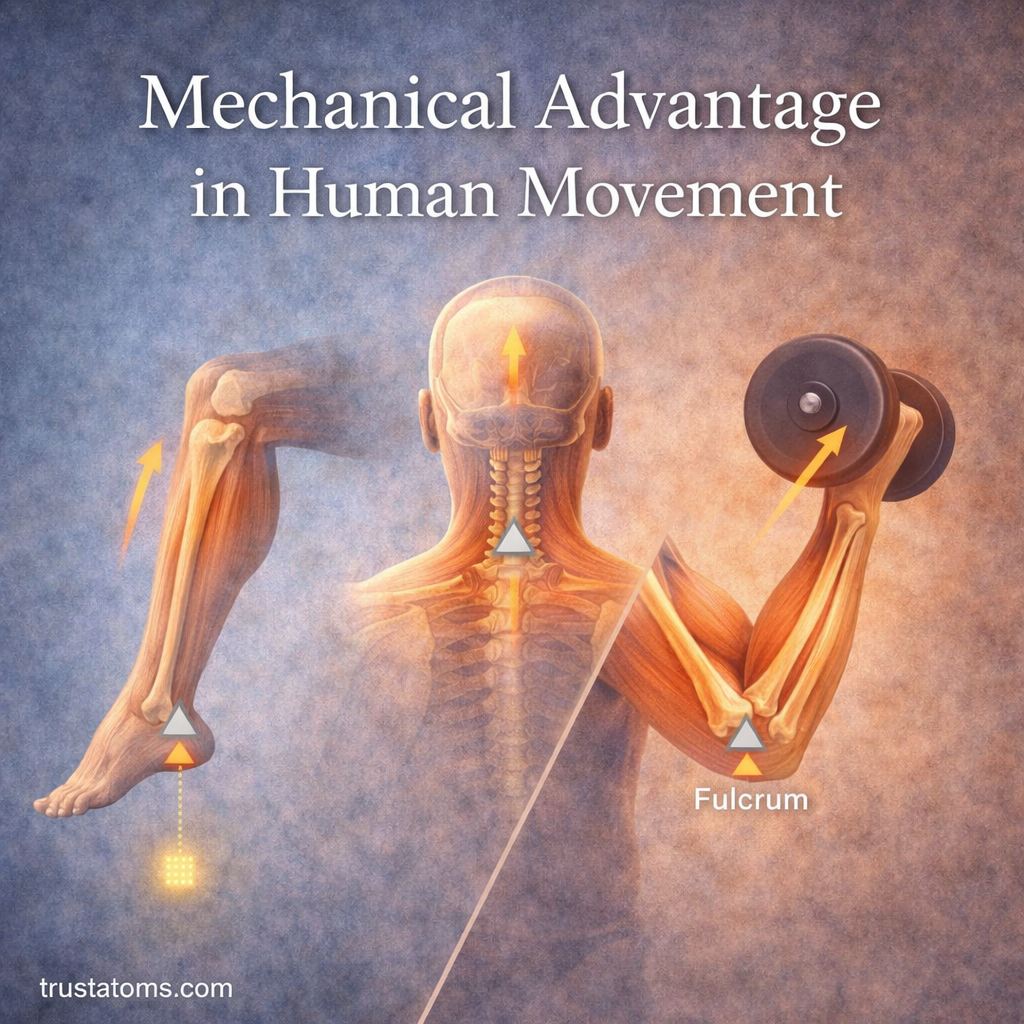
Levers are classified according to the relative positions of the fulcrum, effort, and resistance. The human body uses all three classes, although third-class arrangements are particularly common in limb movements.
| Lever Class | Arrangement | Body Example | Mechanical Effect |
|---|---|---|---|
| First-class | Fulcrum between effort and resistance | Head balancing at the neck | Can favor force or movement depending on moment arms |
| Second-class | Resistance between fulcrum and effort | Rising onto the toes | Typically provides a force advantage |
| Third-class | Effort between fulcrum and resistance | Elbow flexion with the biceps | Typically favors movement distance and speed |
First-Class Levers: Balancing the Head
In a first-class lever, the fulcrum lies between the applied effort and resistance. The joint between the skull and the first cervical vertebra provides an example when the head is balanced or tilted.
The head’s weight acts on one side of the pivot, while neck muscles produce opposing torque. Mechanical advantage depends on the relative moment arms rather than the lever class alone.
Second-Class Levers: Rising Onto the Toes
When standing on the toes, the ball of the foot can act as a pivot, body weight supplies the resistance, and the calf muscles apply effort through the Achilles tendon.
In this simplified arrangement, the resistance lies between the pivot and effort. The longer effort arm provides a force advantage that helps raise the body.
Third-Class Levers: Bending the Elbow
During a biceps curl, the elbow acts as the fulcrum, the biceps applies force close to the joint, and the load is located farther along the forearm.
Because the effort moment arm is shorter than the resistance moment arm, the muscle must generate considerable force. In exchange, a small shortening of the muscle can produce a larger displacement of the hand.
Why the Human Body Often Favors Speed Over Force
Many muscles attach close to the joints they move, creating relatively short effort moment arms. This arrangement often produces a mechanical disadvantage for force but allows the distal parts of the limbs to travel through larger distances.
For example, a small movement near the elbow can create a much larger movement at the hand. This supports activities such as reaching, throwing, and manipulating objects.
A force disadvantage does not mean that movement is inherently inefficient. Ideal levers exchange force for displacement rather than creating additional energy. The relationship between force, displacement, and energy transfer is examined in Mechanical Work in Human Movement.
Mechanical Advantage in Everyday Movements

Mechanical advantage changes as the body moves because joint angles and the lines of action of forces change. This means the same object can place different demands on muscles depending on its position.
- Carrying groceries: Holding a bag farther from the elbow increases its resistance moment arm and the torque that elbow muscles must oppose.
- Squatting: Changes in trunk, hip, knee, and ankle positions alter external moment arms and distribute muscular demands differently.
- Reaching: Extending an arm increases the distance between the shoulder and the hand, changing the torque required to support an object.
- Running: Joint positions, muscle forces, and ground reaction forces combine to produce propulsion and control landing.
How Joint Position Changes Mechanical Advantage
Moment arms are measured perpendicular to a force’s line of action, not simply along the length of a bone. As a joint rotates, the angle between a muscle’s tendon and the bone changes, often altering the muscle’s effective leverage.
External resistance also changes with position. When holding a dumbbell, the gravitational torque about the elbow is generally greatest when the forearm is horizontal and smaller when the weight is positioned nearly directly above or below the joint.
Muscle strength itself varies with joint angle because muscle length and contraction conditions change. Therefore, the position with the greatest mechanical advantage is not necessarily the position where a person can produce the greatest total joint torque.
Applying Mechanical Advantage to Lifting and Exercise
Understanding lever mechanics can help explain exercise difficulty and guide movement choices. Practical applications include:
- Keeping a carried load closer to the body when appropriate to reduce external moment arms.
- Using controlled movement and suitable resistance when learning unfamiliar exercises.
- Recognizing that longer limbs and different body proportions can change lifting mechanics.
- Adjusting exercise technique to match mobility, strength, and task requirements.
Reducing an external moment arm can decrease the torque required at a joint, but no single posture guarantees injury prevention. Tissue capacity, fatigue, movement history, and total training load also influence injury risk.
Frequently Asked Questions
What does mechanical advantage mean in human movement?
Mechanical advantage describes how the arrangement of a joint, muscle force, and resistance affects the force required to move or support a load. It depends on the ratio between effort and resistance moment arms.
Why do muscles often need more force than the weight being lifted?
Many muscles attach close to a joint, giving them short moment arms. When a load acts farther from the joint, the muscle must generate greater force to produce an opposing torque.
Does greater mechanical advantage always mean better movement?
No. Greater mechanical advantage reduces the effort force needed for a given resistance, but lower mechanical advantage can provide greater movement distance and speed. The most useful arrangement depends on the task.
Mechanical advantage explains why the same muscle can face different demands as joint angles and load positions change. Second-class levers commonly provide force advantages, while third-class levers trade force for greater movement distance and speed. Understanding these relationships makes it easier to interpret everyday actions such as carrying objects, bending the elbow, and rising onto the toes.
This article is for general education and is not medical advice. Talk to a qualified health professional about any medical concern.
Sources: Neumann, Kinesiology of the Musculoskeletal System: Foundations for Rehabilitation; Hall, Basic Biomechanics; OpenStax, Anatomy and Physiology 2e.