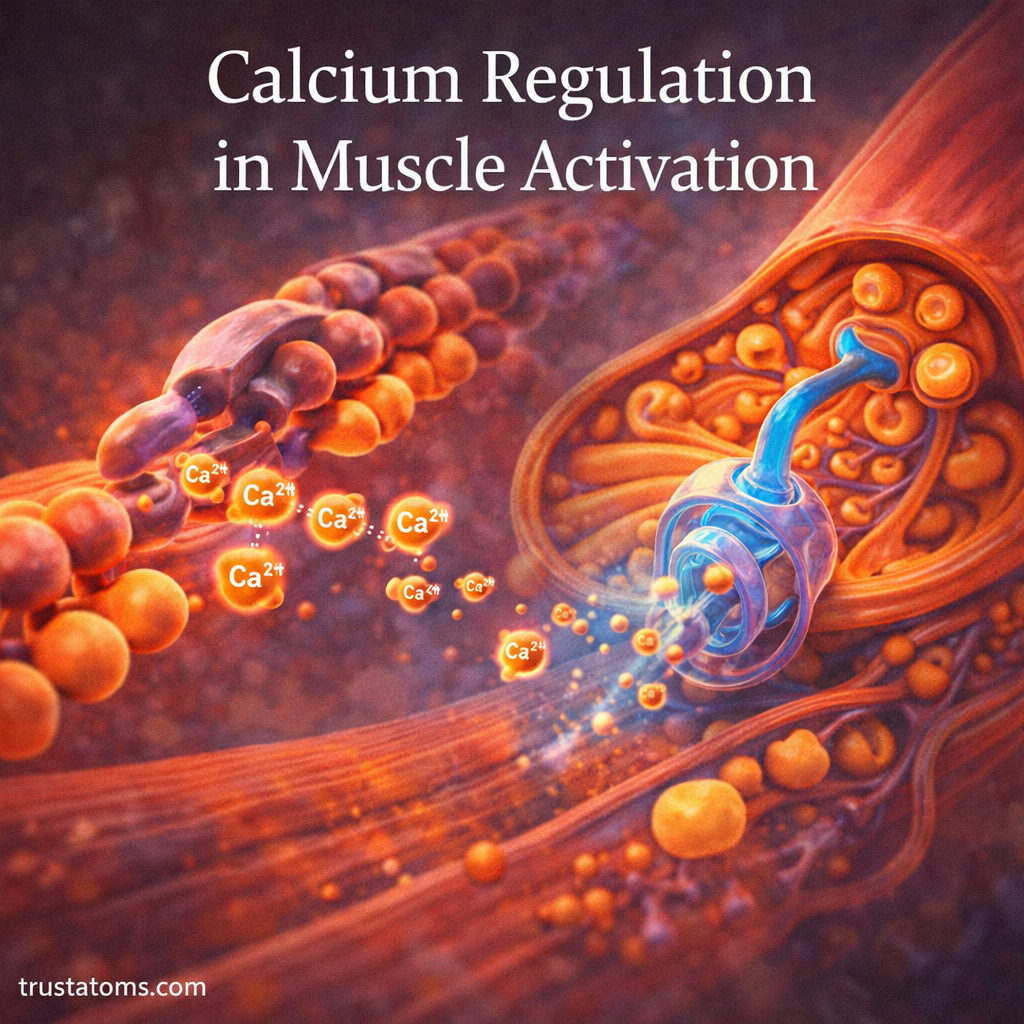
Calcium plays a central role in how muscles contract and relax. While ATP provides the energy for movement, calcium ions (Ca²⁺) act as the key signal that starts and stops muscle activity.
Understanding calcium regulation helps explain how your body controls muscle activation with precision, speed, and coordination.
What Is Calcium’s Role in Muscles?
Calcium ions act as a trigger for muscle contraction.
When calcium is released inside a muscle cell:
- It enables interaction between muscle proteins
- It allows contraction to begin
- It helps regulate the timing of muscle activity
Without calcium, muscles cannot contract—even if ATP is available.
Where Is Calcium Stored?
Calcium is stored inside muscle cells in a specialized structure called the:
Sarcoplasmic Reticulum (SR)
- A network surrounding muscle fibers
- Acts as a calcium storage and release system
- Keeps calcium levels tightly controlled
At Rest
- Calcium is stored inside the SR
- Muscle remains relaxed
How Muscle Activation Begins
Muscle contraction starts with a signal from the nervous system.
Step-by-Step Process
- A nerve impulse reaches the muscle fiber
- The signal travels along the muscle cell membrane
- The sarcoplasmic reticulum releases calcium
- Calcium floods into the muscle cell
This sudden increase in calcium concentration triggers contraction.
Calcium and the Sliding Filament Mechanism
Calcium directly controls the interaction between actin and myosin, the proteins responsible for muscle contraction.
What Happens When Calcium Is Released?
- Calcium binds to a protein called troponin
- This causes a shift in another protein called tropomyosin
- Binding sites on actin are exposed
- Myosin can attach and pull → contraction occurs
Key Insight
- Calcium does not create force itself
- It enables the contraction process to happen
Calcium and Muscle Relaxation
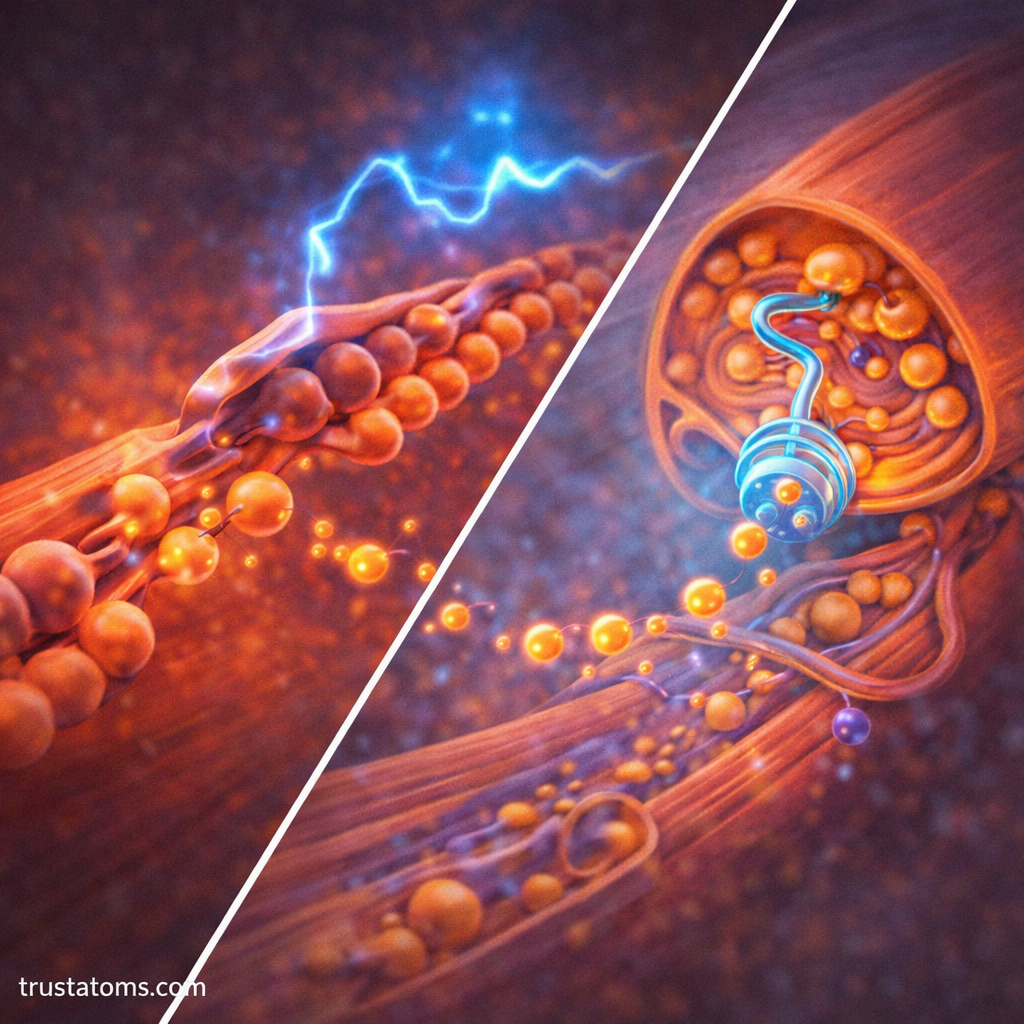
For a muscle to relax, calcium must be removed from the muscle cell.
How Relaxation Works
- Calcium is pumped back into the sarcoplasmic reticulum
- This process requires ATP
- Calcium levels drop inside the muscle cell
Result
- Troponin returns to its original shape
- Tropomyosin blocks binding sites
- Muscle contraction stops
The Importance of Calcium Balance
Calcium levels must be carefully regulated.
Too Much Calcium
- Prolonged contraction
- Muscle stiffness
- Reduced ability to relax
Too Little Calcium
- Weak contractions
- Reduced muscle performance
Balanced Calcium
- Smooth, controlled movement
- Efficient contraction-relaxation cycles
Calcium and Muscle Types
Calcium regulation differs slightly depending on the type of muscle.
Skeletal Muscle
- Voluntary control
- Rapid calcium release and reuptake
- Enables quick, powerful movements
Cardiac Muscle
- Found in the heart
- Calcium also enters from outside the cell
- Supports rhythmic contractions
Smooth Muscle
- Found in organs (e.g., intestines, blood vessels)
- Slower, more sustained calcium signaling
- Supports steady, controlled movements
Calcium and Muscle Fatigue
Calcium regulation can be affected during intense or prolonged activity.
What Happens During Fatigue
- Calcium release may decrease
- Calcium reuptake becomes less efficient
- Muscle contraction strength declines
Result
- Reduced force production
- Slower muscle response
- Increased fatigue
Calcium in Everyday Movement
Calcium regulation allows your body to perform a wide range of movements.
Examples
- Typing or writing → precise calcium control
- Walking → rhythmic calcium cycling
- Lifting weights → strong calcium release
Your body constantly adjusts calcium levels to match the demands of each activity.
Interaction Between Calcium and ATP
Calcium and ATP work together closely in muscle function.
Their Roles
- Calcium → triggers contraction
- ATP → powers contraction and relaxation
Without ATP
- Calcium cannot be pumped back into storage
- Muscles remain contracted
Without Calcium
- Contraction cannot begin
Common Misconceptions
“Calcium only affects bones”
False.
- Calcium is essential for muscle function, nerve signaling, and more
“Calcium directly creates movement”
Not exactly.
- It enables the process, but ATP provides the energy
Why Calcium Regulation Matters
Understanding calcium regulation helps explain:
- How muscles start and stop moving
- Why coordination improves with practice
- How fatigue impacts performance
- The link between nervous system signals and muscle action
Final Thoughts
Calcium is the key signal that controls muscle activation. By regulating when calcium is released and reabsorbed, the body ensures muscles contract and relax efficiently.
This precise control allows for everything from delicate movements to powerful actions, making calcium regulation one of the most important processes in human anatomy.