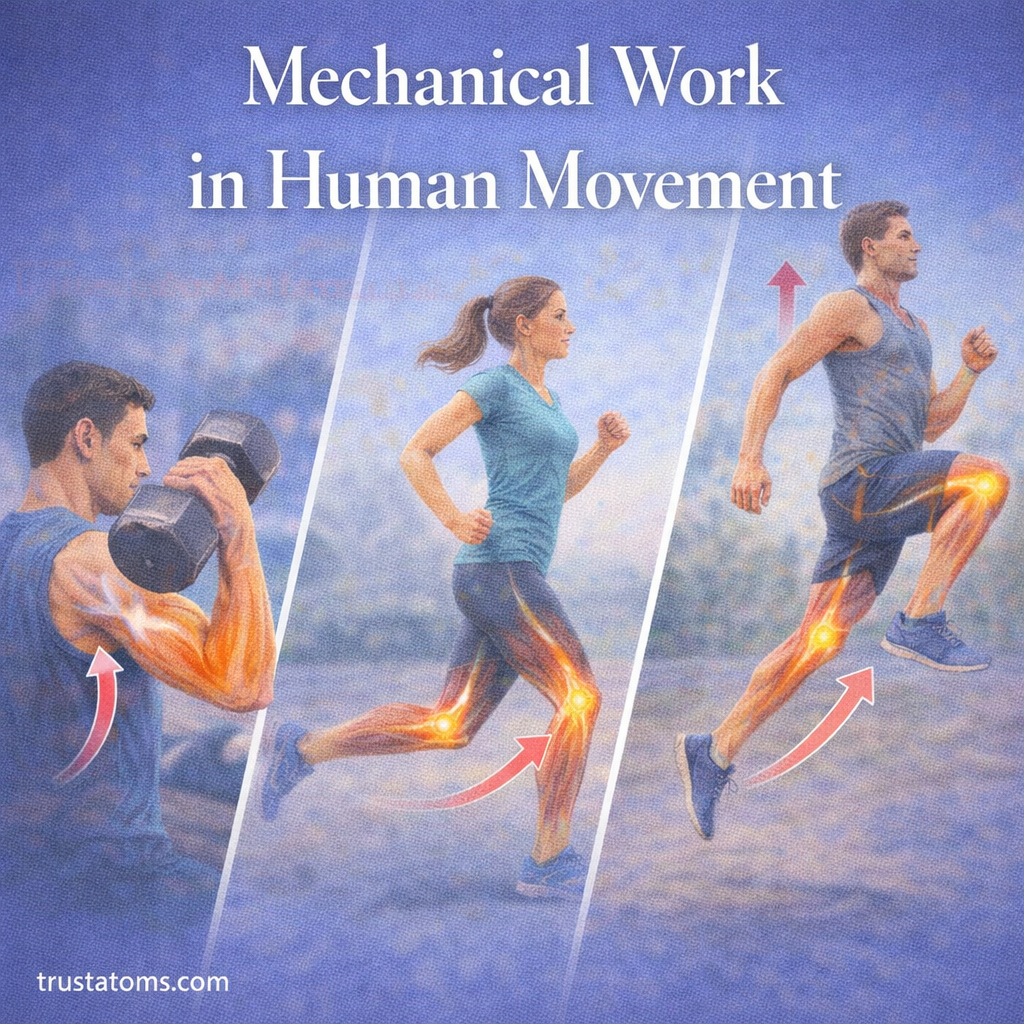
Mechanical work in human movement occurs when a force acts through a displacement, transferring energy as the body lifts, lowers, pushes, or moves objects. Muscles generate forces that act through bones and joints, producing positive or negative mechanical work depending on the direction of force relative to movement.
Understanding mechanical work connects physics with human anatomy and helps explain why lifting a weight, lowering it slowly, and holding it still have different mechanical effects. It also provides a way to compare movement demands using force, distance, and energy.
What Is Mechanical Work?
In physics, mechanical work is the energy transferred when a force acts through a displacement. For a constant force, work equals the force multiplied by the displacement in the direction of that force.
Work = Force × Displacement × cos(angle between force and displacement)
When force and displacement point in the same direction, the equation simplifies to force multiplied by distance. Force is measured in newtons (N), displacement in meters (m), and work in joules (J). One joule equals one newton-meter.
Work is different from torque, which describes the turning effect of a force around a joint. The relationship between muscle force, joint rotation, and moment arms is explored in Torque Production at Joints.
Movement also depends on tissue properties and joint mobility. Elasticity and viscoelasticity in tendons explain how connective tissues store and release energy, while Range of Motion and Flexibility describes how far joints can move.
How Mechanical Work Applies to the Human Body
Muscles produce tension by using chemical energy from ATP. That tension acts through tendons on bones, creating forces and torques that move body segments or resist external loads.
In a biceps curl, the elbow acts as a pivot, the forearm functions as a lever, and the biceps generates torque. The position of the muscle attachment relative to the load affects the required force. This relationship is explained further in Mechanical Advantage in Human Movement.
Mechanical work can be measured at different levels: work done by a muscle-tendon unit, work at a joint, or work done on the body or an external object. These quantities are related but are not always equal because several muscles and joints may contribute to the same movement.
Calculating Work When Lifting a Weight
Consider lifting a 10-kilogram dumbbell vertically through 0.5 meters at a steady speed. Near Earth’s surface, its weight is approximately 98 newtons because gravitational acceleration is about 9.8 meters per second squared.
The mechanical work done against gravity is:
Work = 98 N × 0.5 m = 49 J
The dumbbell gains approximately 49 joules of gravitational potential energy. This calculation assumes that the starting and ending speeds are equal and ignores additional movement of the arm and other body segments.
Lowering the same dumbbell slowly through 0.5 meters reverses the direction of displacement. Gravity then performs positive work, while the upward force controlling the descent performs approximately 49 joules of negative work on the dumbbell.
Positive, Negative, and Zero Mechanical Work
The sign of mechanical work depends on the relationship between force and displacement. In muscle mechanics, different contraction types commonly produce different work patterns.
| Work Type | Force and Movement | Typical Example |
|---|---|---|
| Positive work | Force acts in the direction of displacement | Muscles raising a dumbbell |
| Negative work | Force opposes displacement | Muscles controlling a dumbbell’s descent |
| Zero external work | No displacement occurs at the point of force application | Holding a dumbbell stationary |
Concentric Contractions and Positive Work
During a concentric contraction, an actively producing-force muscle shortens. When its force drives movement in the same direction, the muscle performs positive mechanical work. Raising the body from a squat is a common example.
Eccentric Contractions and Negative Work
During an eccentric contraction, an active muscle lengthens while resisting an external force. The muscle absorbs mechanical energy, as occurs when controlling the downward phase of a squat.
Isometric Contractions and Energy Use
During an ideal isometric contraction, muscle length remains constant. A person holding a weight motionless performs no external mechanical work on that stationary weight, but the muscles still consume metabolic energy to maintain force.
How Muscles Obtain Energy for Mechanical Work
Muscle contraction depends directly on ATP, a molecule that supplies energy for interactions between actin and myosin and for other cellular processes. Because stored ATP is limited, muscles continually regenerate it.
- Phosphocreatine: Helps regenerate ATP rapidly during short, intense activity.
- Carbohydrates: Glucose and stored glycogen supply energy through glycolysis and aerobic metabolism.
- Fats: Fatty acids provide substantial energy during sustained activity, especially when oxygen availability is adequate.
Only part of the chemical energy used by muscles becomes external mechanical work. The remainder contributes to heat production and other cellular processes. This is why muscular effort can increase body temperature even during activities that involve little visible movement.
Levers in the Human Body
Bones and joints form lever systems that transmit muscle forces. A lever includes a pivot or fulcrum, an applied effort, and a resistance. The positions of these elements determine the lever class.
- First-class lever: The fulcrum lies between effort and resistance, as in balancing the head at the neck.
- Second-class lever: Resistance lies between fulcrum and effort, as in a simplified model of rising onto the toes.
- Third-class lever: Effort lies between fulcrum and resistance, as in elbow flexion with the biceps.
These arrangements change the relationship between muscle force and movement distance. A detailed comparison appears in Biomechanics of Levers in the Body.
Mechanical Work in Everyday Activities
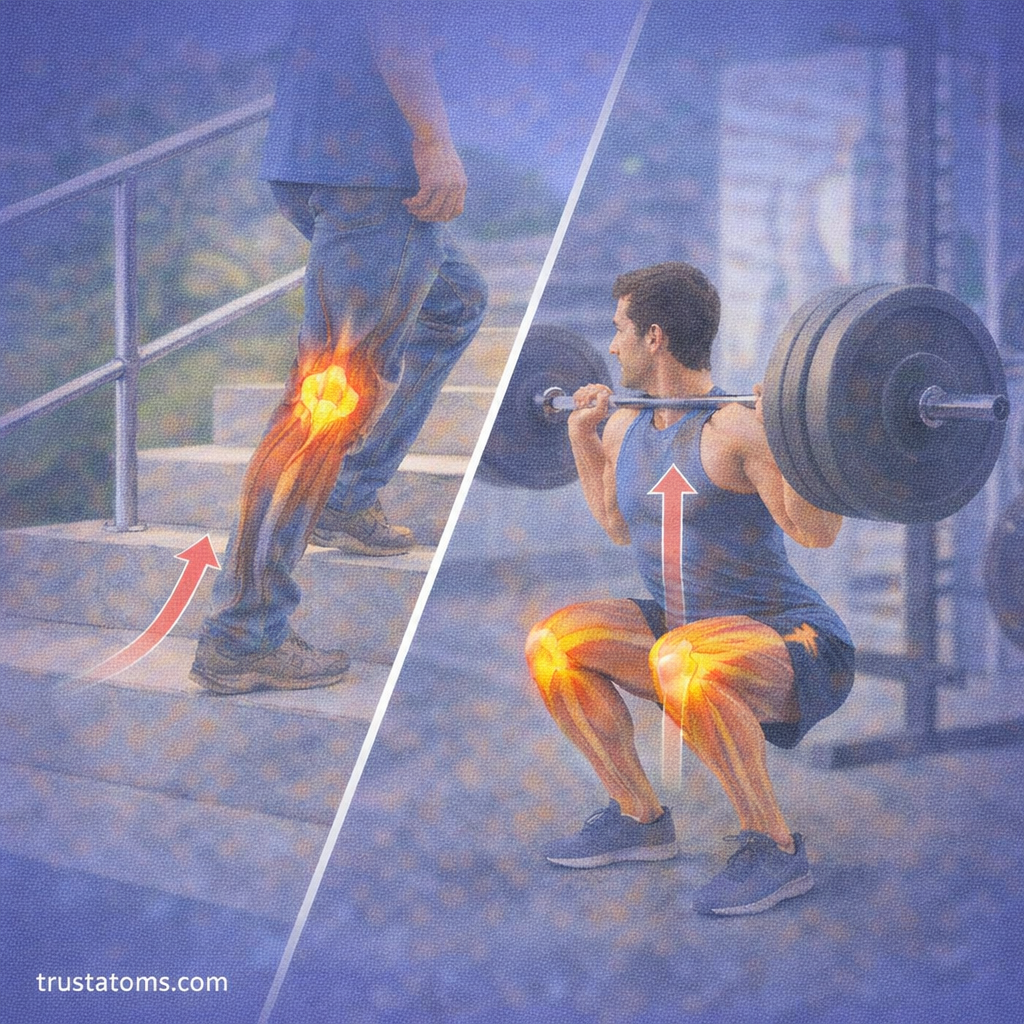
Mechanical work can be observed in activities involving changes in height, speed, or the position of an external load.
- Climbing stairs: Muscles perform net positive work to raise the body’s center of mass against gravity.
- Descending stairs: Muscles absorb energy while controlling the body’s downward movement.
- Walking: Muscles and tendons exchange energy as the limbs move and the body’s center of mass changes position.
- Jumping: Muscles generate positive work during takeoff and absorb energy during landing.
Carrying a heavy bag horizontally at constant height illustrates an important distinction. The upward force supporting the bag is perpendicular to its horizontal displacement, so that force performs no mechanical work on the bag in the idealized calculation. The person still expends metabolic energy while walking.
Mechanical Work, Power, and Efficiency
Work measures energy transfer, while power measures how quickly work is performed. Average mechanical power equals work divided by time and is measured in watts.
For example, performing 100 joules of work in two seconds produces an average power output of 50 watts. Performing the same work in one second produces 100 watts. The total work is unchanged, but the power differs.
Mechanical efficiency compares useful mechanical work with the metabolic energy required. It depends on the activity, contraction conditions, movement technique, and how useful output is defined.
Improving Movement Efficiency and Managing Loads
Training can improve strength, coordination, and the ability to perform a task with consistent technique. Practical strategies include using suitable resistance, progressing gradually, and keeping external loads close to the body when appropriate.
Movement technique changes joint torques and the distribution of work among muscles. However, greater efficiency does not automatically prevent injury. Training volume, recovery, tissue capacity, and individual anatomy also influence physical demands.
Frequently Asked Questions
What is the formula for mechanical work?
For a constant force, mechanical work equals force multiplied by displacement and the cosine of the angle between them. When force and displacement point in the same direction, work equals force multiplied by distance.
Does holding a weight still count as mechanical work?
Holding a stationary weight involves no external mechanical work on the weight because it does not move. However, muscles continue consuming energy to maintain tension, so the activity can still cause fatigue.
What is the difference between mechanical work and power?
Mechanical work measures the energy transferred by a force through displacement, expressed in joules. Power measures the rate of that energy transfer, expressed in watts. The same amount of work can require different power outputs depending on how quickly it is completed.
Mechanical work connects muscle force with the displacement of body segments and external loads. Raising an object requires positive work against gravity, while controlled lowering involves negative work that absorbs energy. Distinguishing work from muscular effort and power helps explain how the body uses energy during lifting, walking, and exercise.
This article is for general education and is not medical advice. Talk to a qualified health professional about any medical concern.
Sources: Hall, Basic Biomechanics; Neumann, Kinesiology of the Musculoskeletal System: Foundations for Rehabilitation; OpenStax, University Physics Volume 1.