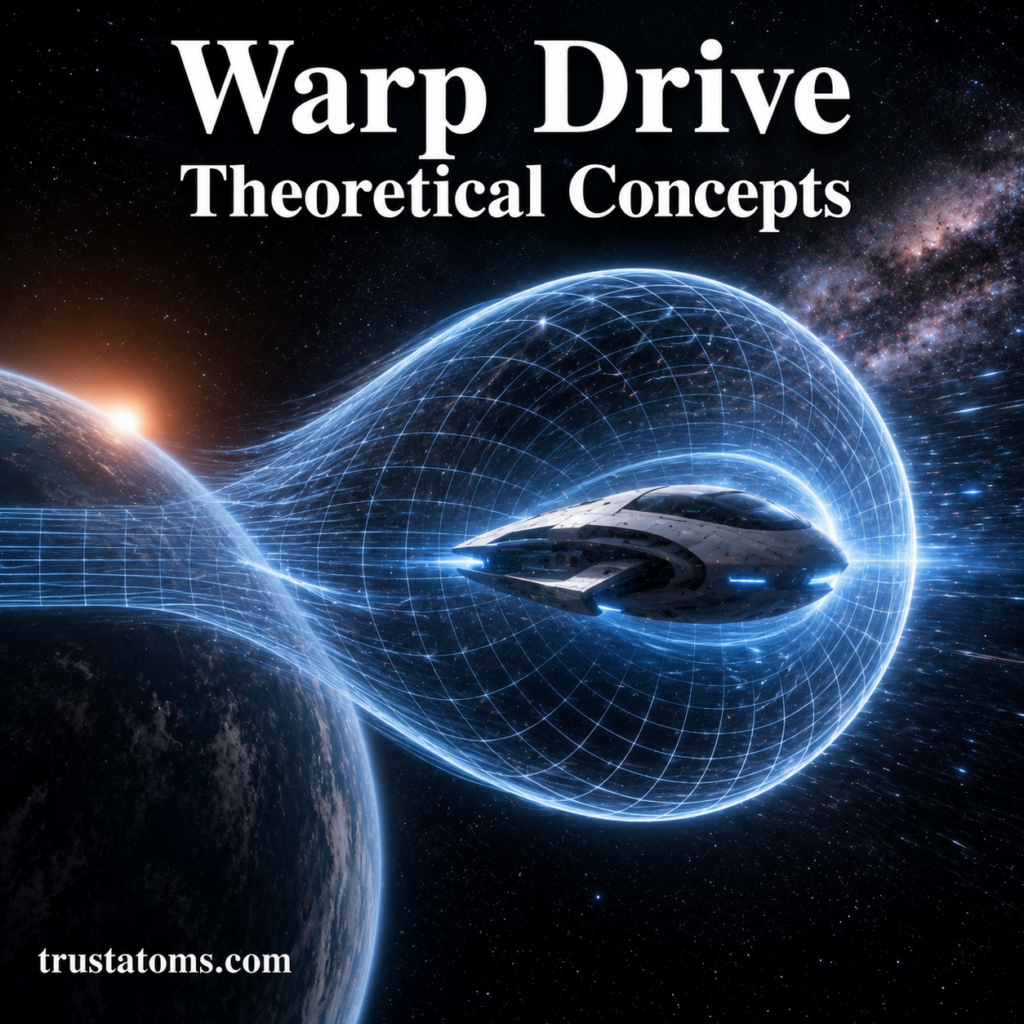
A warp drive is a hypothetical propulsion concept that would distort spacetime around a spacecraft, potentially allowing it to cover enormous distances without locally traveling faster than light. Although general relativity permits mathematical models of such distortions, no working warp drive exists, and major problems involving energy, stability, and causality remain unresolved.
Warp drives are best understood as theoretical investigations rather than technologies awaiting construction. They connect ideas from relativity, quantum physics, and modern astronomy while testing what the known laws of physics might permit under extreme conditions.
What Is a Warp Drive?
A warp drive would attempt to change the geometry of spacetime surrounding a spacecraft instead of accelerating the spacecraft through space using conventional propulsion.
In the best-known model, spacetime contracts ahead of a hypothetical spacecraft and expands behind it. The spacecraft occupies a region called a warp bubble, where its immediate surroundings could remain approximately flat.
The proposed distinction is between motion through nearby space and the changing geometry of spacetime itself. General relativity allows spacetime distances to change in ways that do not correspond to an ordinary object locally exceeding light speed.
However, describing a possible geometry mathematically does not establish that the required matter, energy, or engineering methods can exist.
Why Faster-Than-Light Travel Is Difficult
Einstein’s special theory of relativity establishes that light travels through a vacuum at approximately 299,792 kilometers per second. Objects with mass cannot be accelerated to this speed by ordinary means.
As a massive object approaches light speed, its kinetic energy increases without limit. Reaching light speed would therefore require an unbounded amount of energy under the equations of special relativity.
Even travel at a substantial fraction of light speed presents extraordinary engineering challenges involving propulsion, fuel, radiation exposure, and collisions with interstellar particles.
These practical obstacles are examined further in Interstellar Travel Physics Challenges.
A Concrete Example: Traveling to Proxima Centauri
Proxima Centauri, the nearest known star to the Sun, is approximately 4.24 light-years away. Even a spacecraft traveling at 10% of light speed would require about 42 years to cover that distance, ignoring acceleration and deceleration.
A hypothetical warp bubble with an effective travel speed exceeding light speed could shorten the journey dramatically. This is a mathematical possibility explored in certain models, not a demonstrated capability or a realistic mission estimate.
How the Alcubierre Warp Drive Works
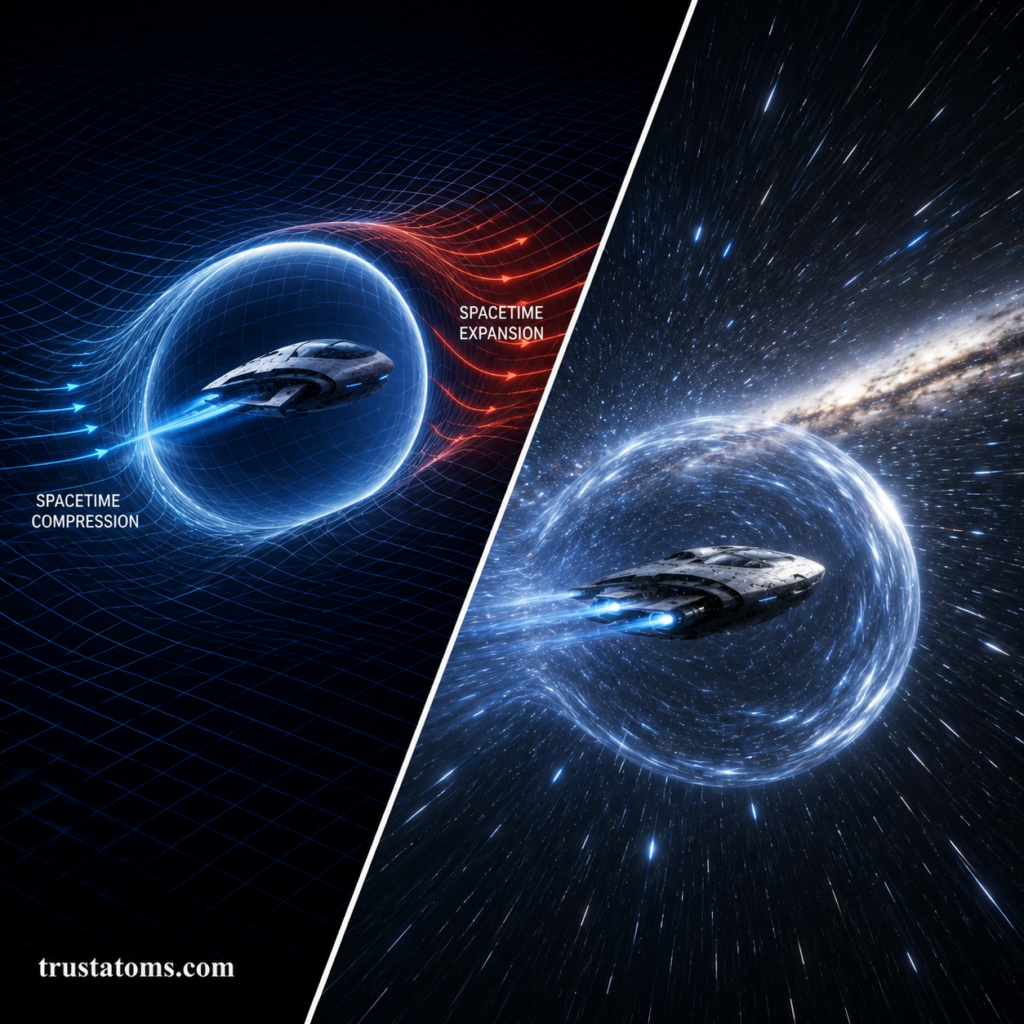
In 1994, physicist Miguel Alcubierre published a theoretical spacetime geometry describing a warp bubble capable of apparent faster-than-light travel relative to distant observers.
His proposal used Einstein’s field equations, which relate the curvature of spacetime to the distribution of matter and energy.
The model describes three important regions:
- Inside the bubble: A region where the spacecraft could remain approximately at rest relative to its immediate surroundings.
- At the bubble boundary: Strong spacetime distortions associated with the proposed motion.
- Outside the bubble: Distant regions used to describe the bubble’s overall displacement.
The familiar description of space contracting ahead and expanding behind summarizes the geometry, but it should not be interpreted as a conventional engine pushing against space.
Alcubierre’s work established a mathematical construction. It did not identify a physical mechanism capable of creating or controlling the required spacetime distortion.
What Would Traveling Inside a Warp Bubble Be Like?
In an idealized Alcubierre model, a spacecraft near the bubble’s center would not need to accelerate locally to faster-than-light speeds. This suggests that occupants might avoid some acceleration effects associated with conventional high-speed travel.
That does not establish that a real spacecraft would experience a comfortable journey. The model does not solve the problems of generating the bubble, controlling its motion, or protecting its occupants.
Some analyses also identify horizons around superluminal warp bubbles. These could prevent signals from traveling between certain regions, complicating attempts to steer or stop the bubble from inside.
Exotic Matter and Negative Energy
One of the most serious difficulties with the original Alcubierre drive is its requirement for negative energy density in parts of the warp bubble.
Ordinary matter has positive energy density. Negative energy density is a more specialized concept that can arise in certain quantum-field descriptions relative to an appropriate reference state.
The original warp-drive geometry violates standard energy conditions used in general relativity. These conditions describe restrictions satisfied by many familiar forms of matter and radiation.
Quantum theory permits limited situations involving negative energy, but that does not mean researchers can accumulate or manipulate it in the quantities and configurations required for a warp drive.
Could the Casimir Effect Provide Negative Energy?
The Casimir effect is a measurable quantum phenomenon involving changes in electromagnetic vacuum behavior between closely spaced conducting surfaces.
In suitable theoretical descriptions, the associated vacuum energy can be negative relative to a reference configuration. However, the effect occurs under highly constrained conditions and does not provide a demonstrated source of usable warp-drive energy.
Quantum inequalities also restrict the magnitude and duration of negative energy in many physical settings, creating additional difficulties for proposed warp geometries.
Is Negative Energy the Same as Dark Energy?
No. Dark energy is the name given to the unknown component associated with the observed accelerated expansion of the universe. It is not an established reservoir of negative energy density suitable for spacecraft propulsion.
Different explanations for cosmic acceleration are discussed in Dark Energy Theories, but none provides a demonstrated method for powering a warp bubble.
The Enormous Energy and Engineering Problem
Early analyses of warp drives identified extremely demanding energy requirements. The estimated quantities depend strongly on assumptions about bubble size, wall thickness, speed, and spacetime geometry.
Researchers have proposed modified configurations that reduce some calculated requirements. However, lowering a theoretical energy estimate is not equivalent to demonstrating a physically achievable propulsion system.
Several challenges remain unresolved:
- Producing the necessary distribution of energy and momentum.
- Creating a bubble without requiring impossible initial conditions.
- Controlling its direction, speed, and termination.
- Maintaining stability under realistic physical disturbances.
- Protecting the spacecraft from potentially hazardous radiation.
None of these problems has a verified engineering solution. There is also no experimental evidence that a controllable warp bubble has ever been produced.
Causality and Time Paradoxes
Causality is the principle that physical causes precede their effects. Faster-than-light signaling creates difficulties because observers moving relative to one another can disagree about the time order of sufficiently separated events.
Under some hypothetical arrangements, faster-than-light travel or communication could permit closed causal paths, raising the possibility of information returning to an earlier time.
These concerns arise from the mathematical structure of relativity, not simply from the engineering difficulty of reaching high speeds.
Understanding Space-Time Curvature helps explain how gravity and geometry influence the paths followed by matter and light.
Related effects, including the different rates at which clocks can run, are examined in Time Dilation in Relativity.
Whether a consistent physical theory would permit controllable superluminal warp travel without causal contradictions remains unresolved.
Radiation, Horizons, and Warp Bubble Stability
Even if the required spacetime geometry could be created, interactions between a moving bubble and surrounding particles could introduce additional hazards.
Some theoretical studies suggest that particles or radiation might become concentrated near parts of a warp bubble. Under particular assumptions, this could produce intense radiation when the geometry changes.
Other analyses investigate quantum effects near horizons associated with superluminal bubbles, including potentially destabilizing radiation.
These results depend on the model being studied. They do not establish that every conceivable warp geometry would behave identically, but they show why a mathematically defined bubble cannot automatically be treated as a safe vehicle.
Quantum Physics and Warp Drives
Warp-drive research sits at the boundary between general relativity and quantum field theory. General relativity describes spacetime geometry, while quantum field theory describes particles and fields at microscopic scales.
Researchers use semiclassical gravity to explore how quantum fields might behave in curved spacetime. This approach treats spacetime classically while incorporating selected quantum effects.
However, physicists do not yet possess an experimentally confirmed theory of quantum gravity that fully unifies these descriptions.
Extreme gravitational configurations also raise questions related to Singularities in Physics, where existing mathematical descriptions may become incomplete. A warp bubble does not inherently require a singularity, but both subjects test the limits of gravitational theory.
Unknown quantum-gravity effects might alter conclusions about unusual spacetime geometries. Nevertheless, the absence of a complete theory is not evidence that warp drives will eventually become possible.
Are There Warp Drive Models Without Negative Energy?
Researchers have explored alternatives to the original Alcubierre geometry, including models intended to satisfy different energy conditions or describe subluminal warp-like motion.
Some proposals show that particular spacetime configurations can be described using positive energy density under specified assumptions.
However, positive-energy models do not automatically provide faster-than-light travel. Other requirements may remain, including unusual stresses, enormous energy concentrations, or matter distributions that cannot be physically constructed.
Claims about new warp-drive solutions therefore require careful distinctions between mathematical consistency, physical plausibility, and experimentally demonstrated propulsion.
Warp Drives Compared With Wormholes
Warp drives and wormholes are different theoretical approaches to shortening journeys across large distances.
| Concept | Proposed Mechanism | Major Difficulty |
|---|---|---|
| Warp drive | Distorts spacetime around a traveling region. | Energy requirements, control, and stability. |
| Traversable wormhole | Connects distant spacetime regions through a hypothetical shortcut. | Maintaining a traversable geometry and satisfying physical constraints. |
| Conventional relativistic spacecraft | Accelerates through space below light speed. | Propulsion energy, travel time, and radiation protection. |
Both warp drives and traversable wormholes appear in theoretical studies of general relativity. Neither has been observed as a practical transportation system.
Conventional spacecraft propulsion is fundamentally different because it relies on established physical processes, even though reaching a significant fraction of light speed remains extremely difficult.
What Would Count as Evidence for a Warp Drive?
A convincing demonstration would require more than a computer simulation or an unusual mathematical solution.
Researchers would need reproducible measurements showing that a physical system generated a controlled spacetime distortion consistent with a clearly defined theoretical prediction.
Independent experiments would then need to verify the effect and rule out ordinary explanations such as electromagnetic interference, measurement errors, or conventional mechanical forces.
Demonstrating useful propulsion would require further evidence that the distortion could be sustained, directed, and safely controlled.
At present, no experiment has met these requirements, and no verified warp-drive propulsion technology exists.
Frequently Asked Questions
Does a warp drive violate Einstein’s theory of relativity?
Not necessarily at the level of mathematical geometry. The original Alcubierre model uses equations from general relativity and does not require a spacecraft to move locally faster than light. However, the model depends on unusual energy conditions and faces unresolved questions about causality and physical realizability.
Has anyone successfully tested a warp drive?
No. Scientists have investigated warp-drive equations, proposed alternative geometries, and studied related quantum effects, but there has been no verified experimental demonstration of a functioning warp bubble or faster-than-light propulsion system.
Could humans build a warp drive in the future?
There is currently no established path to constructing one. The original models require exotic energy distributions, while alternative proposals still face substantial physical and engineering barriers. Future research may clarify which geometries are possible, but it cannot be assumed that a practical warp drive will result.
Warp-drive theory reveals an important distinction between a spacetime geometry that can be written mathematically and a physical system that nature allows engineers to build. The Alcubierre model demonstrates how general relativity can describe apparent faster-than-light displacement, but negative energy, causal consistency, and bubble stability remain formidable obstacles. For now, warp drives are tools for investigating the boundaries of gravitational physics rather than demonstrated methods of interstellar transportation.
Sources: Miguel Alcubierre, “The Warp Drive: Hyper-Fast Travel Within General Relativity” (1994); Michael J. Pfenning and L. H. Ford, “The Unphysical Nature of ‘Warp Drive'” (1997); Alexey Bobrick and Gianni Martire, “Introducing Physical Warp Drives” (2021).