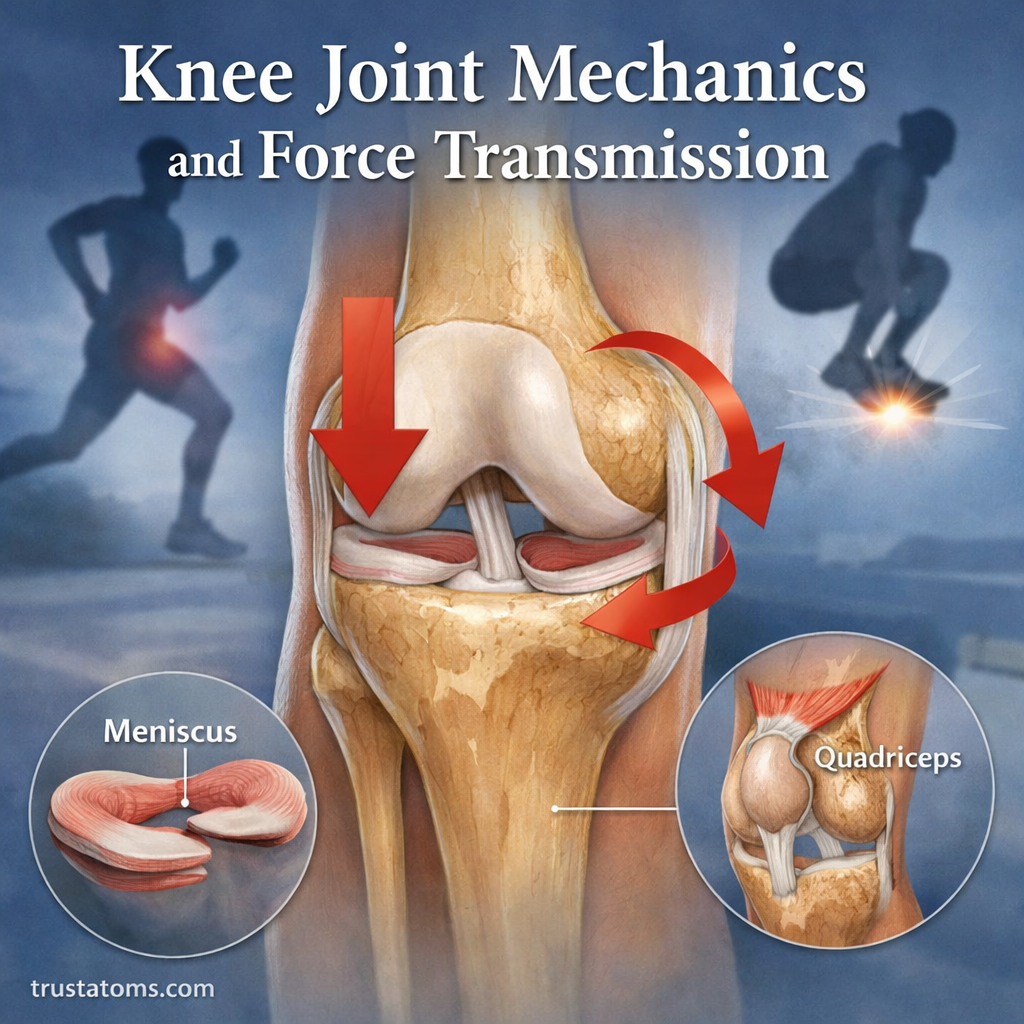
The knee transmits forces between the thigh and lower leg while allowing bending, straightening, and limited rotation. Its bones, cartilage, menisci, ligaments, and muscles work together to distribute loads and control movement during walking, running, squatting, and climbing stairs.
Understanding knee mechanics is an important part of human anatomy because the joint must manage body weight alongside forces generated by muscles and contact with the ground. The way these forces interact helps explain normal movement, athletic performance, and common knee injuries.
Overview of the Knee Joint Structure
The knee is a modified hinge joint connecting three bones: the femur (thigh bone), tibia (shin bone), and patella (kneecap). Its two principal articulations are the tibiofemoral joint, between the femur and tibia, and the patellofemoral joint, between the patella and femur.
The knee belongs to The Appendicular Skeleton, which includes the bones of the limbs and their supporting girdles. Above the knee, the hip provides another major weight-bearing connection, described in Hip Joint Mechanics and Stability.
Structures That Support the Knee
- Articular cartilage: Covers joint surfaces, reduces friction, and distributes contact pressure.
- Medial and lateral menisci: Fibrocartilage structures that increase contact area and help distribute loads.
- Cruciate ligaments: The ACL and PCL limit excessive forward and backward movement of the tibia relative to the femur.
- Collateral ligaments: The MCL and LCL resist excessive sideways forces.
- Muscles and tendons: The quadriceps, hamstrings, and calf muscles produce and control movement.
These structures also influence rotational forces. The mechanical relationship between muscle force, joint position, and rotational leverage is explained in Torque Production at Joints.
How the Knee Moves During Activity
The knee primarily performs flexion and extension. Flexion bends the knee, bringing the lower leg toward the thigh, while extension straightens it.
When flexed, the knee also permits limited internal and external rotation. The femur and tibia undergo coordinated rolling and sliding movements as the joint bends and straightens. Near full extension, a small automatic rotation contributes to the knee’s locking mechanism, improving stability during standing.
These movements depend on joint geometry, ligament tension, and muscle activity. The knee is therefore more mechanically complex than a simple door hinge.
How Forces Travel Through the Knee
During weight-bearing activities, forces pass between the femur and tibia through their contacting surfaces and the menisci. Ground reaction forces act upward through the lower limb, while body weight and muscle forces contribute to the total load experienced by the joint.
The resulting joint contact force is not simply equal to body weight. Muscle contractions can substantially increase compression even when a person is moving slowly or remaining in place.
Compression, Shear, and Torque
- Compression: Forces push joint surfaces together, particularly during standing, walking, and squatting.
- Shear: Forces act parallel to joint surfaces and tend to produce sliding between the femur and tibia.
- Torque: A turning effect produced when a force acts at a distance from a joint axis, requiring muscles to generate opposing moments.
These forces occur together. Their magnitudes and directions change with knee angle, movement speed, muscle activation, and the position of the body’s center of mass.
How Menisci and Cartilage Distribute Pressure
The curved femoral condyles rest on relatively flatter tibial surfaces. The medial and lateral menisci improve the fit between these surfaces, increasing the area over which contact forces are transmitted.
When compressed, the menisci also develop circumferential tension, often called hoop stress. This helps distribute loads rather than concentrating them over a smaller area of cartilage.
Damage to a meniscus can alter this distribution. Removing substantial meniscal tissue generally increases contact stress on the remaining joint surfaces, which may contribute to cartilage deterioration over time.
How the Patella Changes Knee Force Mechanics
The patella sits within the quadriceps tendon and connects to the tibia through the patellar ligament. It increases the effective moment arm of the quadriceps, improving the muscle’s ability to produce knee extension torque.
However, quadriceps tension also creates compressive forces between the patella and femur. These patellofemoral forces change with knee angle and muscle activity, often becoming substantial during stair climbing, squatting, and rising from a chair.
Contact area changes as the knee bends, so greater compression does not always mean proportionally greater pressure at every point. Force distribution depends on both the magnitude of the load and the area supporting it.
Static and Dynamic Knee Stability
Ligaments, joint geometry, and the capsule provide passive resistance to unwanted movement. The ACL, for example, limits excessive forward translation of the tibia, while the PCL resists excessive backward translation.
Muscles provide dynamic stability by adjusting force during movement. The quadriceps help control knee extension, while the hamstrings assist flexion and can influence tibial translation. Calf and hip muscles also affect lower-limb mechanics.
Effective stability depends on coordination between these systems rather than strength alone. Sensory feedback helps the nervous system adjust muscle activation when movement or external forces change unexpectedly.
Load Transmission During Common Activities
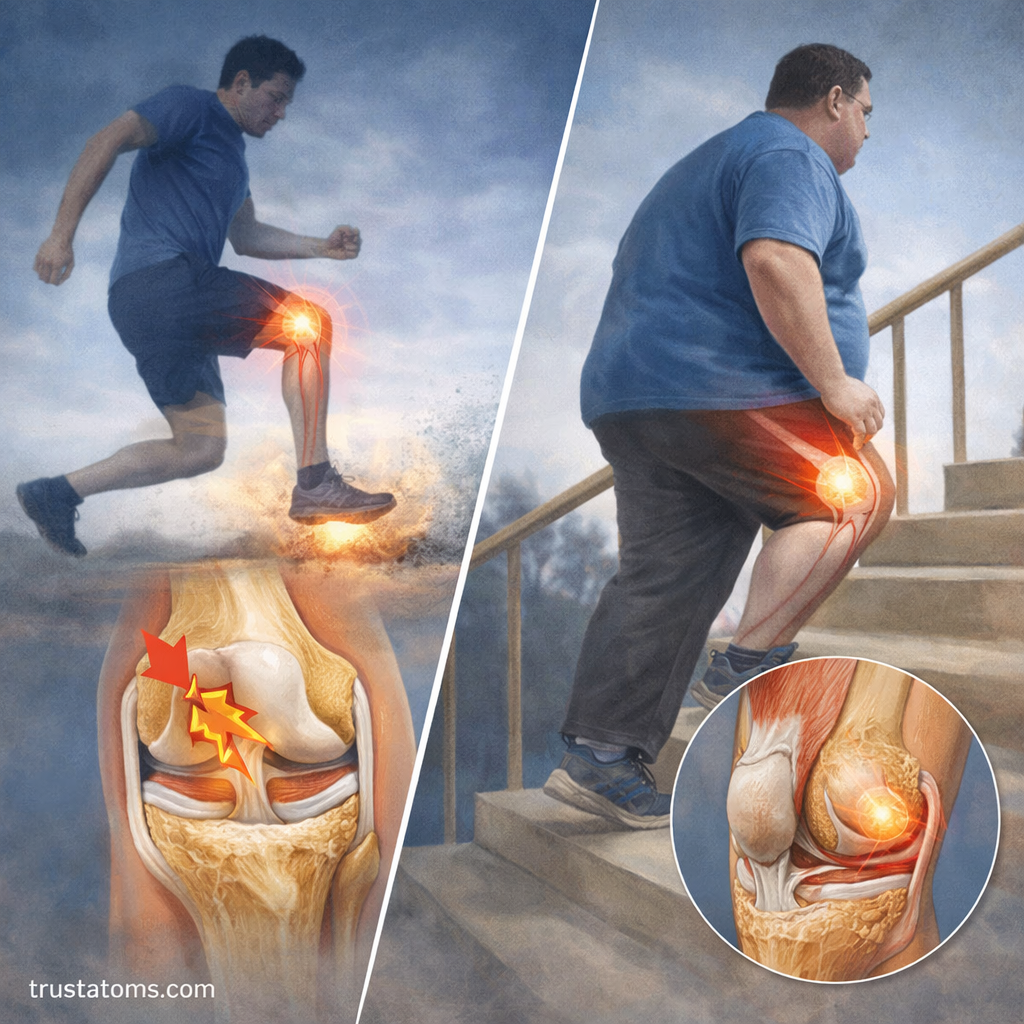
The knee experiences different loading patterns depending on the activity. Movement speed, knee bending angle, and muscle demands all affect how force is transmitted.
| Activity | Mechanical Demands |
|---|---|
| Walking | Alternating loading and unloading with controlled knee flexion and extension. |
| Running | Faster loading, greater muscle demands, and repeated impact absorption. |
| Climbing stairs | Greater knee extensor demand as the body is lifted upward. |
| Descending stairs | Quadriceps control knee bending while lowering body weight. |
| Squatting | Increasing knee flexion changes quadriceps leverage and joint contact forces. |
| Landing | Rapid deceleration requires coordinated action from the knee, hip, and ankle. |
Load transmission also involves the trunk and pelvis. Load Bearing in the Spine explains how the spinal column manages forces through the upper body before they interact with the lower limbs.
Example: Standing Up From a Chair
Imagine standing from a low chair while holding a 5-kilogram backpack. The backpack adds approximately 49 newtons of gravitational force, but the resulting knee contact forces depend on more than this added weight.
As you lean forward and extend your knees, the quadriceps must generate enough torque to help raise your body. A lower chair generally requires greater knee flexion and can increase muscular demands. Moving the trunk forward changes the leverage at the hip and knee, redistributing the effort needed to stand.
Factors That Influence Knee Force Mechanics
Knee loading varies between individuals and activities because of several interacting factors.
- Lower-limb alignment: The orientation of the hip, knee, and ankle affects force distribution between joint compartments.
- Muscle strength and coordination: The quadriceps, hamstrings, and hip muscles influence movement control.
- Movement speed: Faster movements generally require greater rates of force production and absorption.
- Body mass and external loads: Additional weight can increase mechanical demands, although the relationship depends on the activity.
- Fatigue and recovery: Repeated activity may change muscle performance and movement patterns.
Running provides a useful example because stride length, speed, foot placement, and muscle activation all influence lower-limb loading. These interactions are examined in Running Mechanics and Impact Forces.
How Mechanical Stress Contributes to Knee Injuries
Normal mechanical loading is necessary for healthy movement and tissue adaptation. Problems can arise when forces exceed tissue tolerance, especially during sudden injuries or repeated loading without adequate recovery.
- ACL injuries: May occur during rapid deceleration, pivoting, or landing movements that combine several joint forces.
- Meniscal injuries: Can result from twisting under load or gradual tissue degeneration.
- Patellofemoral pain: May be associated with increased loading demands and reduced tolerance of activities involving knee bending.
- Osteoarthritis: Involves changes throughout the joint, influenced by aging, previous injury, genetics, and mechanical factors.
Mechanical stress does not automatically cause damage. The knee is capable of adapting to appropriately progressed activity, and exercise is commonly used to improve strength and functional capacity.
Frequently Asked Questions
Does the knee experience more force than body weight?
Yes. Knee contact forces can exceed body weight because muscle contractions contribute substantially to joint compression. The amount varies with the activity, knee position, movement speed, and individual mechanics.
Why do stairs place greater demands on the knee?
Stair climbing and descending require the quadriceps to generate or control substantial knee extension torque while the joint is bent. This increases muscular demand and can produce considerable tibiofemoral and patellofemoral contact forces.
Do stronger leg muscles reduce knee joint forces?
Not necessarily. Stronger muscles can improve movement control and the ability to tolerate activity, but muscle contractions also contribute to joint compression. Strength training supports knee function without guaranteeing lower forces during every movement.
The knee transfers forces through coordinated contact between bones, cartilage, and menisci while muscles and ligaments guide movement. Its mechanical demands change substantially between walking, running, stair climbing, and landing. Understanding compression, shear, and torque helps explain how the knee supports daily activity and why gradual conditioning matters for long-term function.
This article is for general education and is not medical advice. Talk to a qualified health professional about any medical concern.
Sources: Nordin and Frankel, Basic Biomechanics of the Musculoskeletal System; Neumann, Kinesiology of the Musculoskeletal System: Foundations for Rehabilitation; American Academy of Orthopaedic Surgeons, OrthoInfo.