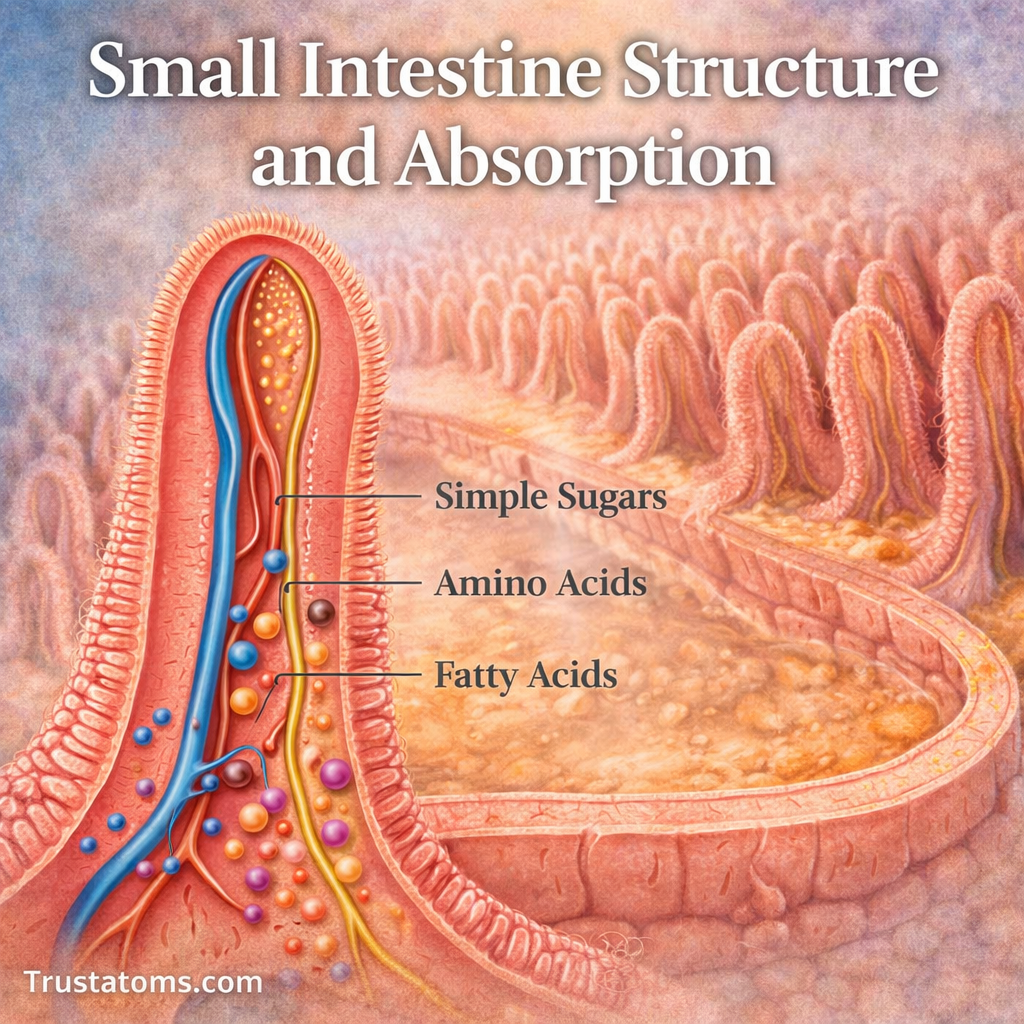
The small intestine is the main site of nutrient absorption, where most digested carbohydrates, proteins, fats, vitamins, and minerals pass from the digestive tract into the body. Its three sections—the duodenum, jejunum, and ileum—work with intestinal folds, villi, and microvilli to complete digestion and efficiently absorb nutrients.
Understanding this process connects human anatomy with the body’s everyday need for energy and nutrients. The small intestine does more than move food along: it breaks down remaining food molecules, selectively transports nutrients, and delivers them to the blood or lymphatic system.
Overview of the Small Intestine
The small intestine is a long, coiled muscular tube connecting the stomach to the large intestine. Its length varies depending on the individual and how it is measured, but it is commonly described as approximately 6 meters (20 feet) long in traditional anatomical references.
Its lining is specialized for both digestion and absorption. Muscular contractions mix intestinal contents with digestive secretions and move material toward the large intestine.
The small intestine performs three major tasks:
- Digestion: Enzymes break large food molecules into smaller components that can be absorbed.
- Absorption: Nutrients, electrolytes, and much of the water entering the intestine cross its epithelial lining.
- Transport: Coordinated muscular movements mix intestinal contents and propel remaining material toward the colon.
The Three Sections of the Small Intestine
Although digestion and absorption occur throughout the small intestine, each region has particular structural and functional characteristics.
Duodenum: Where Chemical Digestion Intensifies
The duodenum is the first and shortest section, measuring approximately 25–30 centimeters in adults. It receives partially digested food, called chyme, from the stomach.
Pancreatic enzymes enter the duodenum to digest carbohydrates, proteins, and fats. Bile, produced by the liver and stored in the gallbladder, helps emulsify fats. Bicarbonate-rich secretions also help neutralize acidic chyme arriving from the stomach.
Jejunum: A Major Site of Nutrient Absorption
The jejunum forms the middle portion of the small intestine. It has prominent folds and numerous villi, making it particularly effective at absorbing sugars, amino acids, lipids, and many other nutrients.
Ileum: Specialized Absorption and Immune Protection
The ileum is the final section, connecting to the large intestine through the ileocecal valve. It absorbs remaining nutrients and is especially important for recovering bile salts and absorbing vitamin B12 bound to intrinsic factor.
The ileum also contains lymphoid tissue, including Peyer’s patches, which helps monitor microorganisms and other material within the intestinal tract.
Structural Features That Maximize Absorption
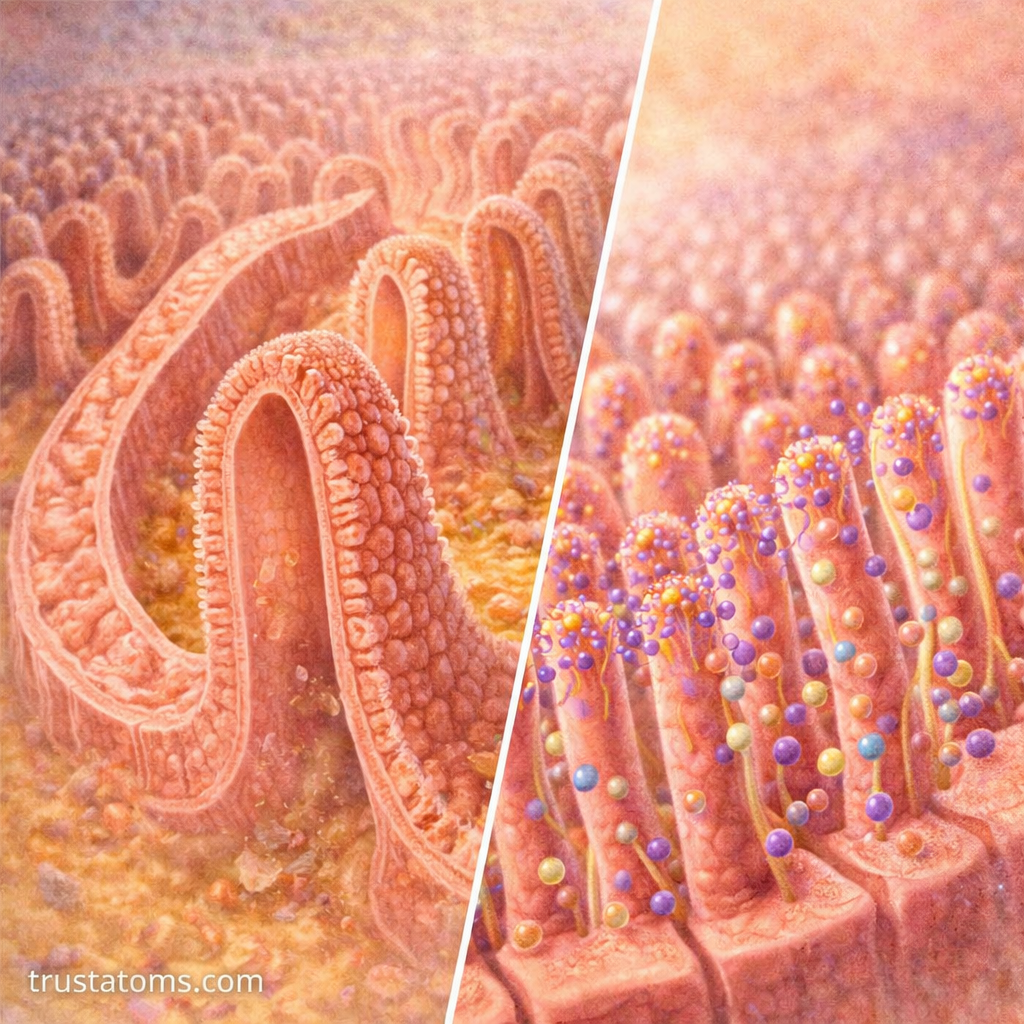
The intestinal lining is not smooth. Structural features like villi and microvilli maximize surface area. Three levels of folding allow extensive contact between digested food and absorptive cells.
Circular Folds
Circular folds, or plicae circulares, are large, permanent ridges involving the mucosa and submucosa. They increase the exposed surface and help mix intestinal contents as they move through the digestive tract.
Villi
Villi are tiny, finger-like projections extending into the intestinal lumen. Each contains blood capillaries and a central lymphatic vessel called a lacteal, providing routes for absorbed nutrients to leave the intestinal lining.
Microvilli and the Brush Border
Microvilli are microscopic extensions of the absorptive epithelial cells, called enterocytes. Together they form the brush border, which contains digestive enzymes and transport proteins that help complete digestion and move nutrients into cells.
These structures also support micronutrient absorption, because vitamins and minerals often require specific transporters or chemical conditions to cross the intestinal lining.
How Nutrient Absorption Works
Absorption begins after food has been broken into molecules small enough to cross the intestinal epithelium. The route depends on the nutrient’s chemical properties and the transport mechanisms available.
- Chyme enters: Partially digested food moves from the stomach into the duodenum.
- Digestion continues: Pancreatic and intestinal enzymes break food into absorbable components.
- Nutrients reach the epithelium: Mixing movements bring dissolved nutrients into contact with absorptive cells.
- Transport occurs: Nutrients cross cell membranes through specialized carriers, diffusion, or other mechanisms.
- Circulation distributes nutrients: Absorbed substances enter blood capillaries or lymphatic vessels, depending on their type.
The different nutrient absorption pathways into blood explain why glucose and amino acids reach the liver through portal circulation, while most long-chain dietary fats initially travel through lymph.
How Different Nutrients Are Absorbed
| Nutrient | Absorbed Form | Main Transport Route |
|---|---|---|
| Carbohydrates | Monosaccharides such as glucose | Blood capillaries |
| Proteins | Amino acids and small peptides | Primarily blood capillaries after cellular processing |
| Long-chain fats | Fatty acids and monoglycerides, repackaged into chylomicrons | Lymphatic lacteals |
| Water-soluble vitamins | Individual vitamin molecules | Generally blood capillaries |
| Fat-soluble vitamins | Vitamins A, D, E, and K | Usually transported with dietary lipids through lymph |
For example, after eating a meal containing bread, eggs, and olive oil, the small intestine handles each component differently. Starch from bread becomes absorbable sugars, egg proteins are broken into amino acids and small peptides, and much of the olive oil’s fat is packaged into chylomicrons before entering intestinal lymphatic vessels.
Enzymes in the Small Intestine
Most nutrients cannot be absorbed efficiently until digestive enzymes reduce them to smaller molecules. These enzymes come primarily from the pancreas and the intestinal brush border.
- Pancreatic amylase: Breaks starch into smaller carbohydrates.
- Pancreatic proteases: Break proteins into smaller peptides.
- Pancreatic lipase: Digests triglycerides into fatty acids and monoglycerides.
- Brush-border enzymes: Complete the breakdown of certain sugars and peptides near the absorptive surface.
The functions of these substances are explained further in digestive enzymes and their roles. Bile supports fat digestion by emulsifying lipids, but it is not itself a digestive enzyme.
How Blood and Lymph Carry Absorbed Nutrients
Most absorbed sugars, amino acids, and many water-soluble substances enter capillaries within the intestinal villi. These nutrients travel through the hepatic portal system to the liver, which processes, stores, or redistributes them.
Most long-chain dietary fats follow a different route. Inside enterocytes, they are reassembled into triglycerides and packaged into chylomicrons. These particles enter lacteals and travel through the lymphatic system before reaching the bloodstream.
Common Problems That Reduce Nutrient Absorption
Malabsorption occurs when the digestive system cannot adequately digest or absorb certain nutrients. Possible causes include:
- Celiac disease: An immune-mediated condition in which gluten exposure damages the small intestinal lining in affected individuals.
- Lactase deficiency: Reduced lactase activity makes lactose difficult to digest and can cause gas, bloating, and diarrhea.
- Pancreatic insufficiency: Inadequate digestive enzyme production can interfere with the breakdown of fats and other nutrients.
- Intestinal inflammation or surgical removal: Can reduce functional absorptive surface or disrupt specialized nutrient uptake.
Absorption is only the beginning of nutrient delivery. Digestive system integration with circulation explains how the cardiovascular system transports absorbed substances to the tissues that need them.
Frequently Asked Questions
Which part of the small intestine absorbs the most nutrients?
The jejunum is a major site of nutrient absorption, although significant absorption also occurs in the duodenum and ileum. Certain substances, including vitamin B12 bound to intrinsic factor and recycled bile salts, are absorbed primarily in the terminal ileum.
What is the difference between villi and microvilli?
Villi are multicellular projections of the intestinal lining containing blood and lymphatic vessels. Microvilli are much smaller extensions of individual epithelial cells that form the brush border and increase the surface available for digestion and transport.
Does all nutrient absorption occur in the small intestine?
No. Most nutrient absorption occurs in the small intestine, but other digestive regions also absorb substances. The large intestine absorbs water, electrolytes, and certain products of microbial fermentation, while the stomach absorbs limited amounts of some substances.
The small intestine combines chemical digestion with an extensive absorptive surface to transfer nutrients from food into the body. Its duodenum, jejunum, and ileum have overlapping but specialized functions, while villi and microvilli provide the close contact needed for efficient uptake. Blood and lymphatic vessels then carry absorbed nutrients toward the organs and tissues that use them.
This article is for general education and is not medical advice. Talk to a qualified health professional about any medical concern.
Sources: OpenStax, Anatomy and Physiology 2e; Hall and Hall, Guyton and Hall Textbook of Medical Physiology; National Institute of Diabetes and Digestive and Kidney Diseases.