Carbohydrate digestion breaks down starches and certain sugars into smaller molecules that the small intestine can absorb. After absorption, glucose, fructose, and galactose enter the bloodstream and travel to the liver, where they can be processed, stored, or made available for energy production.
From bread and rice to fruit and milk, different carbohydrates follow related but distinct digestive pathways. Understanding these processes connects nutrition with human anatomy and explains how the digestive organs make energy-containing nutrients available to the body’s cells.
What Are Carbohydrates?
Carbohydrates are nutrients composed of sugar units. They occur naturally in foods such as fruits, vegetables, grains, and milk, and are also present in foods containing added sugars.
Three broad categories help explain how the body handles them:
- Sugars: Include glucose, fructose, sucrose, and lactose. Some consist of one sugar unit, while others contain two.
- Starches: Long chains of glucose molecules found in foods such as potatoes, rice, bread, and pasta.
- Dietary fiber: Carbohydrates that resist digestion by human digestive enzymes and pass into the large intestine.
Digestible carbohydrates must reach the form of monosaccharides, mainly glucose, galactose, or fructose, before intestinal cells can absorb them.
The digestive system coordinates mechanical processing, enzyme secretion, and nutrient uptake. Digestive enzymes and their roles explains how specialized proteins break different food molecules into absorbable components.
After digestion, absorbed sugars enter circulation through specific transport pathways. Nutrient absorption pathways into blood describes how nutrients move from the intestine toward the liver and other tissues.
Where Does Carbohydrate Digestion Begin?
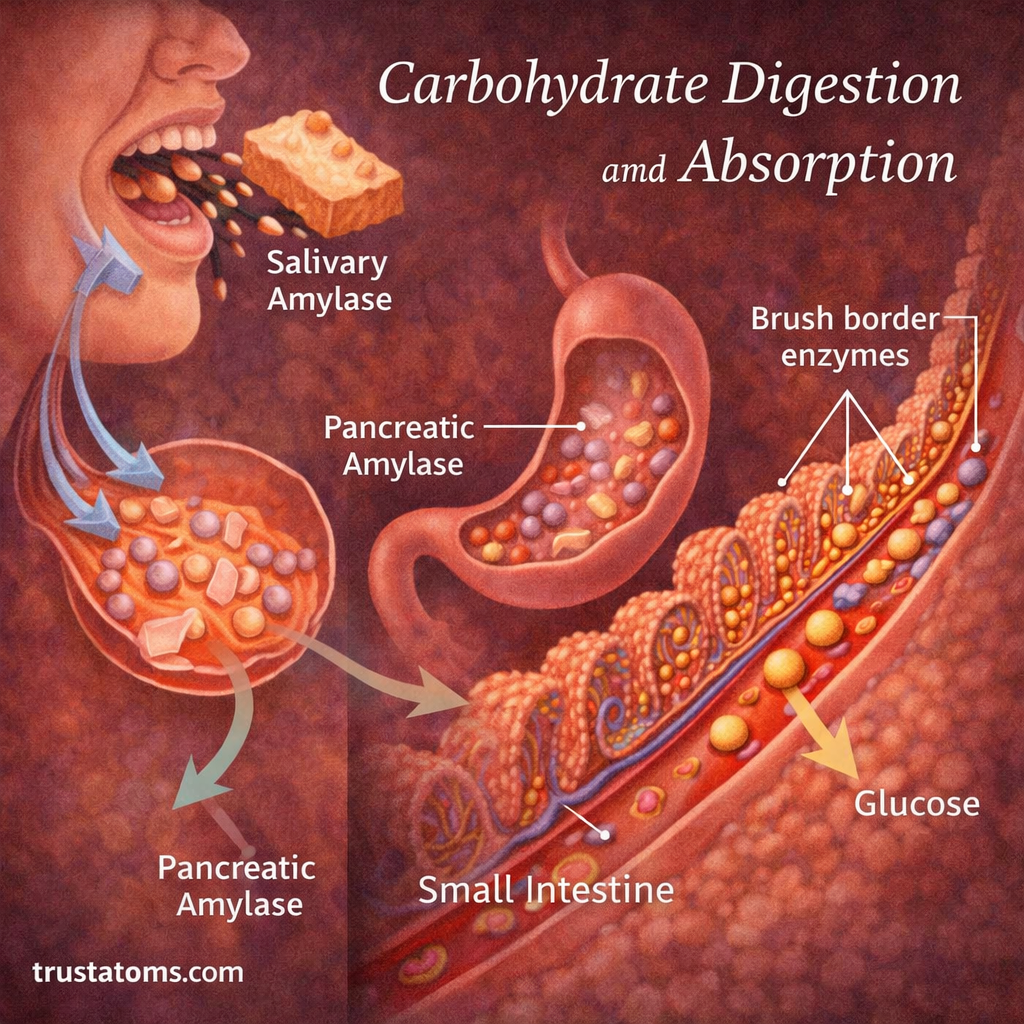
Carbohydrate digestion begins in the mouth, where chewing breaks food into smaller pieces and mixes it with saliva.
Salivary glands release an enzyme called salivary amylase, which begins breaking certain starch bonds. This produces shorter carbohydrate chains and smaller sugars, including maltose.
Because food usually remains in the mouth briefly, only part of the starch is digested at this stage. Most carbohydrate breakdown occurs farther along the digestive tract.
Different nutrients require different enzymes. Protein digestion and amino acid uptake explains how proteins follow a separate pathway involving proteases rather than amylase.
What Happens to Carbohydrates in the Stomach?
The stomach mainly stores, churns, and mixes food with gastric secretions. Some salivary amylase can continue acting briefly within swallowed food, but increasing acidity eventually inactivates the enzyme.
As a result, the stomach performs relatively little additional enzymatic carbohydrate digestion.
Food is mixed and prepared for the small intestine, where most carbohydrate digestion and nearly all normal absorption of digestible sugars take place.
How the Small Intestine Completes Carbohydrate Digestion
When partially digested food enters the duodenum, the pancreas releases pancreatic amylase into the intestinal lumen. This enzyme continues breaking starch into shorter chains and small carbohydrates.
Enzymes attached to the brush border of intestinal epithelial cells then complete the breakdown. The brush border consists of tiny projections called microvilli that increase the surface area available for digestion and absorption.
| Enzyme | Substrate | Products |
|---|---|---|
| Pancreatic amylase | Starch | Shorter carbohydrates, including maltose and dextrins |
| Maltase-glucoamylase | Maltose and short glucose chains | Glucose |
| Sucrase | Sucrose | Glucose and fructose |
| Lactase | Lactose | Glucose and galactose |
| Isomaltase | Branched carbohydrate fragments | Glucose |
Once carbohydrates have been converted into monosaccharides, they can cross the intestinal lining through specialized transport proteins.
How Glucose and Other Sugars Are Absorbed
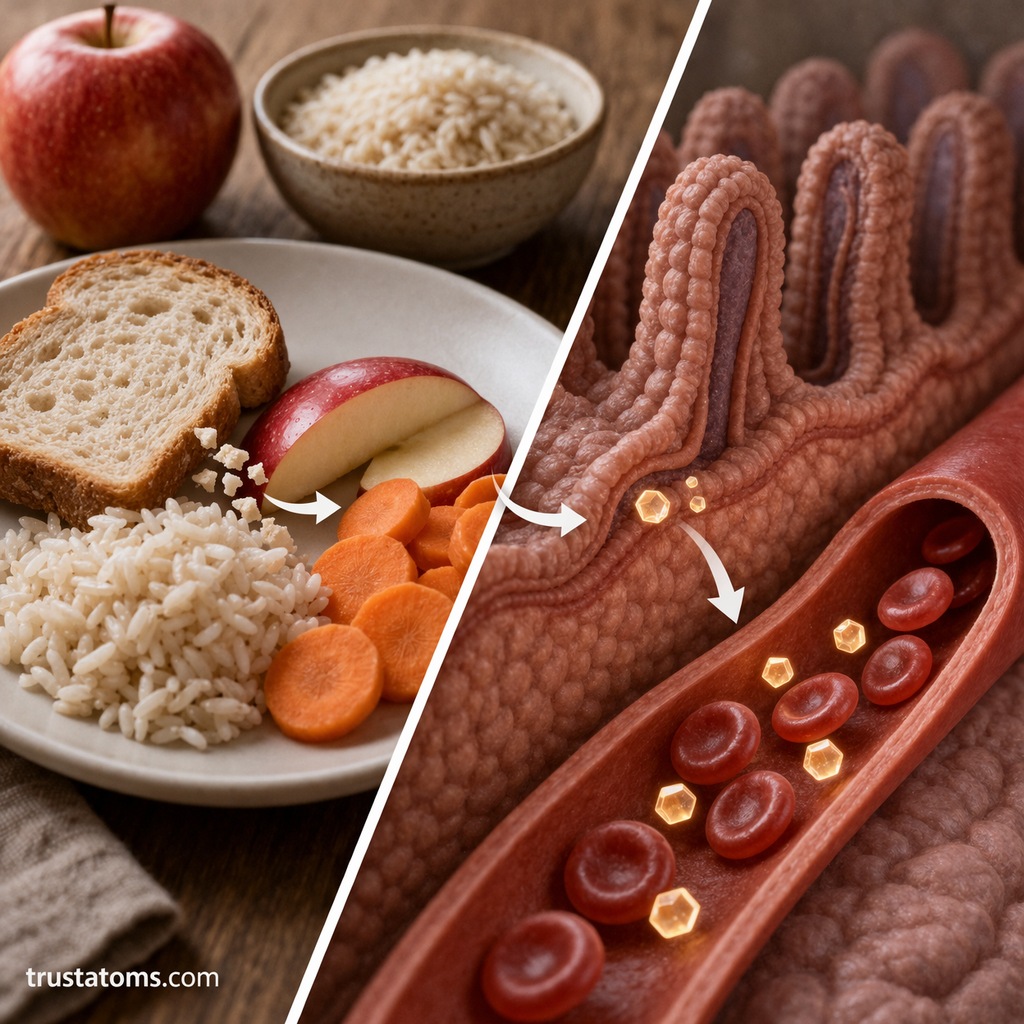
The small intestine contains fingerlike villi covered with epithelial cells. Each villus contains blood capillaries that receive absorbed sugars.
Glucose and galactose enter intestinal cells mainly through SGLT1, a transporter that uses the sodium concentration gradient to drive sugar uptake. Fructose enters primarily through GLUT5 by facilitated diffusion.
All three sugars can leave intestinal cells through GLUT2 transporters on the blood-facing membrane. They then enter capillaries and travel through the hepatic portal circulation toward the liver.
The sodium gradient supporting glucose and galactose absorption is maintained by the sodium-potassium ATPase, which uses ATP. Thus, intestinal glucose uptake depends indirectly on cellular energy even though the sugar itself enters through a sodium-linked transporter.
What Happens to Absorbed Carbohydrates in the Liver?
The liver receives absorbed sugars through the hepatic portal vein and helps regulate their distribution and metabolism.
- Glucose: Can enter circulation, be used by liver cells, or be stored as glycogen.
- Fructose: Is extensively metabolized by the intestine and liver into compounds that can enter other metabolic pathways.
- Galactose: Is processed largely by the liver and can be converted into compounds used in glucose metabolism.
After a carbohydrate-containing meal, insulin helps many tissues increase glucose uptake and encourages energy storage. Between meals, the liver can release glucose by breaking down glycogen and producing glucose from other substances.
An Everyday Example: Digesting a Slice of Bread
Consider eating a slice of bread. Much of its digestible carbohydrate is starch, a collection of long glucose chains.
- Chewing mixes the bread with saliva, allowing salivary amylase to begin starch digestion.
- The stomach mixes the food before gradually releasing it into the small intestine.
- Pancreatic amylase and brush-border enzymes break the starch into glucose molecules.
- Glucose crosses intestinal epithelial cells and enters portal blood.
- The liver processes the incoming glucose, while some becomes available to other tissues for energy production or storage.
The rate of this process depends on factors such as food structure, fiber content, preparation, and the presence of fat or protein in the meal.
What Happens to Fiber That Cannot Be Digested?
Human digestive enzymes cannot break down many dietary fibers. These carbohydrates pass through the small intestine largely undigested and enter the large intestine.
Some fibers are fermented by intestinal microorganisms, producing short-chain fatty acids that can be absorbed and used by the body. Other fibers mainly contribute bulk, retain water, and influence stool consistency.
Fiber can also influence how quickly nutrients become available for absorption, particularly when it changes the viscosity or physical structure of intestinal contents.
What Can Interfere With Carbohydrate Digestion?
Efficient digestion requires functioning enzymes, a healthy intestinal lining, and coordinated movement of food through the digestive tract.
Lactase deficiency is a common example. When insufficient lactase is available, lactose may remain undigested and pass into the colon, where bacterial fermentation can cause gas, bloating, and diarrhea.
Conditions that damage the intestinal lining, such as untreated celiac disease, can also interfere with nutrient absorption. Pancreatic disorders may reduce digestive enzyme delivery, although the effects depend on the severity of the condition.
Frequently Asked Questions
Where does most carbohydrate digestion occur?
Most carbohydrate digestion occurs in the small intestine. Pancreatic amylase breaks starch into smaller carbohydrates, and brush-border enzymes complete their conversion into absorbable monosaccharides.
Are all carbohydrates converted into glucose?
No. Digestible carbohydrates yield glucose, fructose, and galactose, depending on their composition. These sugars follow different metabolic pathways after absorption, while much dietary fiber resists digestion by human enzymes.
Does carbohydrate absorption happen in the stomach?
Very little carbohydrate absorption occurs in the stomach. Nearly all normal absorption of digestible sugars takes place in the small intestine, where specialized transport proteins move monosaccharides into intestinal cells and then into the blood.
Carbohydrate digestion begins with salivary amylase and is completed mainly by pancreatic and intestinal enzymes in the small intestine. Glucose, fructose, and galactose are then absorbed into portal blood and processed by the liver before being used or stored. Dietary fiber follows a different pathway, reaching the large intestine where it can influence digestion and microbial activity.
This article is for general education and is not medical advice. Talk to a qualified health professional about any medical concern.
Sources: Guyton and Hall Textbook of Medical Physiology; Boron and Boulpaep Medical Physiology; OpenStax Anatomy and Physiology 2e.