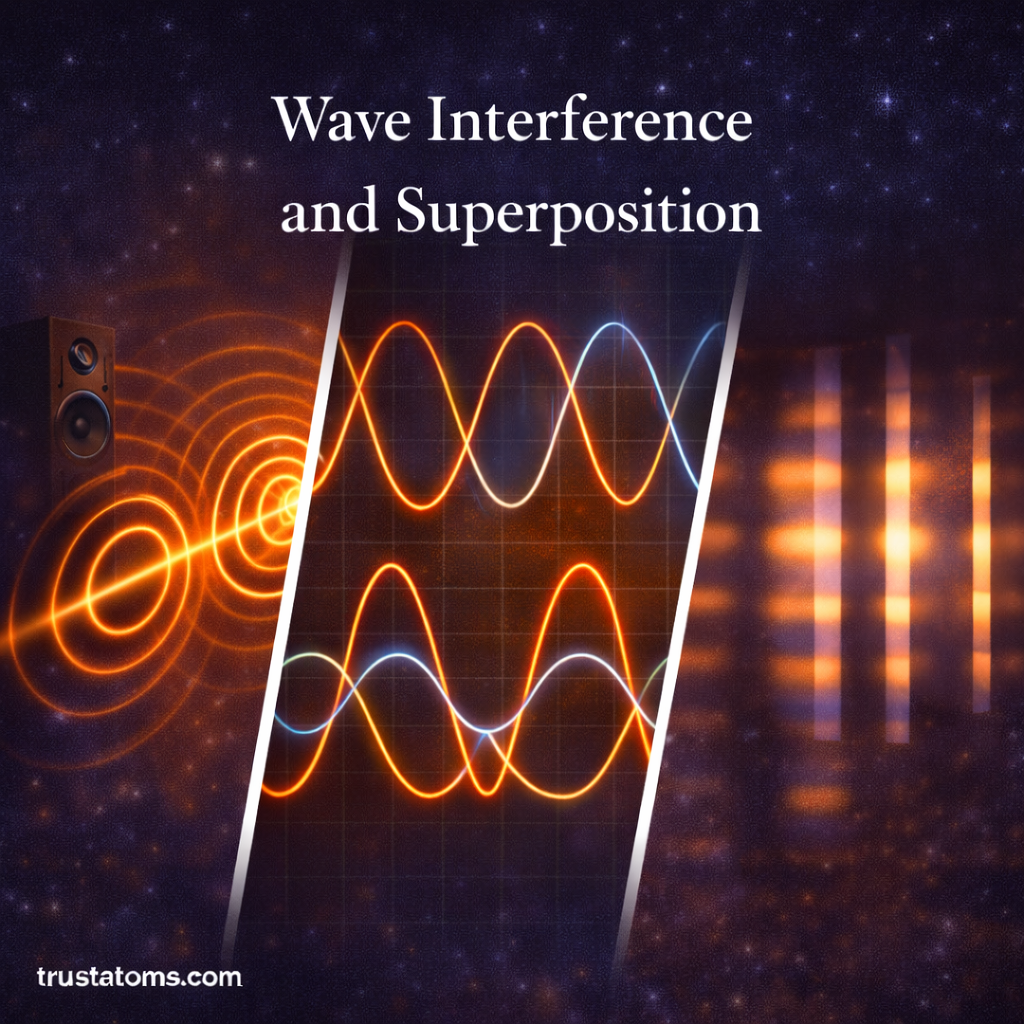
When waves meet, they don’t collide like solid objects. Instead, they pass through one another and combine. This interaction is governed by one of the most fundamental principles in physics: the principle of superposition.
Wave interference and superposition explain everything from noise-canceling headphones and musical harmonics to light patterns and quantum behavior. In this guide, we’ll break down how waves interact and why interference is so important in physics.
The Principle of Superposition
The principle of superposition states:
When two or more waves overlap, the resulting displacement at any point is the sum of the individual displacements.
In simple terms:
- Waves add together.
- They do not permanently change each other.
- After overlapping, they continue as if nothing happened.
This principle applies to:
- Water waves
- Sound waves
- Light waves
- Seismic waves
- Electromagnetic waves
Superposition is the foundation of wave interference.
What Is Wave Interference?
Wave interference occurs when overlapping waves combine due to superposition.
There are two primary types of interference:
- Constructive interference
- Destructive interference
The type depends on the relative phase of the waves.
Constructive Interference
Constructive interference happens when waves meet in phase.
This means:
- Crest aligns with crest.
- Trough aligns with trough.
- Amplitudes reinforce each other.
Results:
- Increased wave amplitude.
- Stronger signal.
- Higher intensity (in light or sound).
Example:
Two synchronized speakers playing the same sound can create louder regions where waves combine constructively.
Destructive Interference
Destructive interference occurs when waves meet out of phase.
This means:
- Crest aligns with trough.
- One wave partially or completely cancels the other.
Results:
- Reduced amplitude.
- Weaker signal.
- Possible complete cancellation.
Example:
Noise-canceling headphones generate sound waves that are out of phase with background noise, reducing what you hear.
Interference in Water Waves
Water provides a clear visual example of interference.
When two ripples overlap:
- You may see larger waves at some points.
- You may see flat regions at others.
- The pattern changes dynamically.
After interacting, the waves continue traveling outward.
This demonstrates that waves carry energy but not permanent shape changes during overlap.
Interference in Sound Waves
Sound interference affects what we hear.
In large spaces:
- Sound waves reflect off walls.
- Overlapping waves create loud and quiet spots.
- These are called standing wave patterns.
Musical instruments rely on interference to produce rich tones.
Engineers use interference analysis to:
- Design concert halls.
- Reduce echo.
- Optimize speaker placement.
Interference in Light Waves

Light also exhibits interference behavior.
When coherent light sources overlap:
- Bright and dark bands appear.
- These patterns are called interference fringes.
- They reveal the wave nature of light.
Applications include:
- Holography
- Optical coatings
- Thin-film interference (like soap bubbles)
Interference patterns helped confirm that light behaves as a wave.
Standing Waves
Standing waves form when:
- Two waves of the same frequency travel in opposite directions.
- They interfere continuously.
This produces:
- Nodes (points of no displacement).
- Antinodes (points of maximum displacement).
Standing waves appear in:
- Guitar strings
- Air columns in pipes
- Microwave cavities
Standing waves are a special case of sustained interference.
Conditions for Sustained Interference
For stable interference patterns to form, waves must be:
- Coherent (same frequency and constant phase relationship)
- Similar in wavelength
- Overlapping in space
Random waves do not produce stable patterns.
Lasers are useful in experiments because they emit coherent light.
Energy in Interference
Interference does not destroy energy.
Instead:
- Energy redistributes.
- Regions of constructive interference gain energy.
- Regions of destructive interference lose energy.
The total energy across the system remains conserved.
This principle ensures consistency with conservation laws in physics.
Real-World Applications
Wave interference and superposition are essential in:
- Audio engineering
- Wireless communication
- Radar systems
- Seismic analysis
- Medical imaging
- Optical devices
Engineers manipulate interference to:
- Enhance signal clarity.
- Reduce unwanted noise.
- Improve system efficiency.
Understanding interference allows precise control over wave behavior.
Common Misconceptions
Many learners believe:
- Waves bounce off each other permanently.
- Interference destroys energy.
- Only water waves interfere visibly.
Important clarifications:
- Waves pass through one another during superposition.
- Energy is redistributed, not lost.
- All wave types can interfere under proper conditions.
Recognizing these ideas strengthens wave theory understanding.
Why Superposition Matters
The principle of superposition extends beyond classical waves.
It is fundamental to:
- Electromagnetic theory
- Quantum mechanics
- Signal processing
- Vibrational analysis
In quantum physics, superposition describes how particles can exist in multiple states simultaneously.
Thus, superposition is not just about waves — it is a core concept in modern physics.
Key Takeaways
- Superposition means waves add together when overlapping.
- Constructive interference increases amplitude.
- Destructive interference decreases amplitude.
- Standing waves form from continuous interference.
- Interference redistributes energy.
- Phase relationships determine the type of interference.
- Superposition applies to mechanical and electromagnetic waves.
Final Thoughts
Wave interference and superposition reveal how waves interact without permanently altering each other. These principles explain sound patterns, light fringes, musical harmonics, and advanced communication systems.
By understanding how waves combine, amplify, and cancel, we gain deeper insight into the behavior of oscillatory systems and the structure of physical reality itself.
Wave superposition is one of the simplest ideas in physics — yet it underlies some of the most profound discoveries in science.