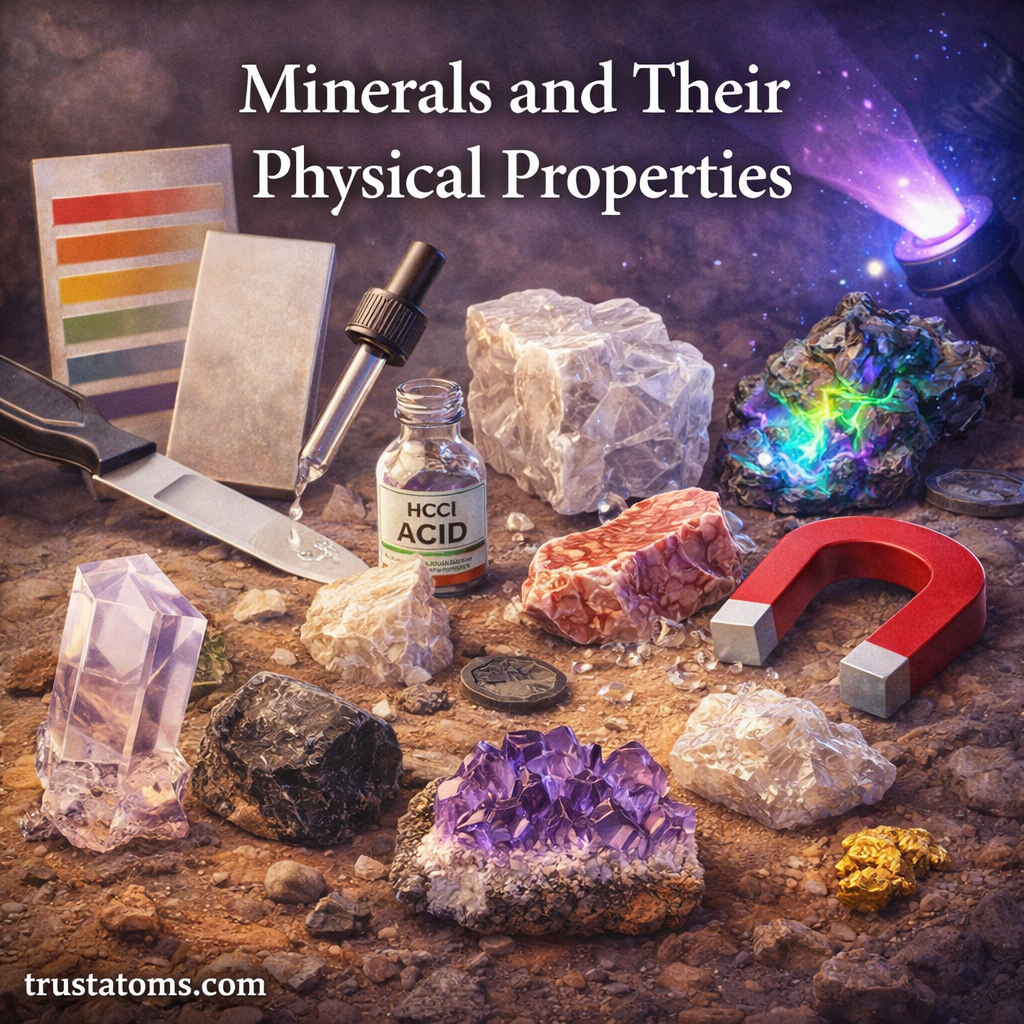
Minerals are the basic building blocks of rocks and play a key role in shaping Earth’s surface. From the quartz in sand to the iron in steel, minerals are everywhere—and understanding their properties helps scientists identify, classify, and use them.
In earth science, minerals are studied based on their physical properties, which can be observed or measured without changing the mineral’s composition.
What Is a Mineral?
A mineral is a naturally occurring, inorganic solid with a specific chemical composition and an organized crystal structure.
Key Characteristics of Minerals
- Naturally formed (not man-made)
- Inorganic (not derived from living organisms)
- Solid at room temperature
- Definite chemical composition
- Ordered internal structure (crystal lattice)
Examples of common minerals include quartz, feldspar, calcite, and mica.
Why Physical Properties Matter
Physical properties allow scientists and geologists to identify minerals quickly and accurately.
Benefits of Studying Mineral Properties
- Helps classify different minerals
- Aids in identifying unknown samples
- Supports mining and resource extraction
- Provides insight into how rocks form
These properties are essential tools in both fieldwork and laboratory analysis.
Common Physical Properties of Minerals
Minerals can be identified using several key physical properties.
Color
Color is often the most noticeable property, but it is not always reliable.
- Some minerals appear in many colors
- Impurities can change a mineral’s color
- Example: Quartz can be clear, pink, purple, or smoky
Because of this variability, color alone is not enough for identification.
Streak
Streak is the color of a mineral in powdered form.
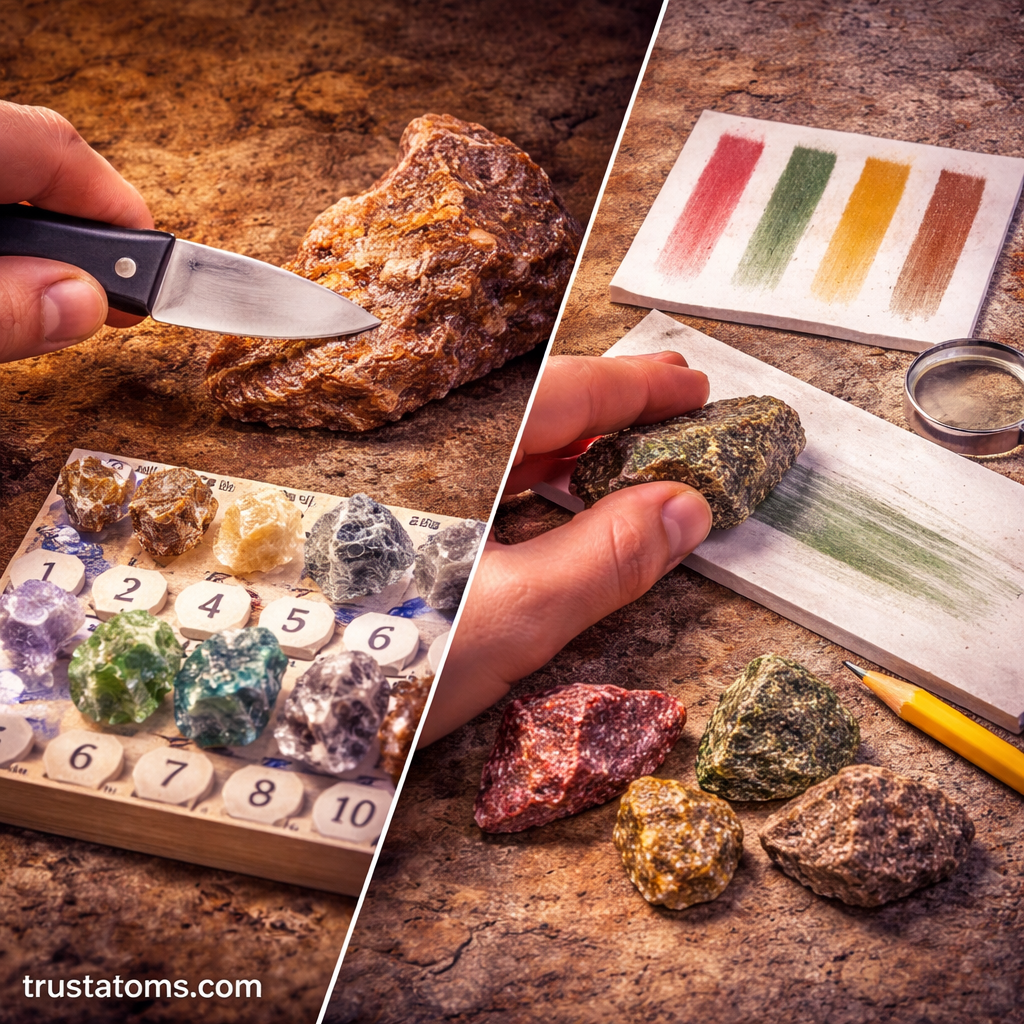
- Determined by rubbing the mineral on a streak plate
- Often more reliable than surface color
- Example: Hematite may look metallic but leaves a reddish streak
Luster
Luster describes how a mineral reflects light.
Types of Luster
- Metallic – shiny like metal
- Non-metallic – dull, glassy, or pearly
This property helps narrow down mineral types.
Hardness
Hardness measures a mineral’s resistance to scratching.
Mohs Hardness Scale
The Mohs scale ranks minerals from 1 (softest) to 10 (hardest):
- Talc – 1
- Gypsum – 2
- Calcite – 3
- Fluorite – 4
- Apatite – 5
- Orthoclase – 6
- Quartz – 7
- Topaz – 8
- Corundum – 9
- Diamond – 10
A harder mineral can scratch a softer one.
Cleavage and Fracture
These properties describe how a mineral breaks.
Cleavage
- Breaks along flat, smooth surfaces
- Occurs in predictable patterns
Fracture
- Breaks irregularly
- Produces rough or uneven surfaces
Example: Quartz has fracture, while mica has cleavage.
Density
Density measures how much mass is packed into a given volume.
- Heavier minerals have higher density
- Useful for identifying metallic minerals
- Example: Gold is much denser than quartz
Crystal Structure
Minerals have an internal arrangement of atoms that forms crystal shapes.
- Determines the external appearance of crystals
- Examples include cubic, hexagonal, and prismatic shapes
This structure is a defining feature of each mineral.
Additional Properties Used in Identification
Some minerals require more advanced tests.
Special Properties
- Magnetism – some minerals are attracted to magnets
- Reaction to acid – calcite fizzes in acid
- Fluorescence – glows under ultraviolet light
- Taste or smell – used cautiously in specific cases (e.g., halite tastes salty)
These properties help distinguish similar-looking minerals.
How Minerals Are Used in Everyday Life
Minerals are essential to modern life and industry.
Common Uses
- Construction materials (sand, gravel, limestone)
- Electronics (silicon, copper, rare earth elements)
- Jewelry (diamonds, gold, gemstones)
- Household products (salt, toothpaste, glass)
Without minerals, many everyday items would not exist.
Final Thoughts
Minerals and their physical properties are fundamental to understanding Earth’s composition. By studying characteristics like hardness, luster, streak, and crystal structure, scientists can identify minerals and learn how rocks form and change.
Whether used in technology, construction, or natural processes, minerals are a crucial part of the world around us.