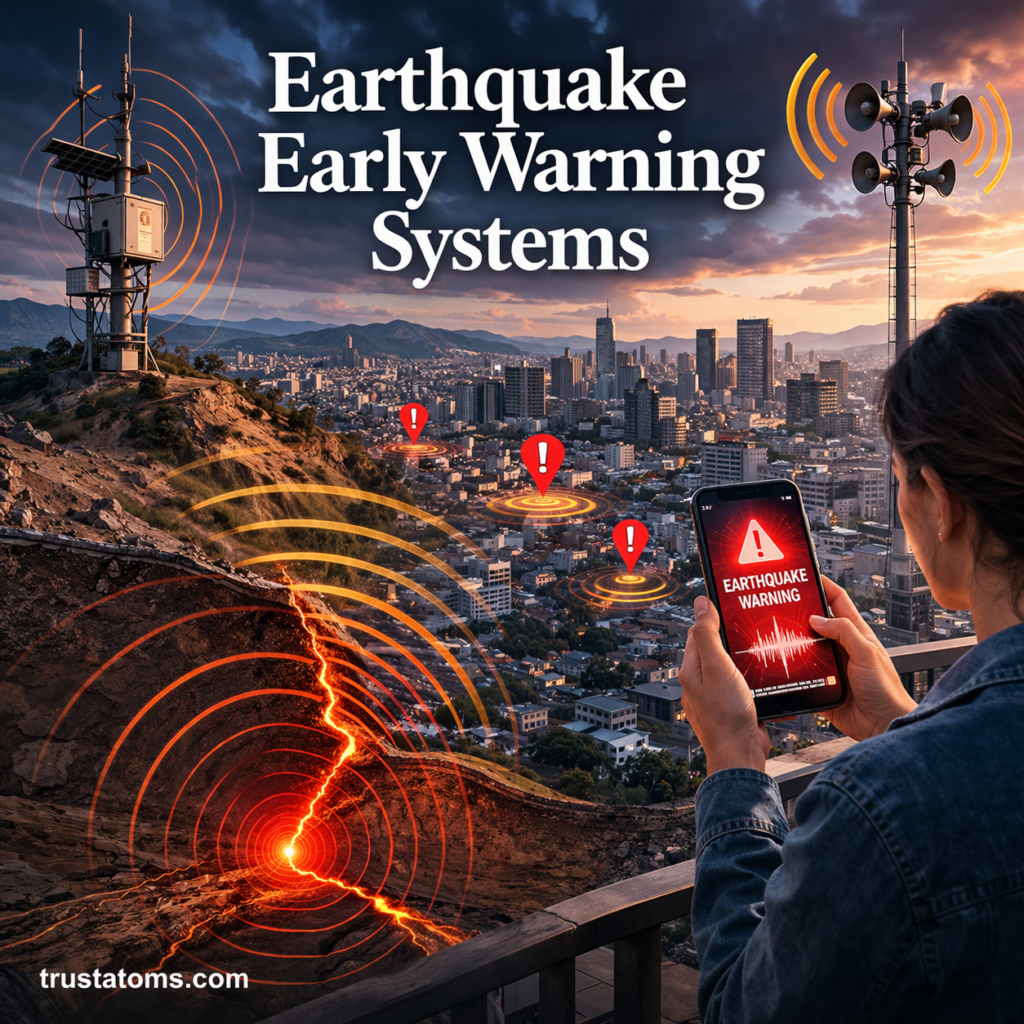
Earthquakes strike without warning—but modern technology is changing that. While we still cannot predict exactly when an earthquake will occur, earthquake early warning systems (EEWS) can detect seismic activity in real time and send alerts before the strongest shaking arrives.
Even a few seconds of warning can make a critical difference, helping people take protective action and allowing systems to respond automatically.
What Is an Earthquake Early Warning System?
An earthquake early warning system is a network of sensors, communication systems, and software designed to detect the first signs of an earthquake and rapidly send alerts.
These systems do not predict earthquakes in advance. Instead, they:
- Detect the initial seismic waves
- Analyze the data instantly
- Estimate the location and magnitude
- Send alerts to areas likely to experience strong shaking
How Earthquake Early Warning Works

Earthquakes generate different types of seismic waves that travel at different speeds.
Primary Waves (P-Waves)
- Travel fastest
- Arrive first
- Cause minimal damage
Secondary Waves (S-Waves)
- Travel slower
- Arrive after P-waves
- Cause most of the damaging shaking
The Key Advantage
Early warning systems detect P-waves and send alerts before S-waves arrive.
This time gap—ranging from a few seconds to over a minute—creates a valuable opportunity to act.
What Happens During an Alert?
When an earthquake is detected, the system automatically triggers alerts through various channels:
- Smartphone notifications
- Emergency broadcast systems
- Sirens and alarms
- Public transportation systems
Actions triggered by alerts may include:
- Slowing or stopping trains
- Shutting down gas lines
- Opening elevator doors
- Pausing surgeries or industrial processes
Examples of Earthquake Early Warning Systems
Several countries have developed advanced EEWS networks.
Japan Meteorological Agency (Japan)
- One of the most advanced systems in the world
- Provides nationwide alerts within seconds
- Widely integrated into public infrastructure
ShakeAlert (United States)
- Operates along the West Coast
- Sends alerts via mobile devices and apps
- Managed by scientific agencies including the United States Geological Survey
Mexico’s Seismic Alert System
- Known for public sirens in cities like Mexico City
- Provides crucial seconds of warning for residents
Benefits of Early Warning Systems
Earthquake early warning systems provide multiple advantages:
1. Life Safety
- Allows people to Drop, Cover, and Hold On
- Reduces injuries and fatalities
2. Infrastructure Protection
- Minimizes damage to critical systems
- Prevents secondary disasters like fires or chemical leaks
3. Economic Impact Reduction
- Helps businesses protect equipment
- Reduces downtime and financial losses
Limitations of Earthquake Early Warning
Despite their benefits, EEWS have important limitations:
Limited Warning Time
- People near the epicenter may receive little or no warning
- Warning time depends on distance from the earthquake source
Detection Challenges
- Complex earthquakes may be harder to analyze quickly
- False alarms or missed alerts can occur
Infrastructure Requirements
- Requires dense sensor networks
- Needs reliable communication systems
How Individuals Should Respond
Knowing how to react to an alert is just as important as receiving one.
Recommended Actions:
- Drop to the ground
- Take cover under sturdy furniture
- Hold on until shaking stops
Additional tips:
- Stay away from windows
- Avoid elevators
- If outdoors, move to an open area
The Role of Technology in EEWS
Modern systems rely on advanced technology to improve speed and accuracy.
Key Technologies Include:
- Real-time seismic sensors
- GPS monitoring for ground movement
- Machine learning for rapid data analysis
- High-speed communication networks
These innovations continue to improve the effectiveness of early warning systems worldwide.
The Future of Earthquake Early Warning
As technology advances, EEWS are becoming more accessible and reliable.
Future developments may include:
- Expanded coverage in developing regions
- Faster and more accurate detection algorithms
- Integration with smart cities and IoT devices
- Personalized alerts based on user location
Common Misconceptions
“Early warning systems predict earthquakes”
They do not predict earthquakes—they detect them after they begin.
“Everyone gets the same warning time”
Warning time varies based on location and distance from the epicenter.
“Alerts are always accurate”
While highly effective, no system is perfect, and improvements are ongoing.
Final Thoughts
Earthquake early warning systems represent one of the most important advancements in disaster preparedness. By detecting earthquakes in real time and providing even a few seconds of notice, these systems help save lives, protect infrastructure, and reduce damage.
While they are not a substitute for long-term preparedness, they are a powerful tool in making communities safer in earthquake-prone regions.