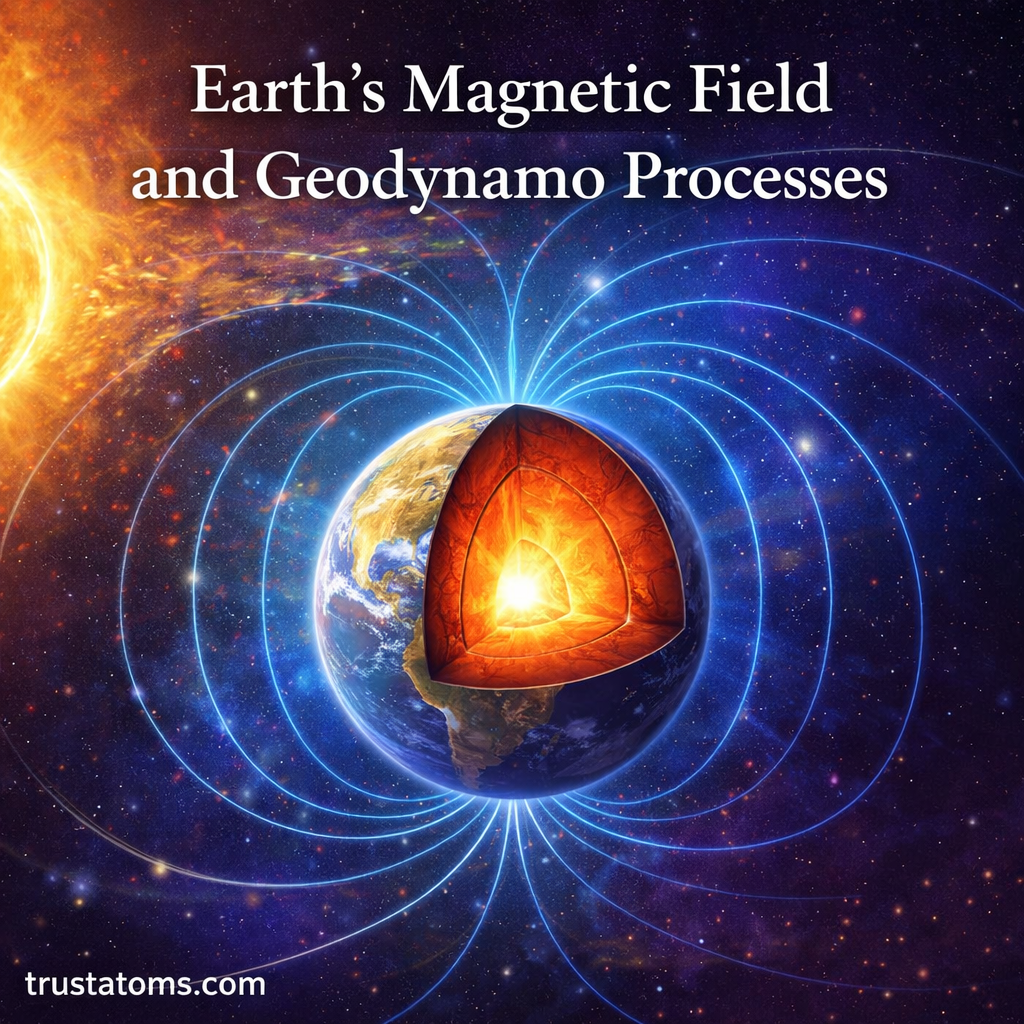
Earth’s magnetic field is generated mainly by the geodynamo, a process involving the movement of electrically conducting liquid metal in the planet’s outer core. The resulting field extends into space, helps guide compass navigation, and forms a magnetosphere that influences how charged particles from the Sun interact with Earth.
Unlike a permanent bar magnet, Earth’s magnetic field changes as fluid motion deep inside the planet evolves. Studying these changes connects Earth science with electromagnetism, planetary interiors, space weather, and the geological record preserved in rocks.
The field is invisible, but its effects can be measured at the surface, observed by satellites, and traced through magnetic patterns recorded in ancient volcanic rocks and oceanic crust.
What Is Earth’s Magnetic Field?
Earth’s magnetic field is a region in which magnetic forces act on moving electric charges, magnetic materials, and compass needles. Near the surface, its overall pattern resembles that of a tilted magnetic dipole, although the actual field is more complicated.
Its strength typically ranges from approximately 25 to 65 microteslas at Earth’s surface, depending on location. Magnetic field lines are a useful way to visualize its direction and geometry, but they are not physical strands surrounding the planet.
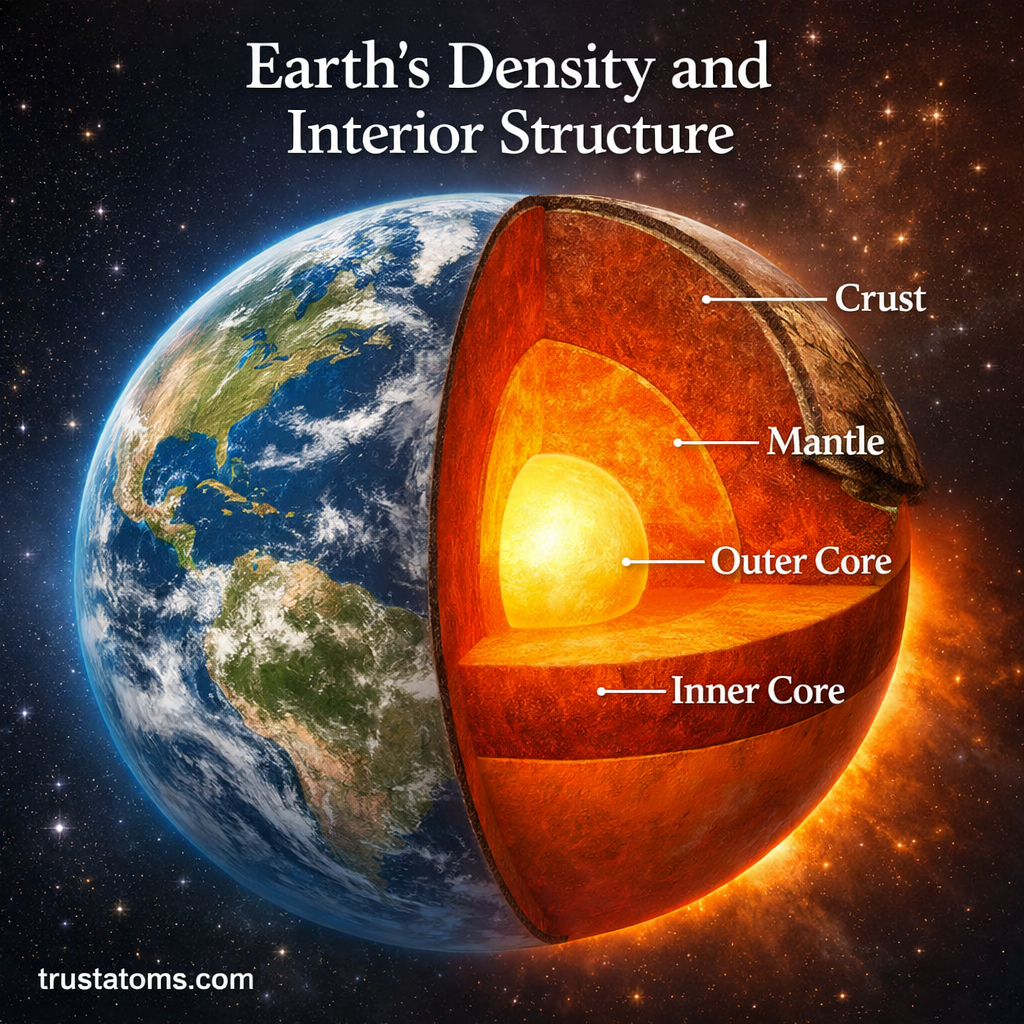
The source of the field lies within the planet’s interior. Understanding the layers of the Earth helps explain why the liquid outer core, rather than the solid crust, generates most of the global magnetic field.
The properties of the core are closely connected to Earth’s Density and Interior Structure, particularly the separation of dense metallic material from the surrounding rocky mantle.
The Magnetosphere: Earth’s Interaction With Solar Wind
The magnetosphere is the region of space where Earth’s magnetic field strongly influences the motion of charged particles. Its shape is continually altered by the solar wind, a stream of charged particles flowing outward from the Sun.
Three important features help describe its structure:
- Bow shock: A region where the supersonic solar wind slows and changes direction before reaching the magnetosphere’s boundary.
- Magnetopause: The boundary separating the region dominated by Earth’s magnetic field from the surrounding solar wind plasma.
- Magnetotail: An elongated region stretching away from the Sun as the solar wind distorts Earth’s magnetic field.
The magnetosphere redirects many incoming charged particles, although some enter regions near the magnetic poles or become trapped in radiation belts. Earth’s atmosphere provides additional protection by absorbing much of the Sun’s harmful ultraviolet and high-energy radiation.
What Is the Geodynamo?
The geodynamo is the physical process that maintains Earth’s global magnetic field through fluid motion and electromagnetic induction. It operates in the outer core, where iron-rich liquid metal conducts electricity.
Heat escaping from the core and changes in chemical composition create buoyancy forces that drive fluid movement. Earth’s rotation influences this motion through the Coriolis effect, helping organize large-scale flow patterns.
When electrically conducting fluid moves through an existing magnetic field, it can generate electric currents. Those currents produce additional magnetic fields, allowing the process to sustain itself under suitable conditions.
This self-sustaining mechanism does not require the core to behave like a permanent magnet. At core temperatures, ordinary permanent magnetism would not explain the observed global field.
How the Geodynamo Generates a Magnetic Field
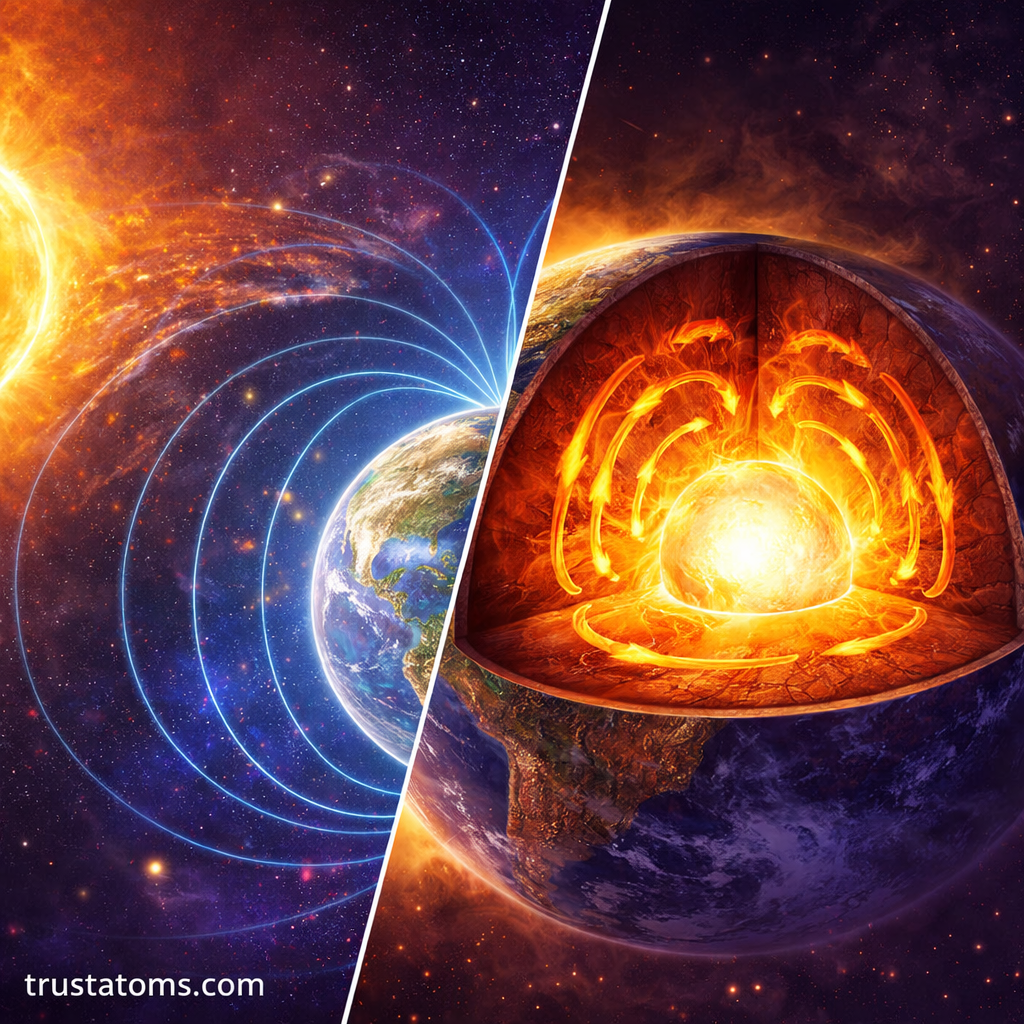
The geodynamo involves several interacting processes rather than a simple circular flow of molten metal. Its main components can be summarized in four stages.
- Heat transfer and the release of lighter elements during inner-core growth create buoyancy within the liquid outer core.
- Buoyancy drives fluid motion, while Earth’s rotation influences the direction and organization of the moving metal.
- Movement of the electrically conducting fluid induces electric currents and modifies the existing magnetic field.
- The resulting magnetic field interacts with continued fluid motion, maintaining the geodynamo as long as the necessary energy and flow conditions persist.
Scientists investigate this process using mathematical equations, laboratory experiments, and computer simulations. Direct observations of outer-core flow are impossible, so researchers infer its behavior from changes in the magnetic field and other geophysical measurements.
How Earth’s Magnetic Field Protects the Planet
Earth’s magnetic field affects how charged particles move through near-Earth space. It can deflect much of the solar wind, trap energetic particles, and guide some particles toward polar regions.
When energetic particles interact with gases in the upper atmosphere, they can produce auroras. These colorful displays are visible evidence of interactions between Earth’s magnetic environment and particles originating from space.
The magnetic field also influences atmospheric escape processes, although its overall effect is complex. A magnetic field alone does not guarantee that a planet retains its atmosphere, and atmospheric protection depends on several interacting factors.
Why Magnetic North Moves and Poles Reverse
Earth’s magnetic poles are not fixed at the geographic poles. Changes in fluid motion within the outer core continually alter the magnetic field, causing the magnetic poles to move.
Over geological time, Earth’s magnetic field has also undergone polarity reversals, during which its dominant north-south orientation switches. These events have occurred repeatedly, but not at regular intervals.
The most recent complete reversal occurred approximately 780,000 years ago, according to geological dating evidence. Reversals generally unfold over thousands of years, and the field can become more complicated and weaker in its dipole component during the transition.
Scientists cannot reliably predict when the next reversal will occur. A weakening field or movement of magnetic poles does not, by itself, establish that a reversal is imminent.
Evidence of Earth’s Magnetic History in Rocks
Paleomagnetism is the study of magnetic information preserved in geological materials. When certain iron-bearing minerals cool or form under suitable conditions, they can retain a record of the surrounding magnetic field.
Oceanic crust provides particularly clear evidence. As basalt forms and cools near mid-ocean ridges, magnetic minerals can record the direction of Earth’s field at that time.
Later crustal movement carries these rocks away from the ridge. Repeated magnetic reversals produce alternating bands of normal and reversed polarity, often arranged in approximately symmetrical patterns on opposite sides of spreading centers.
These patterns support the processes described in Seafloor Spreading Mechanisms and help explain how new oceanic crust forms and moves outward from ridges.
The geological setting of these magnetic stripes is examined in Mid-Ocean Ridges and Seafloor Spreading, where volcanic activity creates new crust along divergent plate boundaries.
Paleomagnetic measurements also contribute to Plate Reconstruction in Geological History by helping scientists estimate past plate positions, rotations, and movements.
How Scientists Measure Earth’s Magnetic Field
Ground-based magnetic observatories continuously record changes in field strength and direction. Satellites provide broader coverage, helping researchers distinguish signals from the core, crust, ionosphere, and magnetosphere.
For example, the International Geomagnetic Reference Field provides a mathematical description of Earth’s main magnetic field that is periodically updated using observational data.
Scientists combine these observations with numerical geodynamo models to investigate how fluid motion inside the core might produce the changes detected at the surface.
Magnetic Changes, Navigation, and Space Weather
A compass points toward magnetic north rather than geographic north. The angular difference between these directions, called magnetic declination, varies by location and changes over time.
For example, a compass user navigating with a geographic map may need to correct for local magnetic declination to follow an accurate bearing. This is one practical reason magnetic field models are regularly updated.
During geomagnetic storms, changing magnetic fields can induce electric currents in power networks and interfere with radio communication, satellites, and some navigation systems. These disturbances arise from space-weather interactions rather than sudden changes in the deep geodynamo.
Frequently Asked Questions
What generates Earth’s magnetic field?
Most of Earth’s global magnetic field is generated by the geodynamo in the liquid outer core. Moving electrically conducting metal produces electric currents that sustain the magnetic field through electromagnetic induction.
Could Earth’s magnetic field disappear during a reversal?
The dipole component can weaken substantially during a reversal, but the magnetic field does not necessarily vanish completely. More complicated magnetic structures may persist throughout the transition.
Is magnetic north the same as geographic north?
No. Geographic north is defined by Earth’s rotational axis, while magnetic north is associated with the planet’s magnetic field. Their positions differ, and magnetic north changes as fluid motion within the outer core evolves.
Earth’s magnetic field connects the movement of liquid metal deep within the core to measurable effects at the surface and in space. Its changing direction, strength, and polarity provide evidence of core dynamics, help scientists reconstruct plate movements, and support the monitoring of navigation and space-weather conditions.
Sources: U.S. Geological Survey (USGS), Geomagnetism Program; National Oceanic and Atmospheric Administration (NOAA), National Centers for Environmental Information geomagnetic resources; British Geological Survey, Geomagnetism research and educational resources.