Isostasy is a fundamental concept in Earth science that explains how Earth’s crust maintains balance as it “floats” on the denser, semi-fluid mantle below. This principle helps scientists understand why mountains stand tall, why continents sit higher than ocean basins, and how the crust responds to changes like erosion, ice melt, and tectonic forces.
What Is Isostasy?
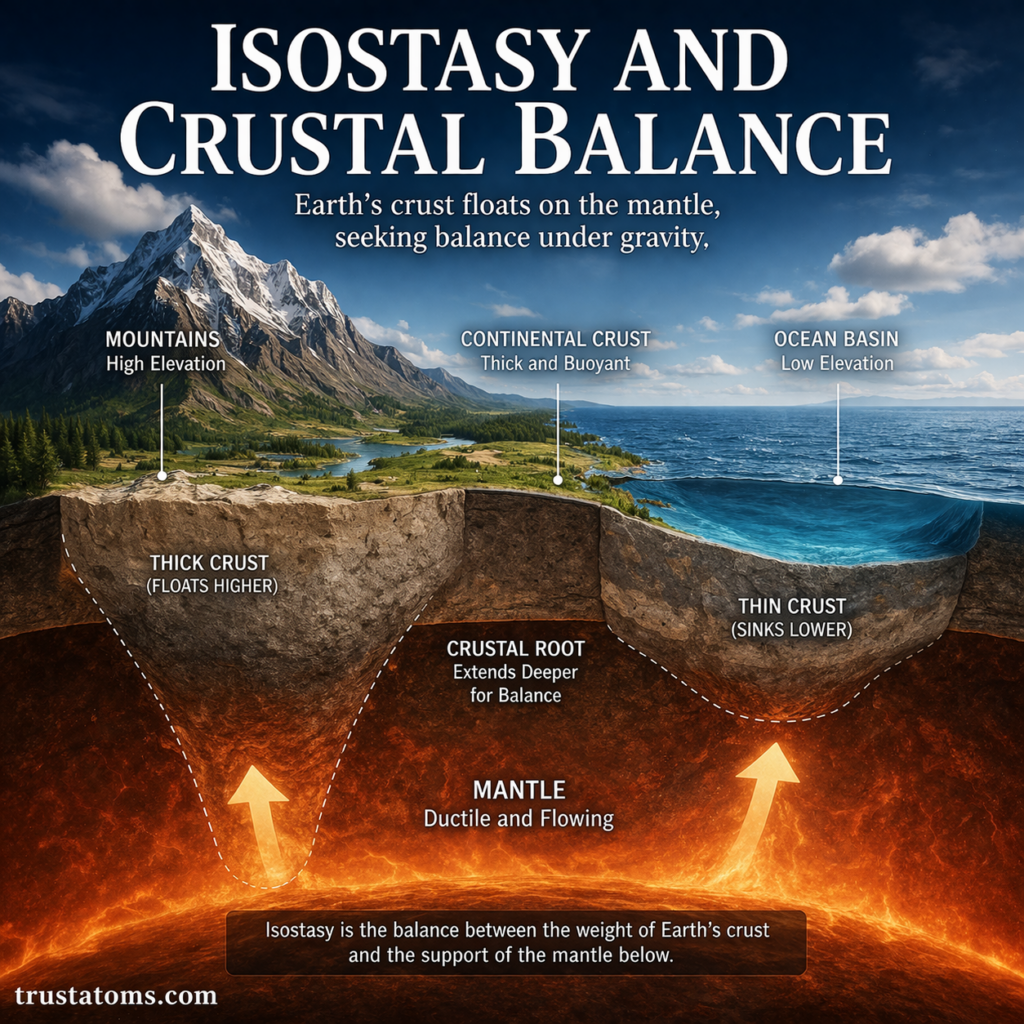
Isostasy refers to the gravitational balance between Earth’s crust (the lithosphere) and the underlying mantle.
Think of it like this:
- The crust behaves like blocks floating on a dense fluid
- Thicker or lighter sections float higher
- Thinner or denser sections sink lower
This balance ensures that Earth’s surface adjusts over time to maintain equilibrium.
The Basic Principle of Crustal Balance
The concept of isostasy is often compared to floating objects in water:
- Icebergs float with most of their mass below the surface
- Taller icebergs have deeper “roots” underwater
- Similarly, mountains have deep crustal roots extending into the mantle
This idea explains why:
- High elevations (like mountain ranges) are supported by thick crust
- Low elevations (like ocean basins) have thinner crust
Historical Development of Isostasy
The idea of isostasy developed in the 18th and 19th centuries when scientists noticed that gravity measurements near mountains did not match expectations.
Key contributors include:
- George Biddell Airy
- John Henry Pratt
They proposed different models to explain how Earth maintains balance.
Major Models of Isostasy
Two primary models describe how isostatic balance works:
1. Airy Model
Proposed by George Biddell Airy, this model suggests:
- The crust has a uniform density
- Mountains extend downward with deep roots
- Taller mountains have deeper roots
Key idea: Variation in crust thickness
2. Pratt Model
Proposed by John Henry Pratt, this model suggests:
- The crust has varying densities
- Higher regions are made of less dense material
- Lower regions are denser
Key idea: Variation in density rather than thickness
3. Modern Understanding
Today, scientists recognize that both models contribute to real-world conditions:
- Some regions follow thickness-based compensation
- Others show density variations
- Most areas involve a combination of both
How Isostasy Works in Real Life
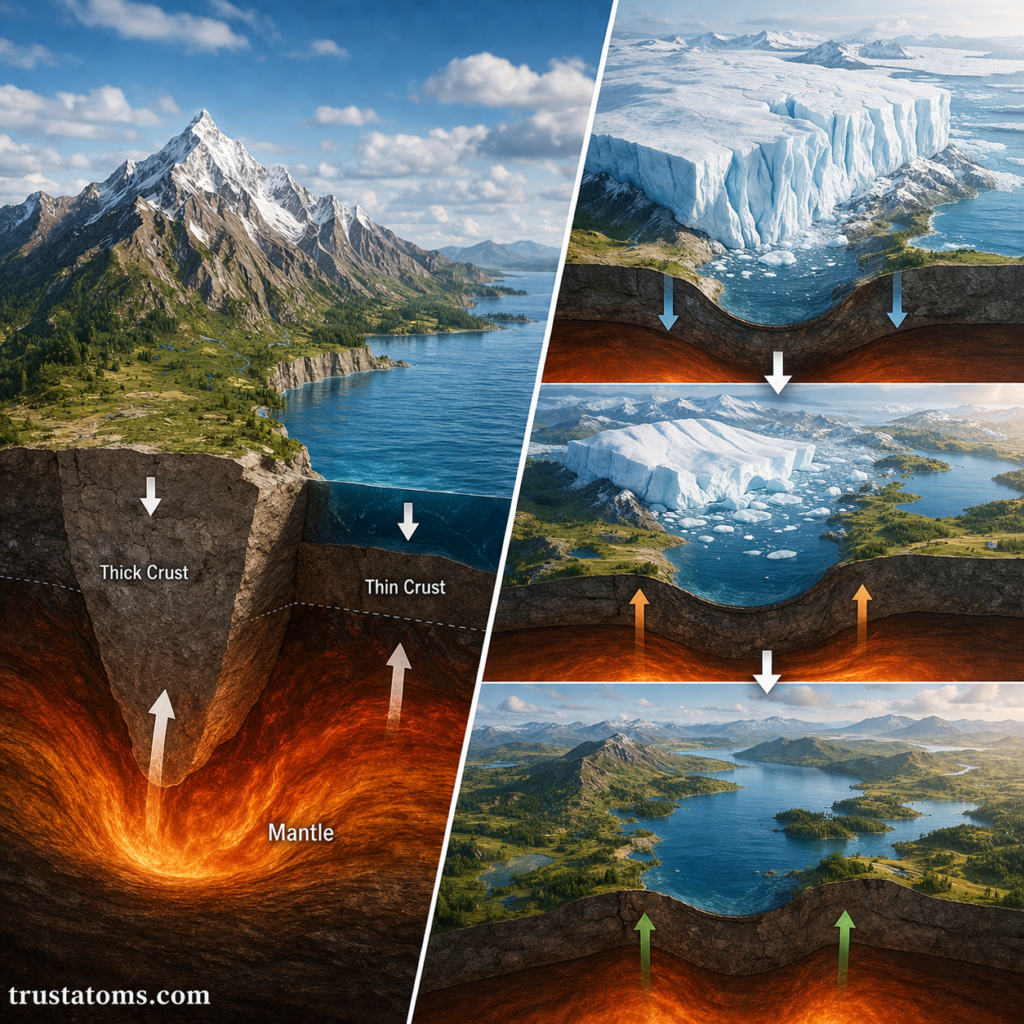
Isostasy is not static—it is a dynamic process that responds to changes in weight on the crust.
Examples of Isostatic Adjustment
1. Glacial Isostatic Rebound
During ice ages:
- Massive ice sheets pressed down on the crust
- After melting, the crust slowly rises back up
This process is still occurring in places like Canada and Scandinavia.
2. Erosion and Deposition
- Erosion removes material from mountains → crust rises
- Sediment buildup adds weight → crust sinks
This continuous adjustment helps maintain balance over time.
3. Mountain Building
- Tectonic forces push crust upward
- The crust thickens and forms deep roots
- Isostatic balance supports the elevation
Relationship Between Isostasy and Plate Tectonics
Isostasy works closely with Plate Tectonics.
Together, they explain:
- How continents move and adjust
- Why oceanic crust is lower than continental crust
- How mountain ranges are supported over long periods
Plate tectonics drives movement, while isostasy maintains vertical balance.
Why Continents and Oceans Sit at Different Heights
One of the most visible effects of isostasy is the difference in elevation between continents and ocean basins.
Key Differences
- Continental crust:
- Thicker
- Less dense
- Floats higher
- Oceanic crust:
- Thinner
- Denser
- Sits lower
This explains why oceans occupy lower regions of Earth’s surface.
Evidence Supporting Isostasy
Scientists use multiple methods to confirm isostatic balance:
- Gravity measurements show mass distribution differences
- Seismic studies reveal crust thickness and mantle structure
- GPS data tracks vertical crust movement
- Observations of post-glacial rebound confirm long-term adjustment
Why Isostasy Matters
Understanding isostasy helps scientists explain many important Earth processes:
- Mountain formation and stability
- Sea level changes over time
- Earthquake and tectonic behavior
- Long-term landscape evolution
It also plays a role in:
- Natural resource exploration
- Climate change studies
- Geological hazard assessment
Final Thoughts
Isostasy provides a powerful framework for understanding how Earth maintains balance despite constant change. From rising mountains to rebounding continents after ice ages, the crust is always adjusting to maintain equilibrium.
By combining the ideas of scientists like George Biddell Airy and John Henry Pratt with modern research, Earth scientists have developed a deeper understanding of how our planet’s surface remains stable over geological time.