Earthquakes are among the most powerful natural events on Earth. They occur when built-up energy in the crust is suddenly released, sending shockwaves through the ground. Understanding earthquakes and fault systems helps explain why they happen, where they occur, and how they impact the planet.
What Is an Earthquake?
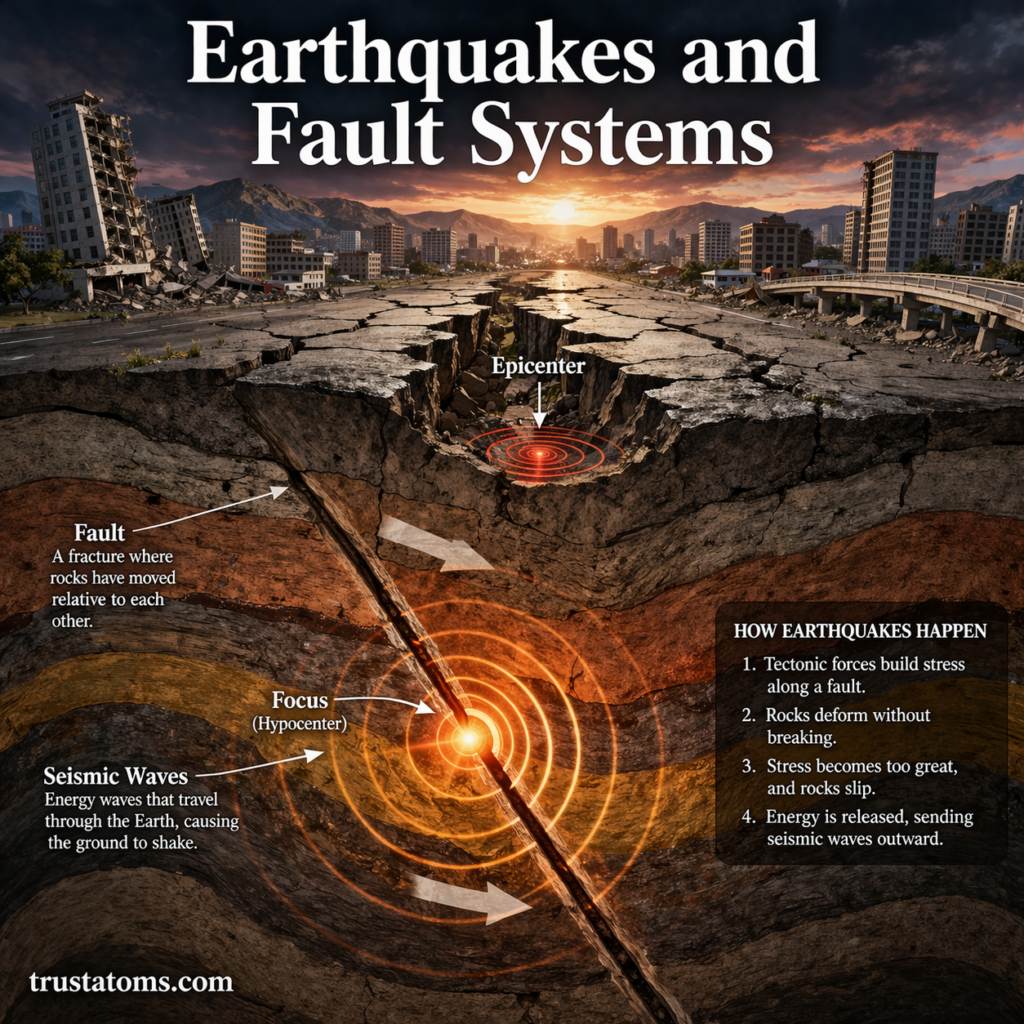
An earthquake is the sudden shaking of the ground caused by the movement of rocks along a fault.
This movement releases energy in the form of seismic waves, which travel through the Earth and are felt as vibrations at the surface.
Key Terms to Know
- Focus (Hypocenter): The point inside the Earth where the earthquake begins
- Epicenter: The point directly above the focus on the surface
- Seismic waves: Energy waves that travel through Earth’s layers
What Are Fault Systems?
Faults are fractures in Earth’s crust where rocks have moved relative to each other. A fault system is a network of connected faults in a region.
These systems are typically found near tectonic plate boundaries but can also occur within plates.
Why Faults Form
Faults develop due to stress in Earth’s crust caused by:
- Plate movement
- Gravity
- Thermal expansion and contraction
When stress exceeds the strength of rocks, they break and shift, forming a fault.
Types of Faults
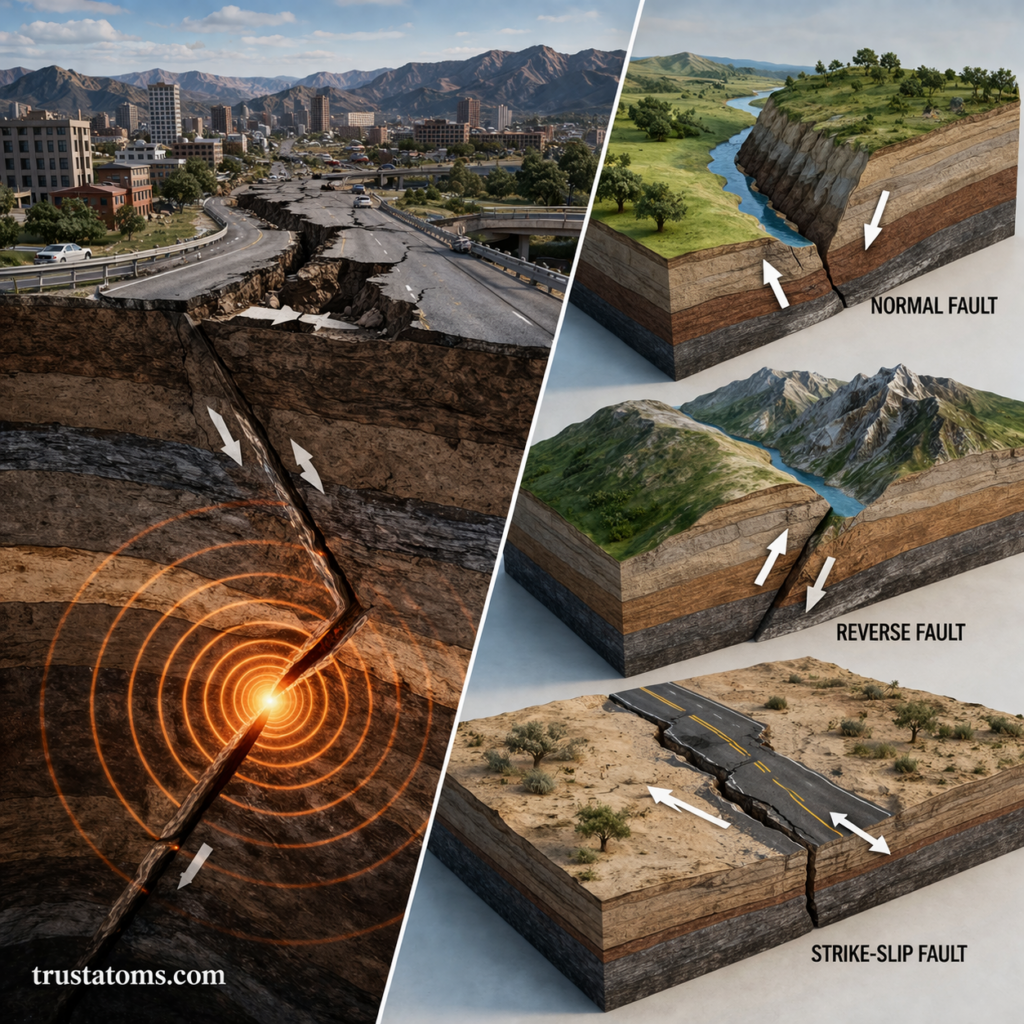
Faults are classified based on how rocks move along them.
1. Normal Faults
- Occur when the crust is stretched (tensional stress)
- One block moves downward relative to the other
- Common at divergent boundaries
Example: Rift valleys
2. Reverse (Thrust) Faults
- Occur when the crust is compressed
- One block is pushed upward over another
- Often found at convergent boundaries
Example: Mountain-building regions
3. Strike-Slip Faults
- Occur when rocks slide horizontally past each other
- Movement is side-to-side rather than vertical
- Common at transform boundaries
Example: The San Andreas Fault
How Earthquakes Occur
Earthquakes result from a process called elastic rebound.
The Elastic Rebound Theory
- Stress builds up along a fault over time
- Rocks bend or deform but do not immediately break
- When stress becomes too great, the rocks snap back
- Energy is released as seismic waves
This sudden release causes the ground to shake.
Types of Seismic Waves
Seismic waves are the energy released during an earthquake.
Body Waves (Travel Through Earth’s Interior)
- P-waves (Primary): Fastest waves, move through solids and liquids
- S-waves (Secondary): Slower, move only through solids
Surface Waves (Travel Along Earth’s Surface)
- Love waves: Cause horizontal shaking
- Rayleigh waves: Cause rolling, wave-like motion
Surface waves usually cause the most damage.
Measuring Earthquakes
Earthquakes are measured using instruments called seismographs.
Magnitude vs. Intensity
- Magnitude: Measures the energy released (e.g., Richter or Moment Magnitude scale)
- Intensity: Describes how strong the shaking is at a specific location
Modern Measurement
- Moment Magnitude Scale (Mw) is now the standard
- Provides more accurate results for large earthquakes
Where Earthquakes Occur
Earthquakes are not random—they are concentrated in specific zones.
Common Earthquake Zones
- Plate boundaries (most common)
- Subduction zones (powerful earthquakes)
- Transform faults
- Mid-ocean ridges
Major Global Regions
- Pacific Ring of Fire
- Mediterranean region
- Himalayan region
Effects of Earthquakes
Earthquakes can have both immediate and long-term impacts.
Primary Effects
- Ground shaking
- Surface rupture
- Structural damage
Secondary Effects
- Landslides
- Tsunamis
- Fires
- Soil liquefaction
Fault Systems and Earthquake Risk
Understanding fault systems is critical for assessing earthquake risk.
Why Fault Systems Matter
- Identify high-risk zones
- Help design safer buildings
- Guide urban planning and infrastructure development
Scientists use fault mapping and historical data to predict where earthquakes are more likely to occur, though exact timing cannot be predicted.
How Humans Prepare for Earthquakes
While earthquakes cannot be prevented, their impact can be reduced.
Common Preparedness Strategies
- Building earthquake-resistant structures
- Early warning systems
- Emergency response planning
- Public education and drills
Final Thoughts
Earthquakes and fault systems are key components of Earth’s dynamic nature. They reveal how stress builds and releases within the crust and help scientists understand the ongoing movement of tectonic plates.
By studying faults and seismic activity, we can better prepare for earthquakes and reduce their impact on human life and infrastructure.