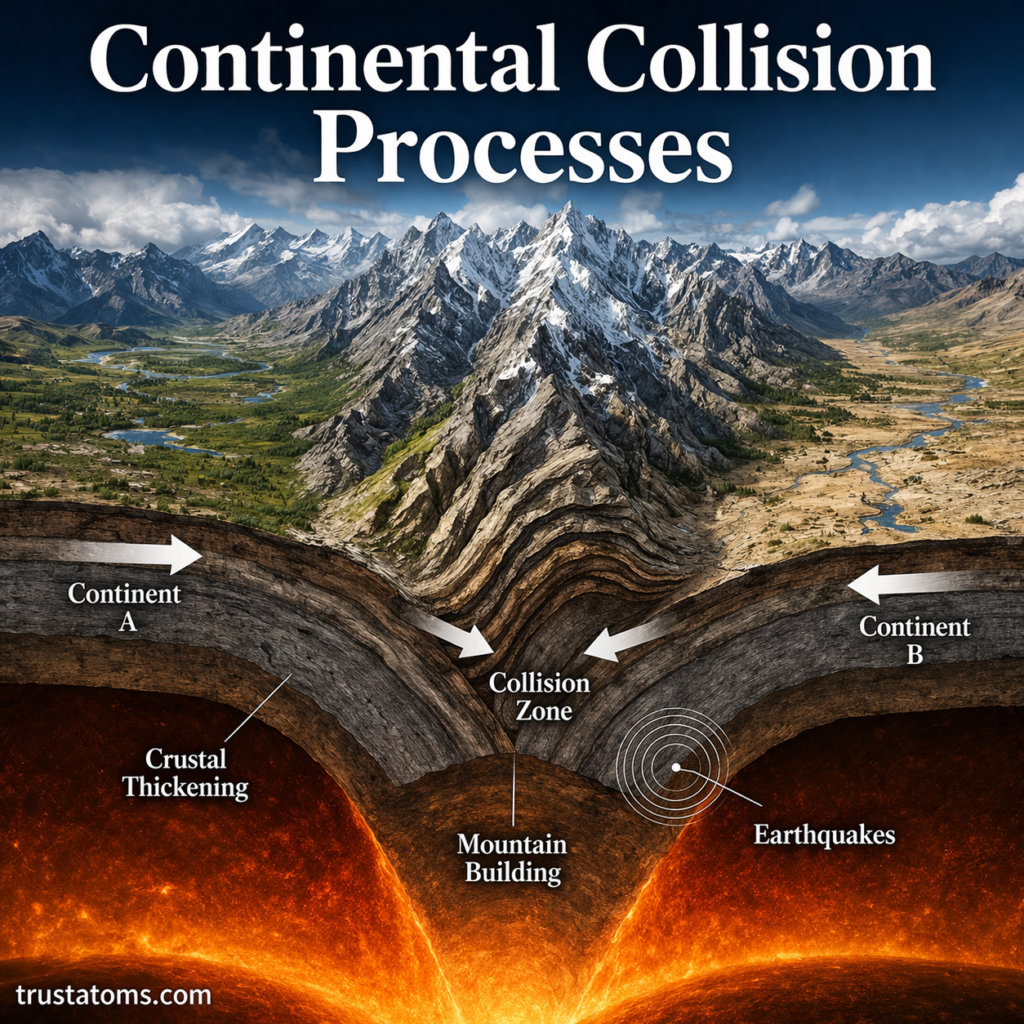
Continental collision is one of the most powerful geological processes on Earth. It occurs when two continental tectonic plates move toward each other and collide, reshaping the planet’s surface on a massive scale.
Unlike oceanic plates, continental plates are thick and buoyant. When they collide, neither plate easily sinks into the mantle. Instead, the crust crumples, folds, and rises—creating some of the world’s largest mountain ranges.
What Is Continental Collision?
Continental collision is a type of convergent plate boundary where two continental plates meet.
Because both plates have similar densities, the collision leads to:
- Crustal thickening
- Mountain building (orogeny)
- Folding and faulting of rock layers
- Earthquake activity
This process can take tens of millions of years, but its results are dramatic and long-lasting.
How Continental Collision Happens
The process of continental collision occurs in several stages:
1. Plate Convergence Begins
- Two tectonic plates begin moving toward each other
- Often starts with an ocean basin between them
- Oceanic crust may subduct beneath one plate initially
2. Ocean Basin Closes
- Continued convergence causes the oceanic crust to be consumed
- The continents move closer together over time
3. Continental Collision
- The two continental masses collide
- Subduction slows or stops due to buoyancy
- The crust compresses and thickens
4. Mountain Building
- Rocks fold and uplift
- Large mountain ranges form
- Deep crustal roots develop beneath mountains
Key Features of Continental Collision Zones
Continental collision zones have distinct geological characteristics:
- Massive folded mountain ranges
- Thickened crust (often double normal thickness)
- High plateaus
- Intense seismic activity
- Metamorphic rocks formed under pressure and heat
These regions are some of the most geologically active on land.
Famous Examples of Continental Collision
The Himalayas
- Formed by the collision of the Indian Plate and the Eurasian Plate
- Home to Mount Everest, the highest point on Earth
- Still rising today due to ongoing plate movement
The Alps
- Created by the collision of the African Plate and the Eurasian Plate
- Known for complex folding and faulting
The Appalachian Mountains
- Formed from ancient continental collisions hundreds of millions of years ago
- Now heavily eroded but once comparable to modern mountain ranges
What Happens to the Crust During Collision?
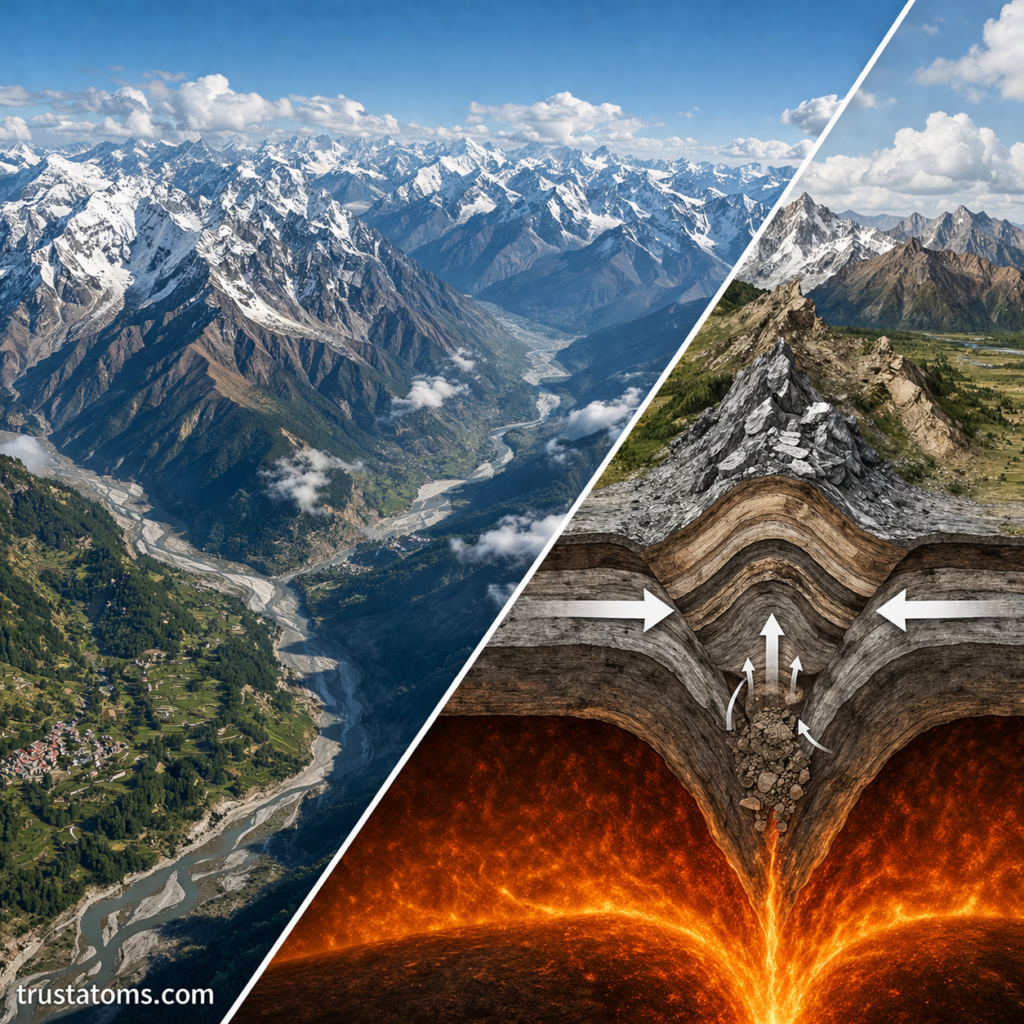
When continents collide, the crust undergoes intense deformation:
Folding
- Rock layers bend under pressure
- Creates wave-like structures in the crust
Faulting
- Rocks break and shift along fractures
- Can trigger earthquakes
Thickening
- Crust becomes deeper and denser
- Forms “roots” beneath mountain ranges
Metamorphism
- Rocks change due to heat and pressure
- New minerals and textures form
Why Continental Collision Does Not Create Volcanoes
Unlike oceanic-continental convergence, continental collisions rarely produce volcanoes.
This is because:
- There is little to no subduction of oceanic crust
- Less melting occurs in the mantle
- Magma formation is limited
Instead, the dominant feature is mountain building rather than volcanic activity.
The Role of Isostasy
Isostasy refers to the balance between Earth’s crust and the mantle beneath it.
In collision zones:
- Thickened crust sinks deeper into the mantle
- Uplift occurs as the crust adjusts
- Mountains can continue rising even after collision slows
This balance helps explain why large mountain ranges remain elevated over time.
How Fast Do Continental Collisions Occur?
Continental collisions happen very slowly:
- Typically a few centimeters per year
However, over millions of years, this gradual movement leads to:
- Massive mountain ranges
- Major changes in global geography
- Long-term climate impacts
Impact on Climate and Environment
Continental collisions influence Earth beyond geology:
- Mountains affect weather patterns and rainfall
- High elevations can create glaciers
- Erosion of mountains contributes to sediment formation
- Atmospheric circulation can shift due to large landforms
For example, the rise of the Himalayas has influenced monsoon patterns in Asia.
Evidence of Continental Collision
Scientists study several types of evidence to understand past and present collisions:
- Folded and deformed rock layers
- Fossils found in mountain regions (indicating former ocean basins)
- Seismic data showing crustal thickness
- GPS measurements tracking plate movement
- Metamorphic rock formations
Continental Collision vs. Other Convergent Boundaries
It’s important to distinguish continental collision from other types of plate convergence:
Continental–Continental
- Both plates resist subduction
- Forms mountains
- Limited volcanic activity
Oceanic–Continental
- Oceanic plate subducts
- Produces volcanoes and trenches
Oceanic–Oceanic
- One plate subducts
- Forms island arcs and volcanic chains
Common Misconceptions
Collisions Happen Suddenly
False. These processes take millions of years and occur gradually.
Mountains Form Instantly
Mountain building is slow and continuous, often still happening today.
All Collisions Cause Volcanoes
Only collisions involving subduction zones commonly produce volcanoes.
Final Thoughts
Continental collision processes are among the most powerful forces shaping Earth’s surface. Through slow but relentless movement, tectonic plates create towering mountain ranges, reshape continents, and influence global systems like climate and erosion.
By studying these processes, scientists gain insight into Earth’s dynamic history and better understand the forces still shaping our planet today.