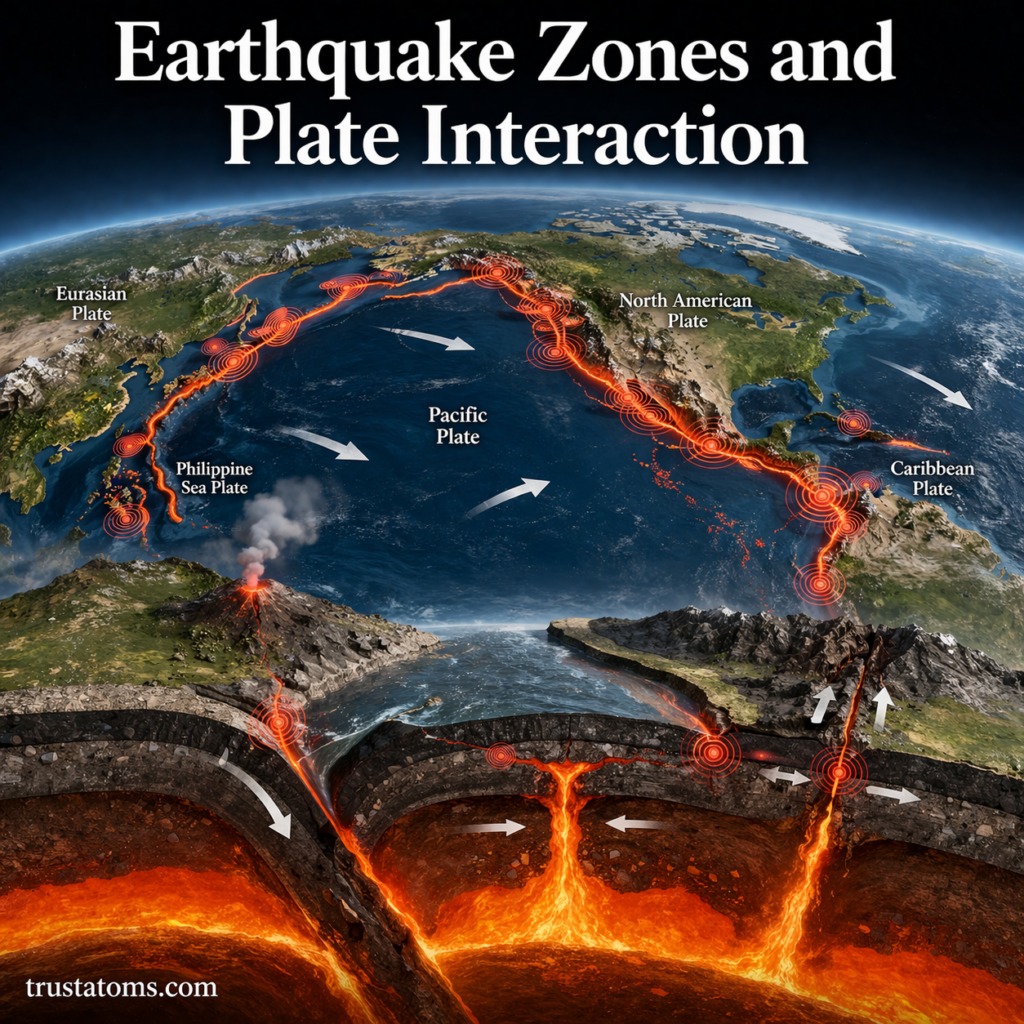
Earthquakes are one of the most powerful natural forces on our planet. While they may seem sudden and unpredictable, most earthquakes occur in specific regions known as earthquake zones—areas closely linked to the movement and interaction of tectonic plates.
Understanding how plate interactions create earthquake zones helps explain where earthquakes are most likely to occur and why they happen in the first place.
What Are Earthquake Zones?
Earthquake zones are regions of the Earth’s crust where seismic activity is concentrated. These areas typically align with tectonic plate boundaries, where large sections of the Earth’s lithosphere interact.
Earthquake zones are characterized by:
- Frequent seismic activity
- Fault lines and fractures in the crust
- Ongoing stress buildup and release
- Association with plate boundaries
Some of the most active earthquake zones include the Pacific Ring of Fire and major fault systems like the San Andreas Fault.
The Basics of Plate Tectonics
To understand earthquake zones, it’s important to understand plate tectonics.
The Earth’s outer layer is divided into large plates that move slowly over time. These plates:
- Float on the semi-fluid asthenosphere
- Move due to convection currents in the mantle
- Interact at their boundaries
When plates interact, stress builds up. When that stress is suddenly released, it produces an earthquake.
Types of Plate Boundaries and Earthquake Activity
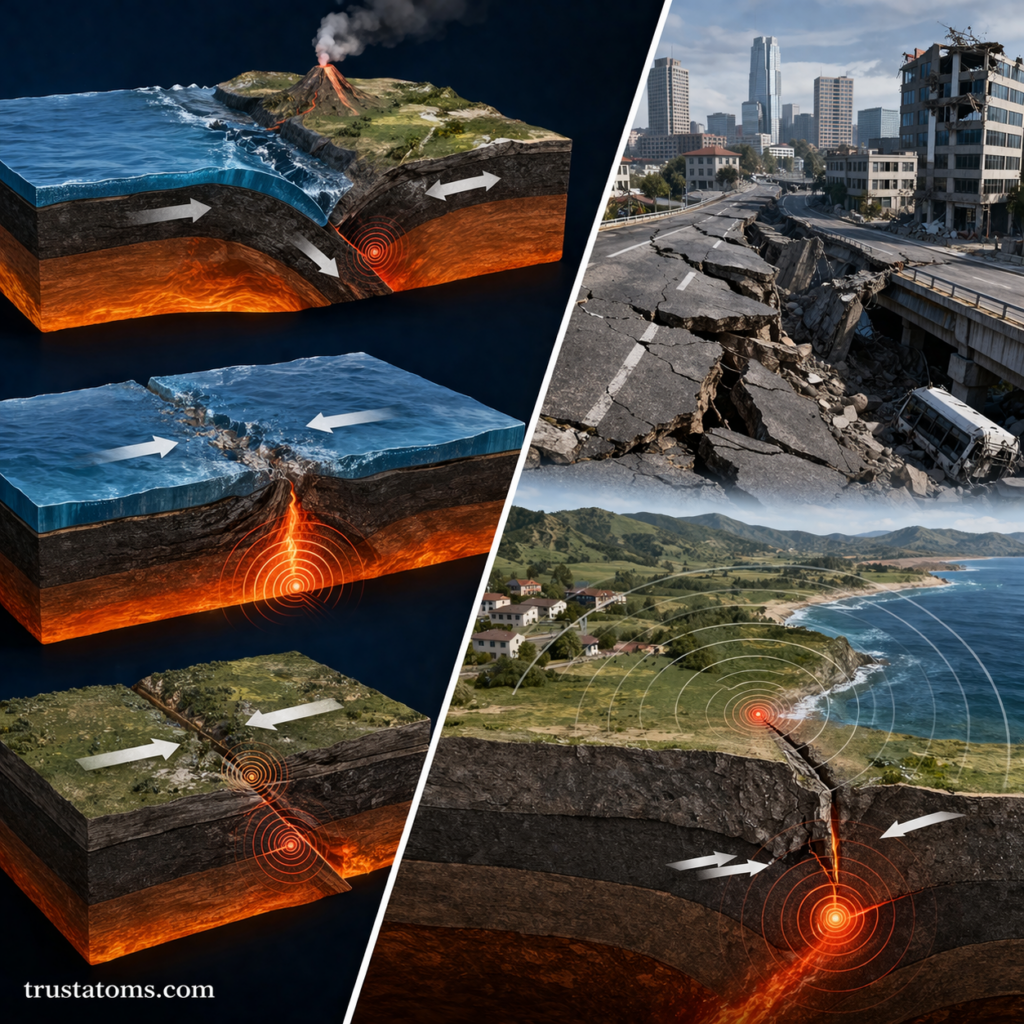
Different types of plate boundaries create different kinds of earthquake zones.
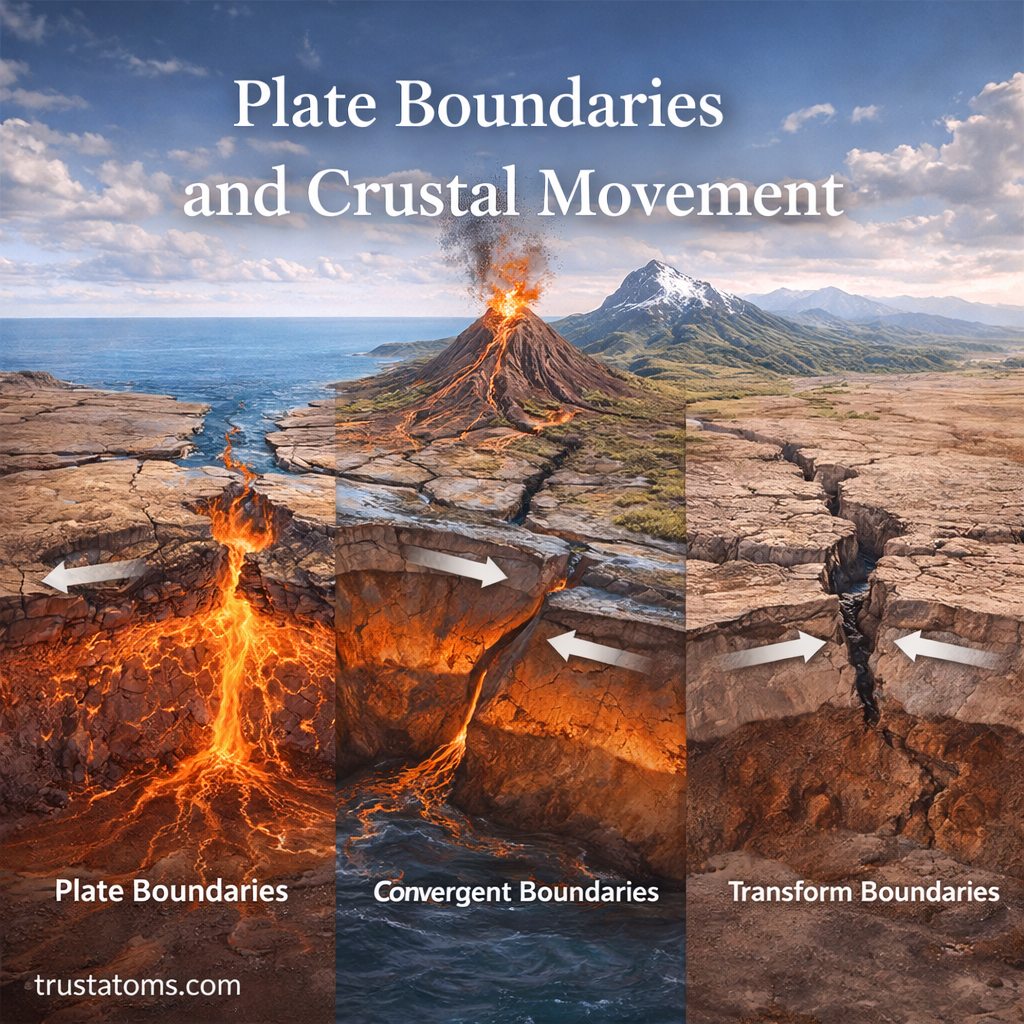
Convergent Boundaries (Collision Zones)
At convergent boundaries, two plates move toward each other.
- One plate may be forced beneath another (subduction)
- Intense pressure builds up over time
- Sudden release causes powerful earthquakes
Characteristics:
- Deep and shallow earthquakes
- Often associated with volcanic activity
- Can generate tsunamis
Example: Oceanic plate subducting beneath a continental plate
Divergent Boundaries (Spreading Zones)
At divergent boundaries, plates move away from each other.
- Magma rises to fill the gap
- New crust is formed
- Earthquakes tend to be smaller and shallow
Characteristics:
- Frequent but less intense earthquakes
- Common along mid-ocean ridges
Example: Mid-Atlantic Ridge
Transform Boundaries (Sliding Zones)
At transform boundaries, plates slide past each other horizontally.
- Friction prevents smooth movement
- Stress builds until it is released suddenly
Characteristics:
- Shallow, often strong earthquakes
- No significant volcanic activity
Example: San Andreas Fault in California
Fault Lines and Earthquake Zones
Faults are fractures in the Earth’s crust where movement occurs.
Types of Faults
- Normal faults – caused by tension (pulling apart)
- Reverse faults – caused by compression (pushing together)
- Strike-slip faults – caused by horizontal movement
Fault lines are often the exact locations where earthquakes originate within broader earthquake zones.
Why Earthquakes Occur
Earthquakes happen due to the buildup and release of stress in the Earth’s crust.
The Elastic Rebound Theory
- Tectonic plates move but get stuck due to friction
- Stress builds up in the rocks
- When the stress exceeds the strength of the rock, it breaks
- Energy is released as seismic waves
This sudden release of energy causes the ground to shake.
Major Global Earthquake Zones
Certain regions experience more earthquakes due to their position along plate boundaries.
Pacific Ring of Fire
- Encircles the Pacific Ocean
- Contains about 75% of the world’s active volcanoes
- Frequent and powerful earthquakes
Alpide Belt
- Extends from Europe through Asia
- Includes regions like the Mediterranean and Himalayas
- Caused by continental collisions
Mid-Ocean Ridges
- Underwater mountain ranges
- Frequent, smaller earthquakes
- Associated with divergent boundaries
Measuring Earthquakes
Scientists use several tools to study earthquakes and their zones.
Seismographs
- Record ground motion
- Detect even very small earthquakes
Magnitude Scales
- Measure the energy released (e.g., Moment Magnitude Scale)
Intensity Scales
- Measure the effects on people and structures (e.g., Modified Mercalli Scale)
Hazards Associated with Earthquake Zones
Earthquake zones pose several risks to both natural environments and human communities.
Ground Shaking
- Can damage or destroy buildings
- Primary cause of earthquake-related destruction
Surface Rupture
- Cracks and displacement along fault lines
Landslides
- Triggered by shaking in mountainous areas
Tsunamis
- Caused by undersea earthquakes
- Can travel across entire oceans
Human Impact and Preparedness
Living near earthquake zones requires planning and awareness.
Risk Reduction Strategies
- Earthquake-resistant building design
- Early warning systems
- Public education and preparedness drills
Monitoring and Prediction
While exact prediction is not possible, scientists can:
- Identify high-risk zones
- Monitor stress buildup
- Improve hazard assessments
Why Understanding Plate Interaction Matters
Studying plate interactions provides critical insights into Earth’s behavior.
Key Benefits
- Helps identify earthquake-prone regions
- Improves disaster preparedness
- Supports safer infrastructure development
- Advances scientific understanding of Earth systems
Final Thoughts
Earthquake zones are a direct result of tectonic plate interactions. Whether plates collide, separate, or slide past each other, the stress they generate can lead to powerful seismic events.
By understanding how these processes work, we can better prepare for earthquakes, reduce risks, and appreciate the dynamic forces shaping our planet.