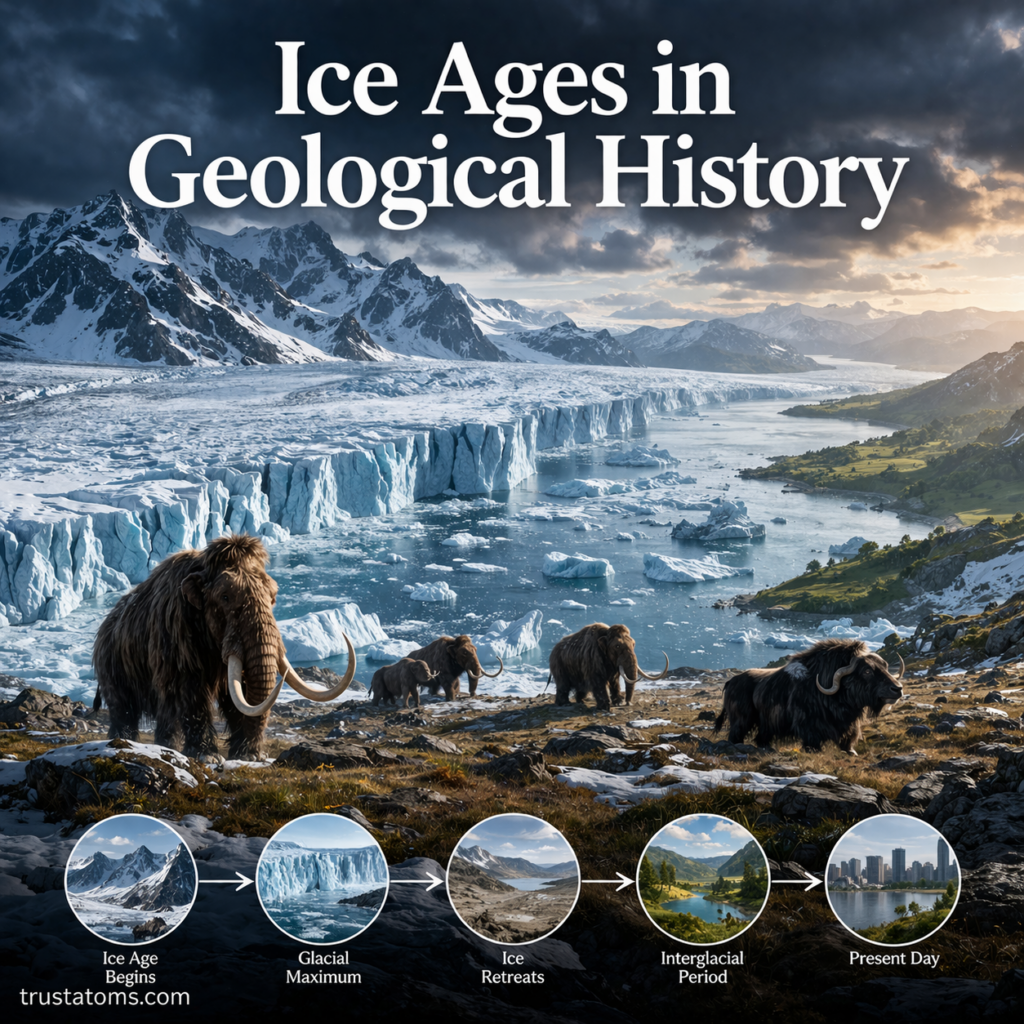
Throughout Earth’s history, the planet has experienced long periods of extreme cold known as ice ages. During these times, massive ice sheets expanded across continents, dramatically reshaping landscapes, sea levels, and ecosystems.
Ice ages are not single events but extended intervals marked by alternating colder (glacial) and warmer (interglacial) periods. Understanding these cycles helps explain how Earth’s climate has evolved over millions of years.
What Is an Ice Age?
An ice age is a prolonged period during which global temperatures are low enough for large ice sheets to form and persist, especially near the poles.
Key Characteristics
- Expansion of continental ice sheets
- Lower global temperatures
- Reduced sea levels due to water locked in ice
- Increased reflectivity of Earth’s surface (albedo effect)
Even within an ice age, the climate fluctuates between colder and warmer phases.
Major Ice Ages in Earth’s History
Earth has experienced several major ice ages over billions of years.
1. Huronian Ice Age (2.4–2.1 billion years ago)
- One of the earliest known ice ages
- Likely triggered by a drop in greenhouse gases
- Possibly linked to the rise of oxygen-producing organisms
2. Cryogenian Ice Age (720–635 million years ago)
- Often referred to as “Snowball Earth”
- Ice may have covered nearly the entire planet
- Extreme conditions challenged early life
3. Andean-Saharan Ice Age (450–420 million years ago)
- Occurred during the late Ordovician and Silurian periods
- Associated with shifts in continental positions
4. Late Paleozoic Ice Age (335–260 million years ago)
- Affected parts of present-day South America, Africa, and Antarctica
- Linked to the formation of the supercontinent Pangaea
5. Quaternary Ice Age (2.6 million years ago–present)
- The current ice age
- Includes repeated glacial and interglacial cycles
- Humans evolved during this period
Glacial vs. Interglacial Periods
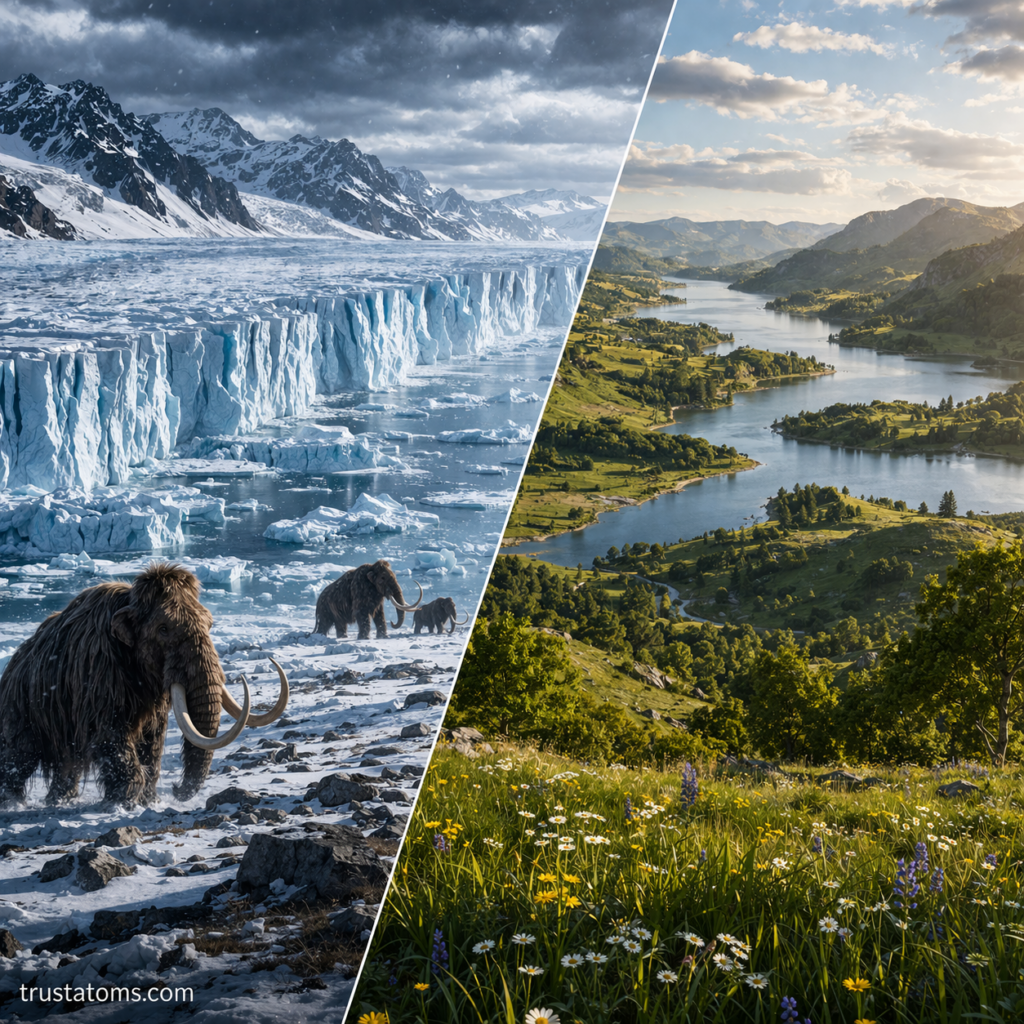
Ice ages are made up of alternating phases:
Glacial Periods
- Colder conditions dominate
- Ice sheets expand across continents
- Sea levels drop significantly
Interglacial Periods
- Warmer conditions return
- Ice sheets retreat
- Sea levels rise
We are currently living in an interglacial phase called the Holocene.
What Causes Ice Ages?
Ice ages result from a combination of factors that influence Earth’s climate over long timescales.
Primary Drivers
- Variations in Earth’s orbit (Milankovitch cycles)
- Changes in atmospheric greenhouse gases
- Continental drift and plate tectonics
- Ocean circulation patterns
Feedback Mechanisms
- Ice-albedo effect (more ice reflects more sunlight)
- Carbon cycle changes
- Vegetation shifts
These processes can reinforce cooling or warming trends over time.
How Ice Ages Shape the Planet
Ice ages have had a profound impact on Earth’s surface and ecosystems.
Geological Effects
- Carving of valleys and fjords by glaciers
- Formation of lakes and river systems
- Deposition of sediments and moraines
Climate and Ocean Changes
- Lower sea levels exposing land bridges
- Changes in ocean currents
- Altered global weather patterns
Biological Impacts
- Species migration and adaptation
- Extinctions of less adaptable organisms
- Evolution of new species
Ice Ages and Human Evolution
The Quaternary Ice Age played a key role in shaping human history.
Key Influences
- Migration routes opened by lower sea levels
- Adaptation to diverse and changing climates
- Development of tools, clothing, and shelter
Human survival often depended on the ability to adapt to rapidly shifting environments.
Evidence of Past Ice Ages
Scientists use multiple lines of evidence to reconstruct ancient ice ages.
Key Sources
- Ice cores containing trapped air bubbles
- Ocean sediment layers
- Fossil records
- Glacial landforms (moraines, striations)
These records reveal patterns of climate change stretching back millions of years.
Are We Still in an Ice Age?
Yes—Earth is technically still in an ice age.
Why?
- Permanent ice sheets exist in Antarctica and Greenland
- The current warm period (Holocene) is just an interglacial phase
This means that, over long timescales, Earth could return to colder conditions.
Ice Ages vs. Modern Climate Change
It’s important to distinguish between natural ice age cycles and current climate trends.
Key Differences
- Ice ages occur over thousands to millions of years
- Modern climate change is happening rapidly (within decades to centuries)
- Current warming is strongly linked to human activities
Understanding past ice ages provides context, but today’s climate changes are occurring at an unusually fast pace.
Final Thoughts
Ice ages are a fundamental part of Earth’s long-term climate system. From “Snowball Earth” to the ongoing Quaternary Ice Age, these periods have shaped continents, ecosystems, and even human evolution.
By studying ice ages, scientists gain valuable insights into how Earth’s climate works—and how it may change in the future.