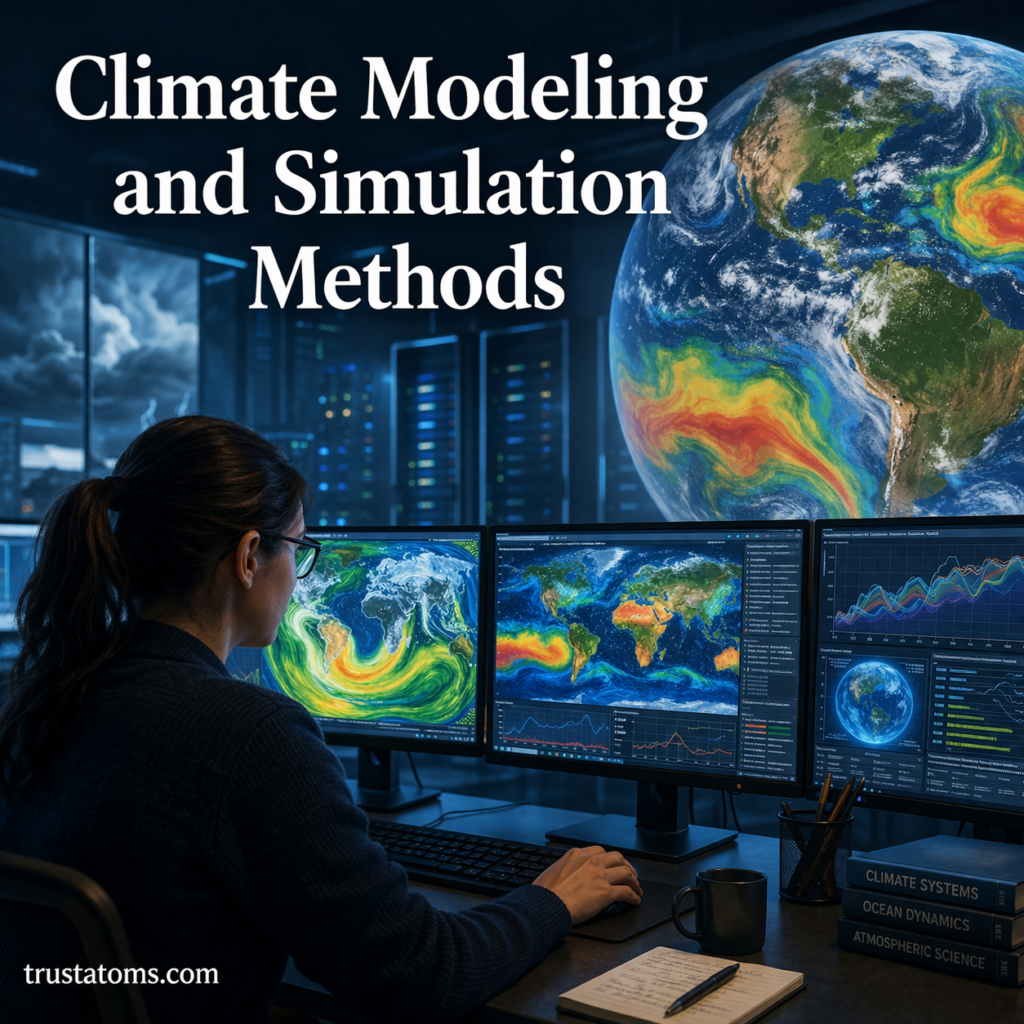
Climate modeling is one of the most powerful tools scientists use to understand Earth’s past, present, and future climate. By simulating interactions between the atmosphere, oceans, land, and ice, researchers can explore how different factors influence global climate systems.
This guide explains how climate models work, the different types used, and why they are essential for predicting climate change.
What Is Climate Modeling?
Climate modeling involves using mathematical equations and computer simulations to represent Earth’s climate system.
These models simulate:
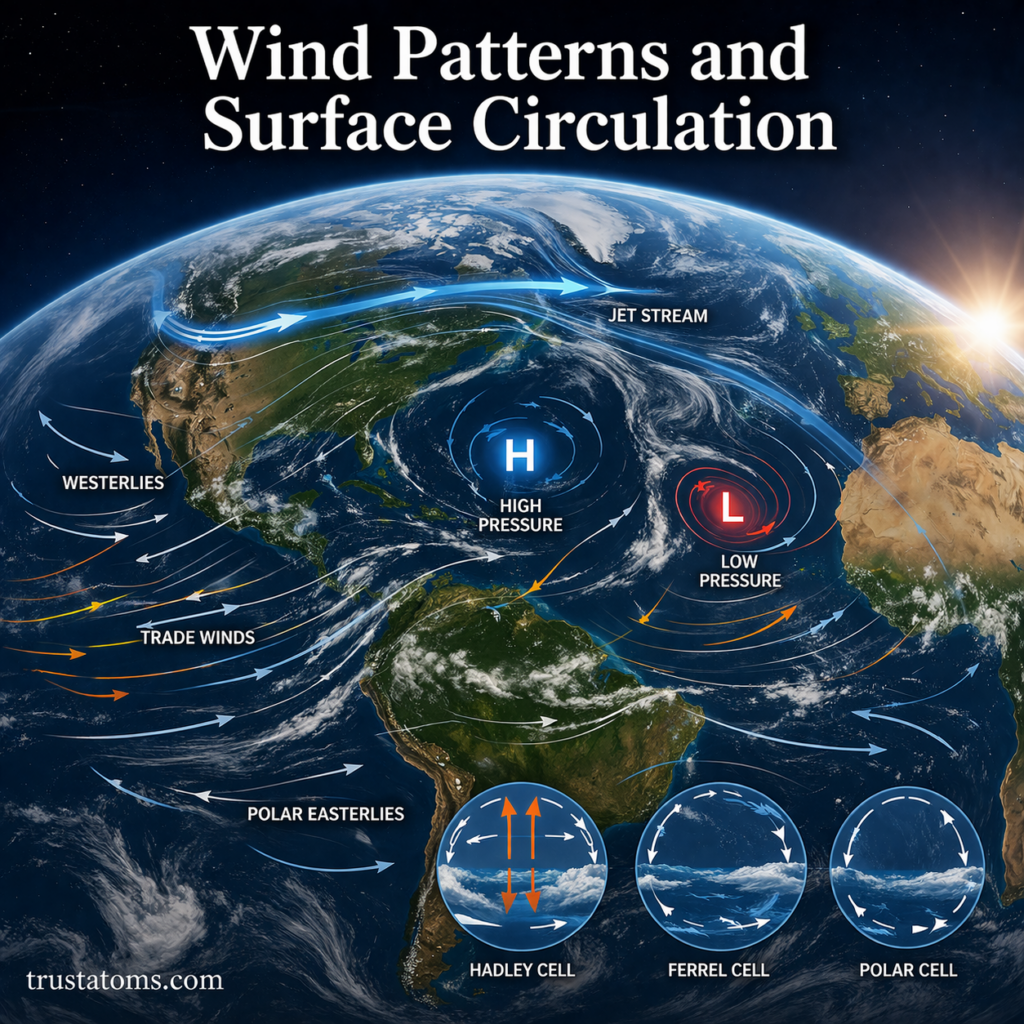
- Atmospheric circulation (wind, temperature, pressure)
- Ocean currents and heat distribution
- Land surface processes
- Ice sheets and glaciers
- Energy exchange from the sun
By combining these components, scientists can recreate how the climate behaves over time.
How Climate Models Work
Breaking Earth Into a Grid
Climate models divide the planet into a 3D grid:
- Horizontal grid cells cover land and ocean areas
- Vertical layers represent the atmosphere and ocean depth
Each grid cell contains variables such as:
- Temperature
- Humidity
- Wind speed
- Pressure
The model calculates how these variables change over time using physical laws.
Time Steps and Calculations
Models run in small time increments called time steps:
- Initial conditions are set (current climate data)
- Equations calculate changes for each grid cell
- Results are updated step by step over time
This process allows simulations to project climate changes over decades or even centuries.
Types of Climate Models
1. General Circulation Models (GCMs)
GCMs are the most comprehensive climate models.
They simulate:
- Atmosphere and ocean circulation
- Energy transfer across the planet
- Interactions between major climate systems
These models are widely used for global climate projections.
2. Earth System Models (ESMs)
ESMs build on GCMs by including additional processes:
- Carbon cycle interactions
- Vegetation and ecosystems
- Atmospheric chemistry
This makes them more realistic when studying long-term climate change.
3. Regional Climate Models (RCMs)
RCMs focus on smaller geographic areas.
They provide:
- Higher resolution data
- More detailed local predictions
- Better insights for specific regions
These are useful for studying extreme weather events and regional impacts.
Key Components of Climate Models
Atmosphere
Simulates:
- Air movement
- Cloud formation
- Heat transfer
Oceans
Tracks:
- Ocean currents
- Heat storage and transport
- Interaction with the atmosphere
Land Surface
Includes:
- Soil moisture
- Vegetation
- Surface temperature
Cryosphere
Represents:
- Ice sheets
- Sea ice
- Snow cover
Each component interacts with the others, making climate modeling highly complex.
Inputs and Data Used in Models
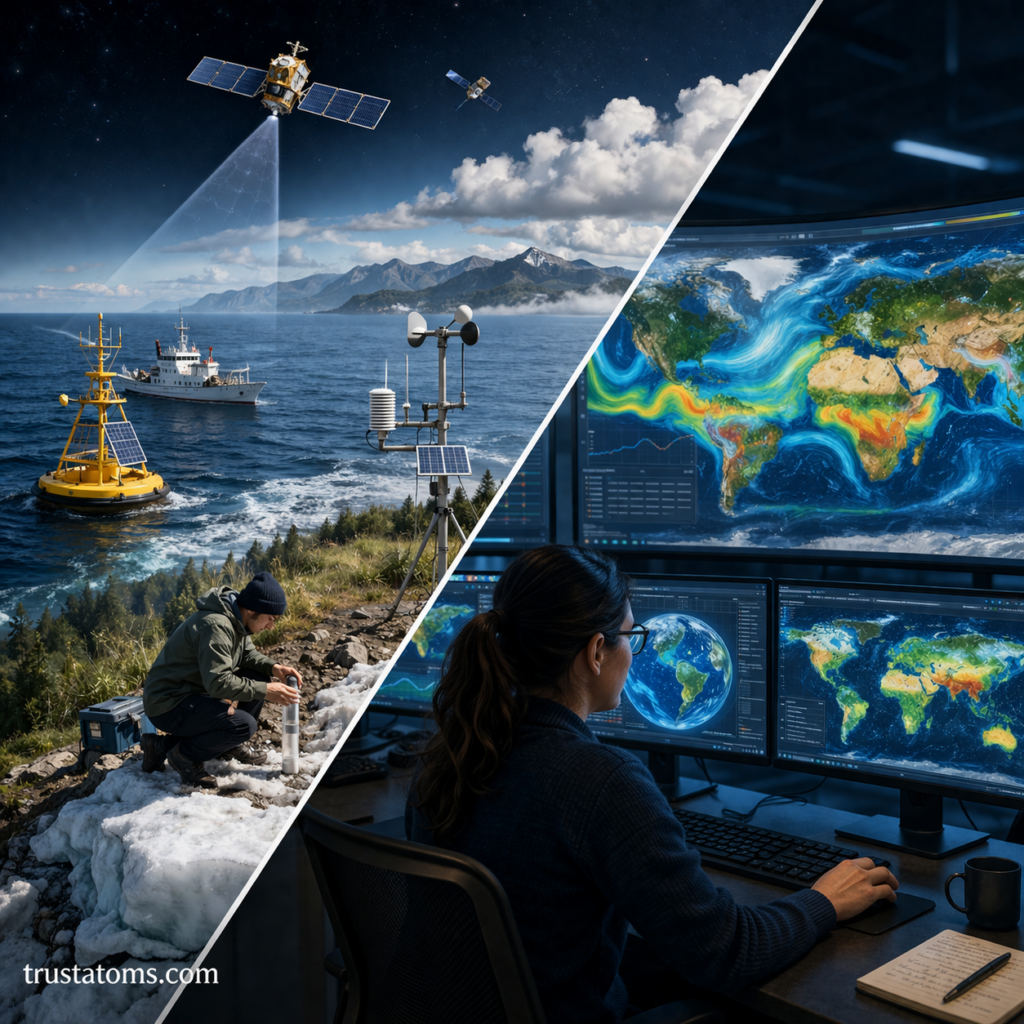
Climate models rely on both current and historical data.
Observational Data
- Weather station records
- Satellite measurements
- Ocean buoys
Historical Climate Data
- Ice cores
- Tree rings
- Sediment records
Emissions Scenarios
Models use different future scenarios based on:
- Greenhouse gas emissions
- Population growth
- Energy use
These scenarios help simulate possible future outcomes.
Climate Simulation Scenarios
Baseline Simulations
- Represent current or past climate conditions
- Used to validate model accuracy
Future Projections
- Explore how climate may change under different emissions levels
- Often extend to the year 2100 or beyond
Sensitivity Experiments
- Test how specific variables (like CO₂) affect climate
- Help isolate cause-and-effect relationships
Strengths of Climate Models
Climate models provide valuable insights:
- Predict long-term temperature trends
- Identify patterns in extreme weather
- Help policymakers plan for climate risks
- Test “what-if” scenarios safely
They are essential for understanding complex systems that cannot be tested in real life.
Limitations and Uncertainty
Despite their usefulness, climate models have limitations:
Resolution Constraints
- Grid cells may be too large to capture small-scale processes
Uncertain Inputs
- Future human behavior (emissions) is unpredictable
Simplified Processes
- Some natural processes are approximated rather than fully modeled
To address this, scientists use multiple models and compare results to improve reliability.
Model Validation and Accuracy
Scientists test models by comparing them to real-world data.
Hindcasting
- Models are run using past data
- Results are compared to known historical outcomes
Model Intercomparison
- Multiple models are compared in large projects
- Helps identify consistent patterns and reduce bias
These methods increase confidence in model predictions.
Why Climate Modeling Matters
Climate models play a critical role in modern science and policy.
They help:
- Forecast global warming trends
- Predict sea level rise
- Understand extreme weather risks
- Guide climate mitigation strategies
Without modeling, it would be nearly impossible to anticipate future climate conditions.
The Future of Climate Modeling
Advancements in technology are improving climate models:
Higher Resolution
- More detailed simulations of local climates
Better Data Integration
- Improved satellite and observational data
Increased Computing Power
- Faster and more complex simulations
AI and Machine Learning
- Enhancing pattern recognition and prediction accuracy
These improvements will make future climate projections even more precise.
Key Takeaways
- Climate models simulate Earth’s climate using mathematical equations
- They divide the planet into grid systems and calculate changes over time
- Major types include GCMs, ESMs, and RCMs
- Models rely on observational data and future emission scenarios
- While not perfect, they are essential for predicting climate change
Conclusion
Climate modeling and simulation methods provide a window into Earth’s future. By combining physics, data, and computing power, scientists can explore how the climate system responds to natural and human influences.
As models continue to improve, they will remain a cornerstone of climate science—helping society make informed decisions in a changing world.