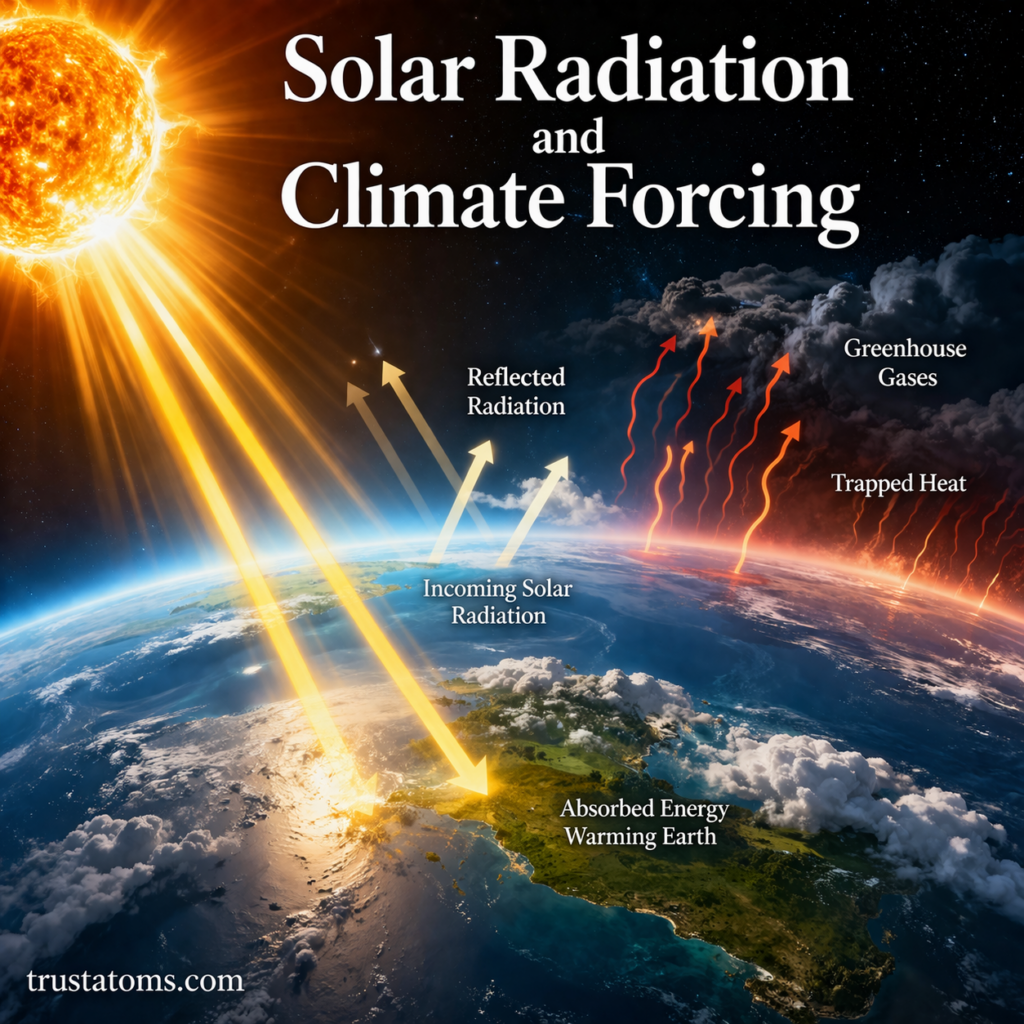
Solar radiation is the primary source of energy for Earth’s climate system. Every second, the Sun sends vast amounts of energy toward our planet, driving weather patterns, ocean currents, and temperature regulation.
Climate forcing refers to factors that alter Earth’s energy balance—either warming or cooling the planet. Solar radiation is one of the most important natural drivers of this balance.
This article explains how solar radiation works, how it influences climate forcing, and how it interacts with other factors affecting global temperatures.
What Is Solar Radiation?
Solar radiation is the energy emitted by the Sun in the form of electromagnetic waves.
Types of Solar Radiation
- Visible light: The portion we can see
- Ultraviolet (UV): Higher energy radiation
- Infrared (IR): Heat energy
When solar radiation reaches Earth, it can be:
- Reflected back into space
- Absorbed by the atmosphere
- Absorbed by land and oceans
Earth’s Energy Balance
Earth’s climate depends on a balance between incoming solar energy and outgoing heat.
How the Balance Works
- Solar radiation enters Earth’s atmosphere
- Some is reflected by clouds, ice, and surfaces
- The rest is absorbed and warms the planet
- Earth emits heat (infrared radiation) back into space
If more energy enters than leaves, Earth warms. If more leaves than enters, Earth cools.
What Is Climate Forcing?
Climate forcing (or radiative forcing) refers to factors that change the balance between incoming and outgoing energy.
Types of Climate Forcing
- Positive forcing: Leads to warming
- Negative forcing: Leads to cooling
Forcing is measured in watts per square meter (W/m²), indicating how much energy is added or removed from the system.
Solar Forcing: The Sun’s Influence
Solar forcing refers specifically to changes in solar radiation that affect Earth’s climate.
Natural Variations in Solar Output
The Sun’s energy output is not perfectly constant.
Key variations include:
- Solar cycles (about 11 years): Small fluctuations in solar activity
- Sunspots: Dark areas linked to changes in energy output
- Solar flares: Short bursts of increased radiation
These changes slightly influence Earth’s climate over time.
The Role of Earth’s Orbit
Earth’s orbit also affects how solar radiation is distributed.
Milankovitch Cycles
These long-term cycles influence climate over thousands of years:
- Eccentricity: Shape of Earth’s orbit
- Axial tilt: Angle of Earth’s axis
- Precession: Wobble in Earth’s rotation
Together, these cycles affect how much solar energy different regions receive, contributing to ice ages and warmer periods.
Reflection and Absorption: The Albedo Effect
Not all solar radiation is absorbed—some is reflected.
Surfaces With High Albedo
- Ice and snow
- Clouds
Surfaces With Low Albedo
- Oceans
- Forests
Climate Impact
- Higher albedo → more reflection → cooling
- Lower albedo → more absorption → warming
Changes in albedo (like melting ice) can significantly affect climate forcing.
Atmospheric Interaction With Solar Radiation
The atmosphere plays a key role in how solar radiation is processed.
Key Processes
- Absorption: Gases like ozone absorb UV radiation
- Scattering: Particles redirect sunlight in different directions
- Reflection: Clouds bounce sunlight back into space
These processes determine how much energy reaches Earth’s surface.
Solar Radiation vs Greenhouse Gases
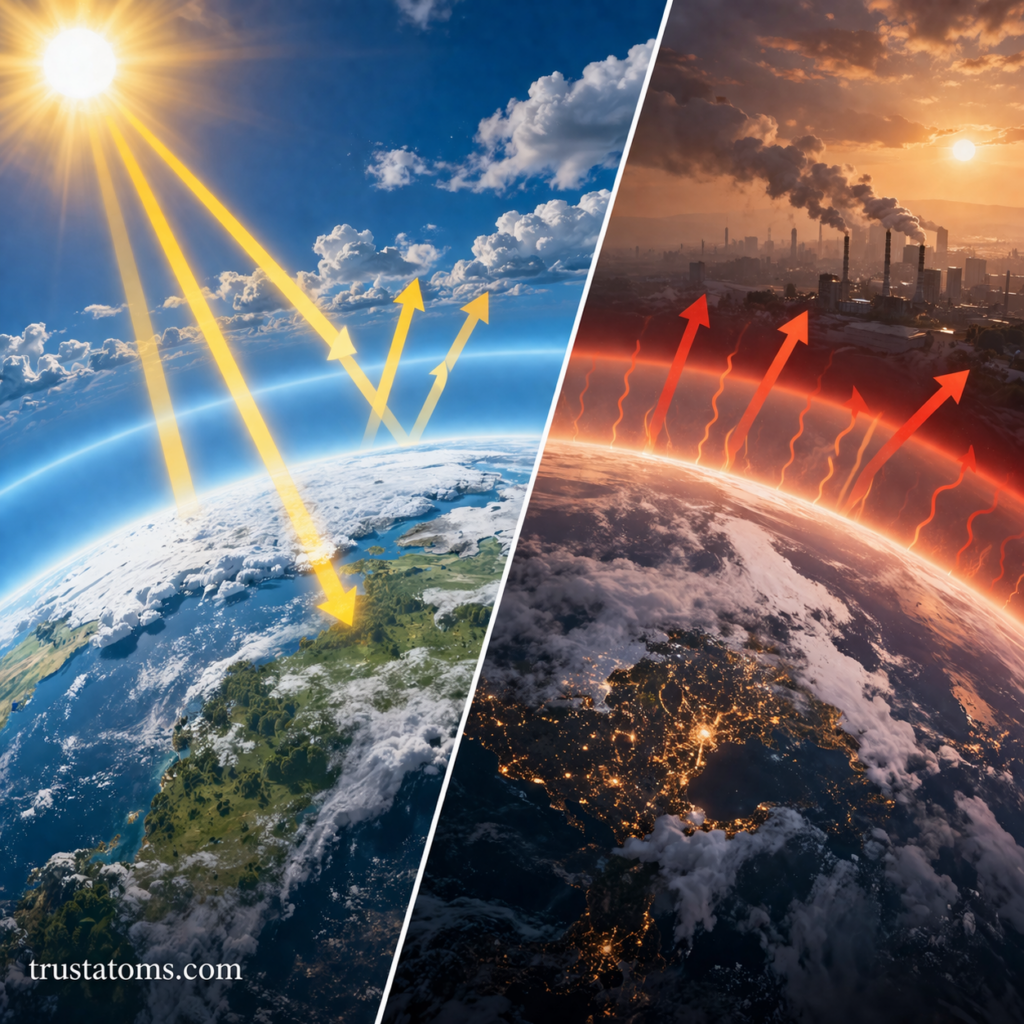
While solar radiation is the main energy source, greenhouse gases control how much heat is retained.
Key Differences
- Solar radiation provides incoming energy
- Greenhouse gases trap outgoing heat
Combined Effect
- Increased greenhouse gases amplify warming
- Even small changes in solar input can influence climate when combined with atmospheric effects
Today’s climate change is primarily driven by greenhouse gases, not changes in solar output.
Short-Term vs Long-Term Climate Forcing
Short-Term Forcing
- Solar flares
- Volcanic eruptions
- Temporary cloud changes
These have brief impacts on climate.
Long-Term Forcing
- Orbital changes
- Greenhouse gas accumulation
- Persistent albedo changes
These drive long-term climate trends.
Measuring Solar Radiation and Forcing
Scientists use several tools to study solar radiation and its effects.
Satellite Observations
- Measure incoming solar energy
- Track changes in Earth’s energy balance
Ground-Based Instruments
- Monitor sunlight intensity
- Measure atmospheric conditions
Climate Models
- Simulate how solar forcing interacts with other factors
- Predict future climate scenarios
Why Solar Radiation Matters for Climate
Solar radiation is fundamental to understanding climate systems.
Key Impacts
- Drives global temperature patterns
- Powers atmospheric and ocean circulation
- Influences seasonal and regional climates
- Interacts with other climate forcing factors
Without solar radiation, Earth would not sustain life as we know it.
Key Takeaways
- Solar radiation is Earth’s primary energy source
- Climate forcing refers to changes in Earth’s energy balance
- Solar forcing results from variations in solar output and Earth’s orbit
- Albedo and atmospheric processes affect how radiation is absorbed or reflected
- Modern climate change is mainly driven by greenhouse gases, not solar variation
Conclusion
Solar radiation and climate forcing are at the heart of Earth’s climate system. While the Sun provides the energy that powers the planet, how that energy is absorbed, reflected, and retained determines global temperatures.
Understanding these processes helps clarify the difference between natural climate variability and human-driven climate change—providing a clearer picture of how Earth’s climate is evolving.