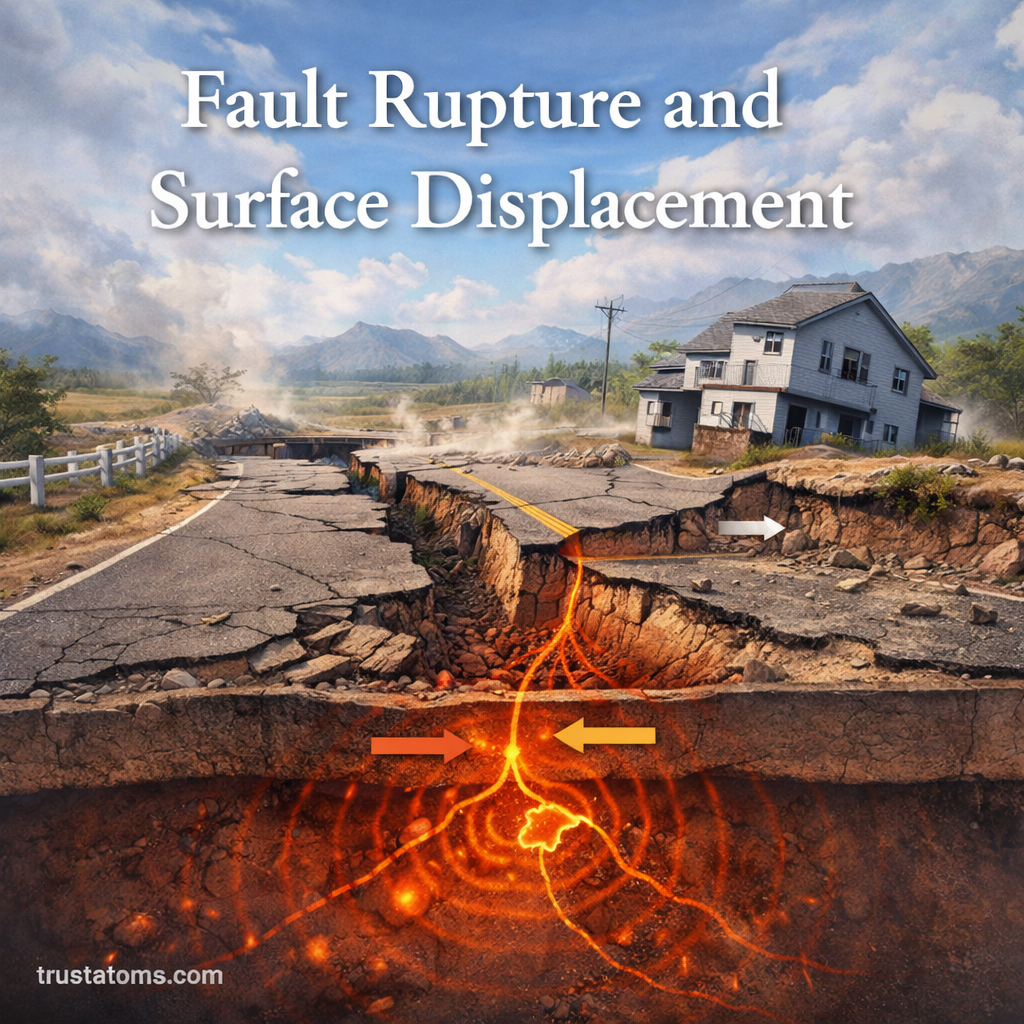
Earthquakes are not just vibrations beneath our feet—they can permanently change the shape of the land. One of the most visible and powerful effects of an earthquake is fault rupture, which often leads to surface displacement.
These processes reveal how stress builds up in Earth’s crust and is suddenly released, reshaping landscapes in seconds. Understanding fault rupture and surface displacement is essential for earthquake science, hazard planning, and infrastructure design.
What Is Fault Rupture?
Fault rupture occurs when stress along a fault line becomes too great and the rocks suddenly break and move.
A fault is a fracture in Earth’s crust where blocks of rock move relative to each other. Over time, tectonic forces cause stress to accumulate along these faults.
When the stress exceeds the strength of the rocks:
- The fault breaks (ruptures)
- Stored energy is released as seismic waves
- The ground shifts along the fault line
This sudden movement is what we experience as an earthquake.
What Is Surface Displacement?
Surface displacement refers to the visible movement of the ground during or after a fault rupture.
This movement can occur in different ways:
- Horizontal shifting (side-to-side movement)
- Vertical movement (uplift or sinking)
- Combination of both
In some earthquakes, roads, fences, and even rivers can be offset by several feet or more.
Types of Fault Movement
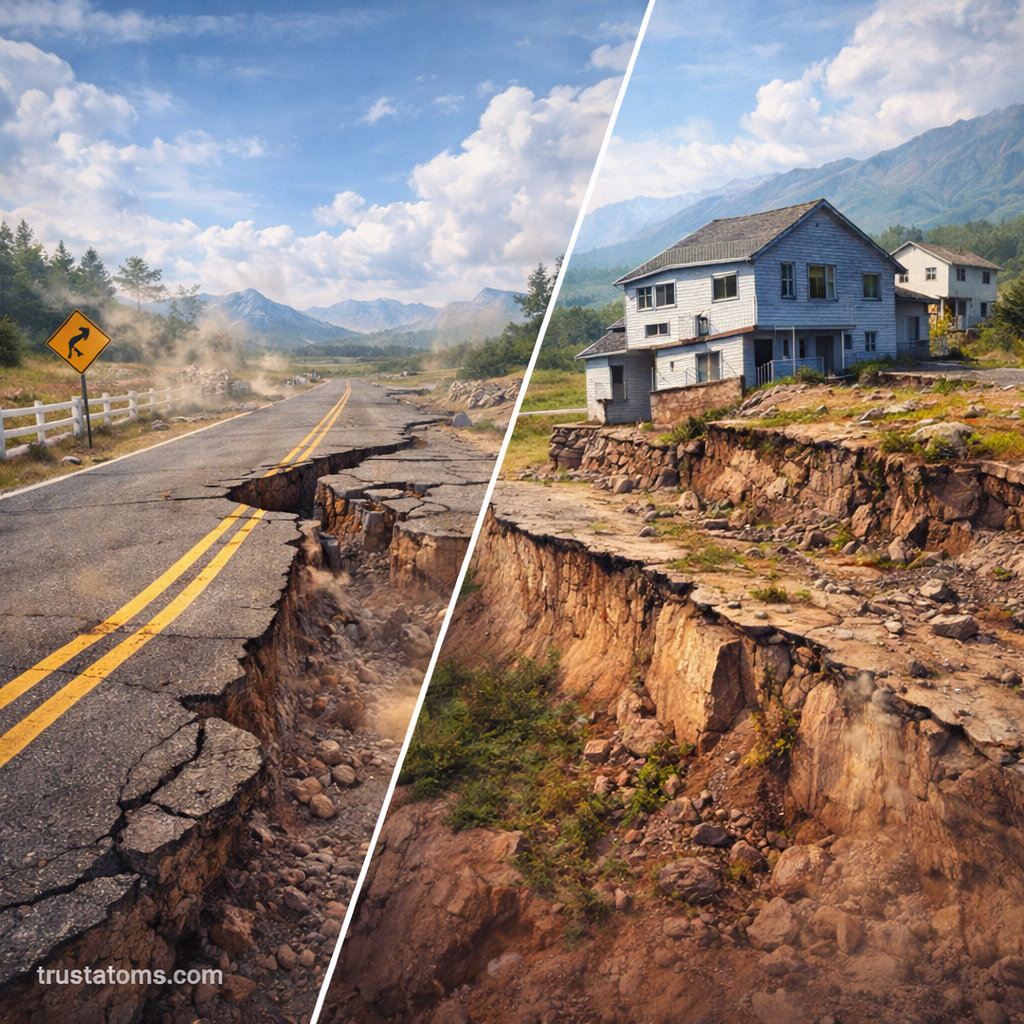
Different types of faults produce different patterns of rupture and displacement.
Strike-Slip Faults
- Movement is primarily horizontal
- Blocks slide past each other
- Common along transform boundaries
Example effects:
- Roads offset sideways
- Fences appearing “broken” or shifted
Normal Faults
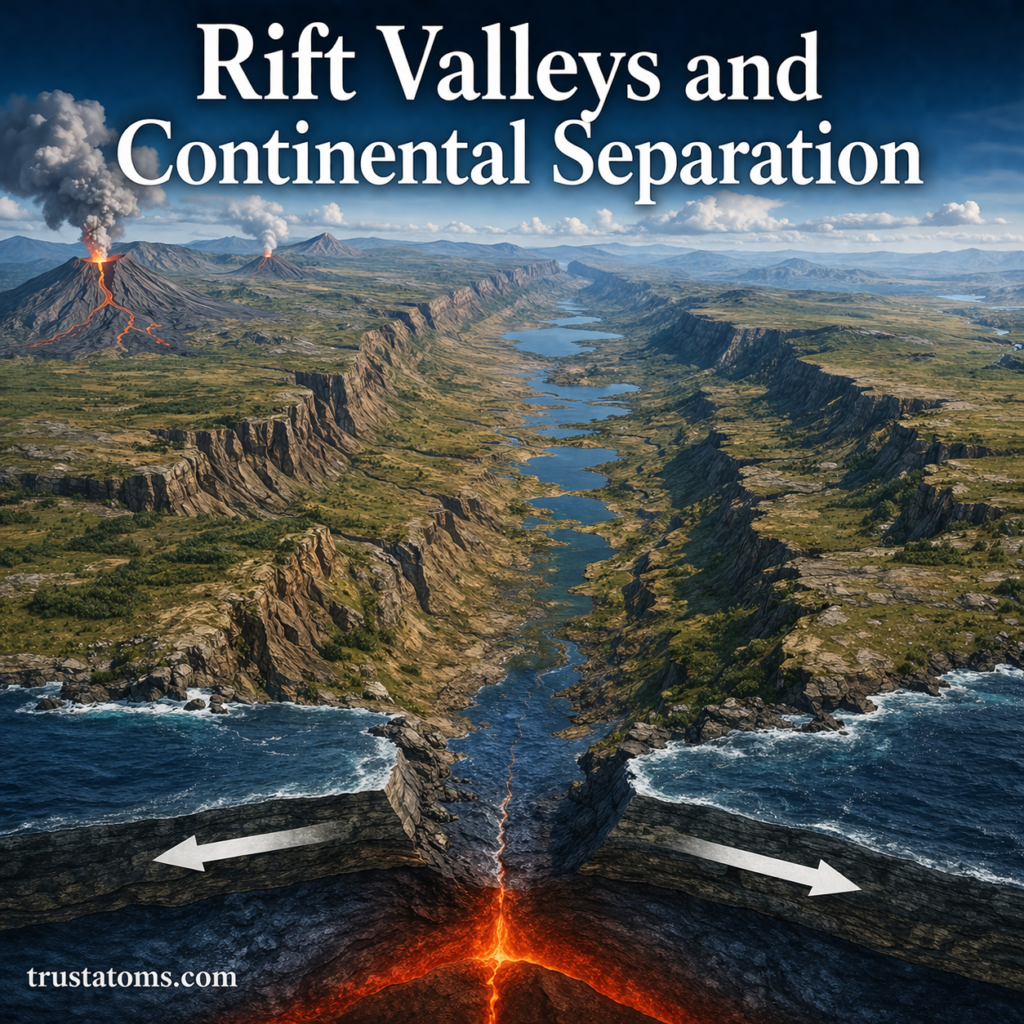
- Occur where the crust is being pulled apart
- One block moves downward relative to the other
Example effects:
- Formation of valleys or basins
- Surface cracks and step-like drops
Reverse (Thrust) Faults
- Occur where the crust is compressed
- One block is pushed upward over another
Example effects:
- Sudden uplift of land
- Formation of ridges or hills
How Fault Rupture Reaches the Surface
Not all earthquakes produce visible surface rupture. Whether a rupture reaches the surface depends on several factors:
- Depth of the earthquake
- Magnitude (strength)
- Type of fault
- Rock composition
Shallow vs Deep Earthquakes
- Shallow earthquakes (0–70 km) are more likely to cause surface rupture
- Deep earthquakes often release energy before reaching the surface
When rupture does reach the surface, it can create long, visible fault lines stretching for miles.
Measuring Surface Displacement
Scientists use several methods to measure how much the ground has moved:
Field Observations
- Measuring offsets in roads, fences, and natural features
- Mapping visible fault lines
GPS Technology
- Tracks precise ground movement before and after earthquakes
- Can detect shifts of just a few millimeters
Satellite Imaging (InSAR)
- Uses radar data to map ground deformation over large areas
- Helps visualize displacement patterns
These tools provide valuable data for understanding earthquake behavior.
Real-World Examples of Surface Displacement
Some earthquakes have produced dramatic and well-documented surface changes.
1906 San Francisco Earthquake
- Large strike-slip movement along the San Andreas Fault
- Ground shifted up to 20 feet (6 meters) in some areas
2011 Tōhoku Earthquake (Japan)
- Massive displacement along a subduction zone
- Triggered a devastating tsunami
- Parts of the coastline shifted several meters
2016 Kaikōura Earthquake (New Zealand)
- Complex rupture across multiple faults
- Uplifted sections of coastline by several feet
These events highlight how powerful and varied fault rupture can be.
Hazards of Fault Rupture and Surface Displacement
Surface displacement can cause significant damage, especially when it occurs directly beneath infrastructure.
Common Risks
- Structural damage to buildings and bridges
- Road and railway deformation
- Pipeline breaks (water, gas, oil)
- Disruption of utilities
Even small displacements can have major consequences if they affect critical systems.
Why Fault Rupture Matters for Engineering and Planning
Understanding fault rupture is essential for designing safer communities.
Key Applications
- Identifying fault zones to avoid construction
- Designing flexible infrastructure that can tolerate movement
- Updating building codes in earthquake-prone areas
- Planning emergency response strategies
Engineers and geologists work together to minimize risk in regions near active faults.
Fault Rupture vs Ground Shaking
While both occur during earthquakes, they are different processes:
- Ground shaking is caused by seismic waves traveling through the Earth
- Fault rupture is the physical breaking and movement of rock
Ground shaking can affect wide areas, but surface rupture is usually limited to the fault line itself.
However, rupture tends to cause more permanent and localized damage.
Why Studying Surface Displacement Is Important
Surface displacement provides direct evidence of how faults behave.
It helps scientists:
- Understand earthquake mechanics
- Estimate future earthquake risks
- Improve hazard maps
- Study long-term tectonic movement
By analyzing past events, researchers can better prepare for future ones.
Final Thoughts
Fault rupture and surface displacement are among the most powerful and visible effects of earthquakes. In just seconds, they can permanently reshape landscapes and disrupt human systems.
By studying these processes, scientists gain valuable insight into Earth’s dynamic crust—and help societies better prepare for the risks associated with living on an active planet.