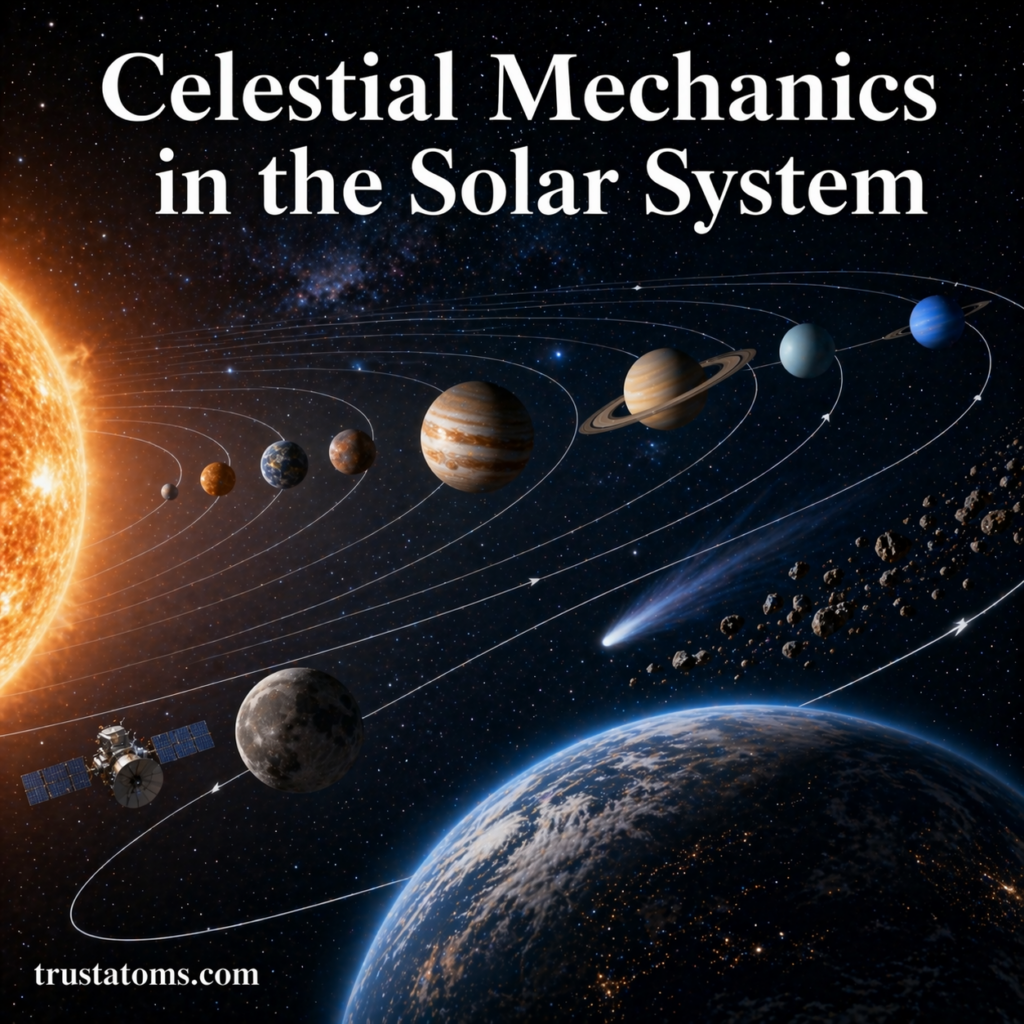
Celestial mechanics is the branch of astronomy that studies how objects move under the influence of gravity. In our solar system, it explains everything from the orbits of planets to the motion of moons, comets, and asteroids.
By understanding celestial mechanics, scientists can predict planetary positions, plan space missions, and explain how the solar system formed and evolves. Much of this field builds on the work of pioneers like Isaac Newton and Johannes Kepler, whose discoveries laid the foundation for modern orbital physics.
What Is Celestial Mechanics?
Celestial mechanics focuses on how gravitational forces influence the motion of objects in space.
Key concepts include:
- Orbital motion
- Gravitational attraction
- Energy and momentum
- Stability of planetary systems
In the solar system, the dominant force is the Sun’s gravity, which governs the motion of planets and other bodies.
The Role of Gravity in the Solar System
Gravity is the force that holds the solar system together. Every object with mass attracts every other object, but the Sun’s massive size makes it the central influence.
How gravity shapes motion:
- Planets orbit the Sun in predictable paths
- Moons orbit planets
- Comets follow elongated trajectories
- Asteroids move within gravitational regions
This continuous interaction creates a dynamic but stable system.
Kepler’s Laws of Planetary Motion
Johannes Kepler developed three fundamental laws that describe how planets move around the Sun.
First Law: Elliptical Orbits
r=1+ecosθa(1−e2)
- Planets move in elliptical orbits with the Sun at one focus
Second Law: Equal Areas in Equal Time
- A line from the planet to the Sun sweeps out equal areas in equal times
- Planets move faster when closer to the Sun
Third Law: Orbital Period Relationship
T2∝a3
- The square of a planet’s orbital period is proportional to the cube of its average distance from the Sun
These laws remain essential for understanding orbital motion.
Newton’s Law of Gravitation
Isaac Newton expanded on Kepler’s work by explaining why planets follow these laws.
F=Gr2m1m2
What this means:
- Every object attracts every other object with a force
- The force depends on mass and distance
- Stronger masses create stronger gravitational pulls
- Greater distance weakens the force
This law explains how planets stay in orbit rather than flying off into space.
Types of Orbits in the Solar System
Not all orbits are the same. Celestial mechanics helps classify them based on shape and behavior.
Common orbit types:
- Circular orbits (nearly round paths)
- Elliptical orbits (elongated paths)
- Parabolic trajectories (escape paths)
- Hyperbolic trajectories (objects passing through the system)
Planets typically follow stable elliptical orbits, while comets often have highly elongated paths.
Orbital Elements and Positioning
Astronomers use specific parameters to describe an object’s orbit.
Key orbital elements:
- Semi-major axis (average distance from the Sun)
- Eccentricity (shape of the orbit)
- Inclination (tilt of the orbit)
- Longitude of ascending node
- Argument of perihelion
These elements allow precise calculations of an object’s position at any given time.
Gravitational Interactions and Perturbations
The solar system is not perfectly stable. Objects influence each other through gravitational interactions.
Examples of perturbations:
- Jupiter altering asteroid orbits
- The Moon affecting Earth’s tides
- Planetary resonances creating orbital patterns
These small changes can accumulate over time, affecting long-term motion.
Celestial Mechanics and Space Exploration
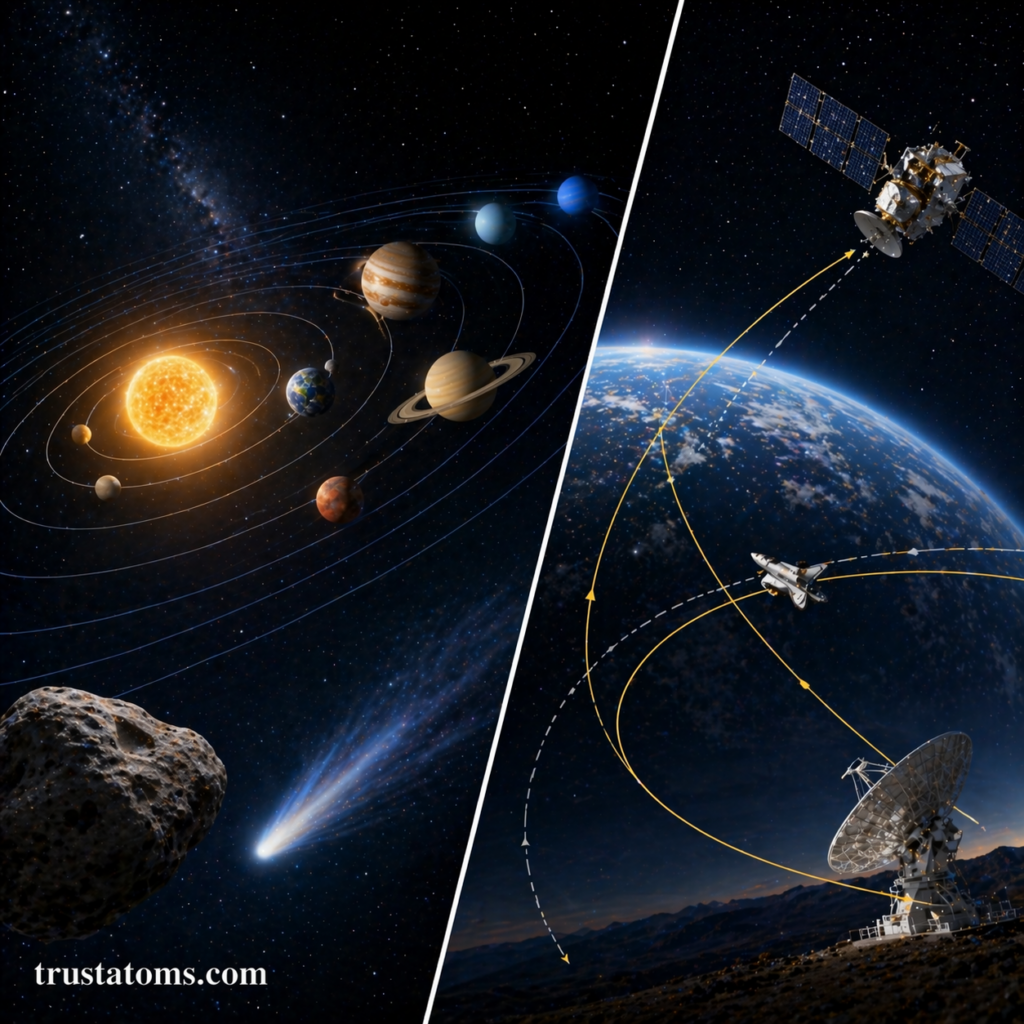
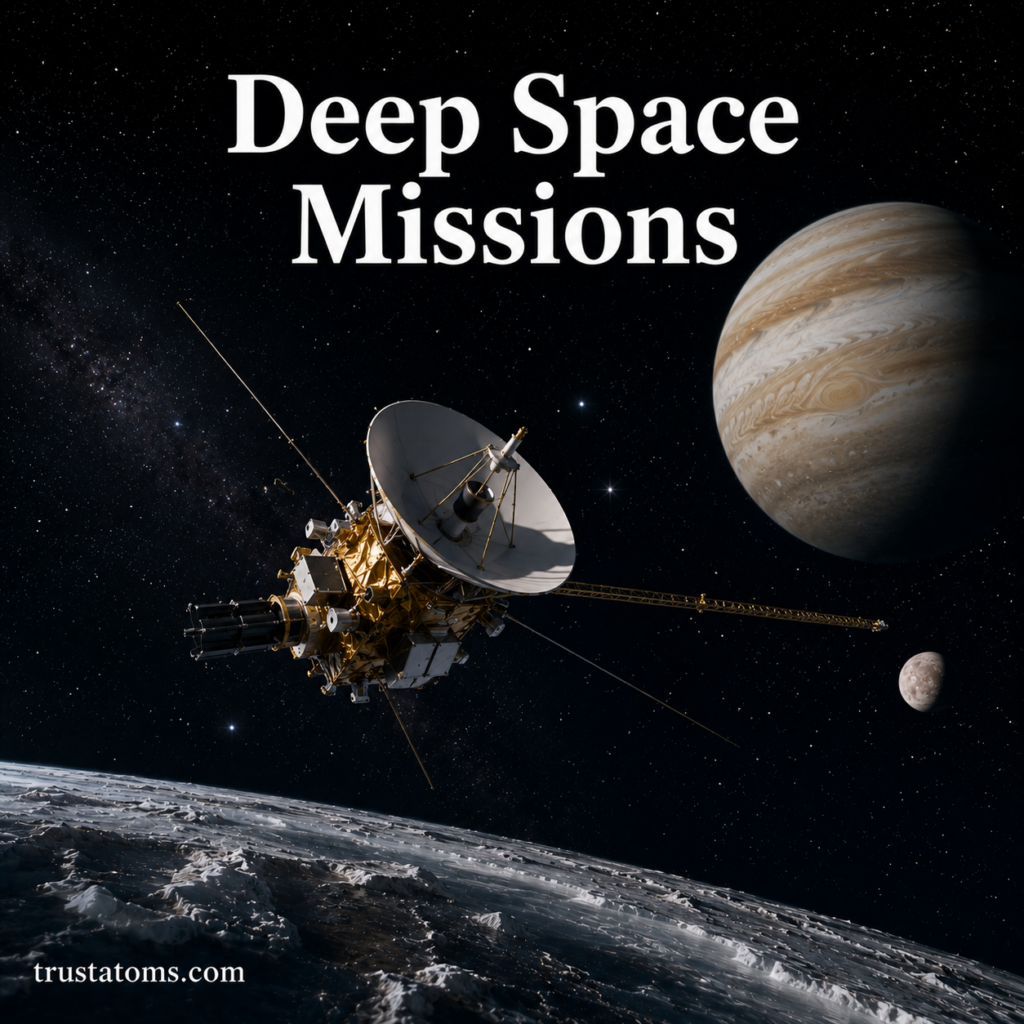
Celestial mechanics is critical for planning and executing space missions.
Applications include:
- Calculating spacecraft trajectories
- Using gravity assists to save fuel
- Predicting satellite orbits
- Navigating between planets
For example, missions launched by NASA rely heavily on precise orbital calculations.
Stability of the Solar System
Despite constant motion and interactions, the solar system remains relatively stable over long periods.
Why it stays stable:
- Balanced gravitational forces
- Predictable orbital patterns
- Large distances between major bodies
However, long-term simulations show that small changes can lead to significant shifts over millions or billions of years.
The Future of Celestial Mechanics
Modern technology is advancing our understanding of celestial motion.
Emerging developments:
- High-precision simulations
- AI-assisted orbital predictions
- Improved measurements of gravitational effects
- Study of exoplanet systems
These advancements are helping scientists explore not just our solar system, but planetary systems across the galaxy.
Final Thoughts
Celestial mechanics provides the framework for understanding how the solar system works. From the motion of planets to the paths of comets, it reveals the invisible forces shaping the universe.
By combining centuries of scientific discovery with modern technology, celestial mechanics continues to guide exploration and deepen our understanding of cosmic motion.