The Sun is the heart of our Solar System and the primary source of energy for life on Earth. While it appears as a simple glowing sphere in the sky, the Sun is a complex, dynamic star with multiple layers and powerful energy-generating processes happening deep within its core.
Understanding the Sun’s structure and how it produces energy helps explain everything from sunlight and seasons to solar flares and space weather.
What Is the Sun?
The Sun is a main-sequence star composed mostly of hydrogen and helium. It formed about 4.6 billion years ago and continues to generate energy through nuclear fusion.
Key Facts About the Sun
- Diameter: About 1.39 million kilometers
- Mass: 99.8% of the Solar System’s total mass
- Surface temperature: ~5,500°C (9,932°F)
- Core temperature: ~15 million°C (27 million°F)
Despite its size and intensity, the Sun is considered an average-sized star.
The Structure of the Sun
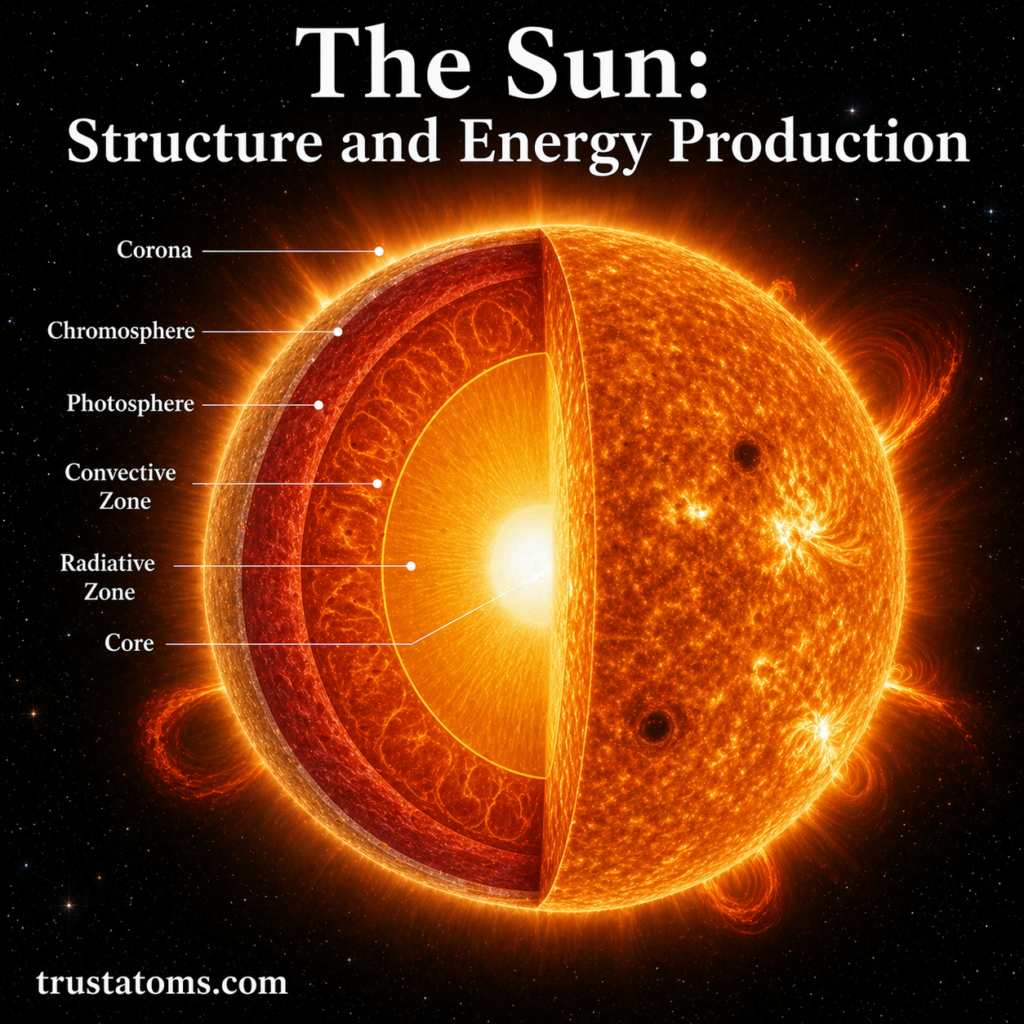
The Sun is made up of several distinct layers, each playing a role in how energy is produced and transported.
Core: Where Energy Is Created
The core is the innermost region and the engine of the Sun.
- Temperature: ~15 million°C
- Extremely high pressure
- Site of nuclear fusion
This is where hydrogen atoms combine to form helium, releasing massive amounts of energy.
Radiative Zone: Energy Transfer by Radiation
Surrounding the core is the radiative zone.
- Energy moves outward as electromagnetic radiation
- Photons bounce around randomly
- Energy transfer is slow (can take thousands to millions of years)
This layer acts like a dense barrier where energy gradually makes its way outward.
Convective Zone: Energy Transfer by Motion
Above the radiative zone is the convective zone.
- Hot plasma rises toward the surface
- Cooler plasma sinks back down
- Creates convection currents
This movement helps transport energy more efficiently to the Sun’s outer layers.
Photosphere: The Visible Surface
The photosphere is the layer we see as the Sun’s surface.
- Temperature: ~5,500°C
- Emits visible light
- Contains sunspots (cooler, darker regions)
Most of the sunlight that reaches Earth comes from this layer.
Chromosphere: A Thin Atmospheric Layer
Above the photosphere lies the chromosphere.
- Reddish glow visible during solar eclipses
- Temperature increases with height
- Contains spicules (jets of gas)
This layer marks the transition between the surface and the outer atmosphere.
Corona: The Outer Atmosphere
The corona is the Sun’s outermost layer.
- Extends millions of kilometers into space
- Extremely high temperatures (over 1 million°C)
- Visible during total solar eclipses
The corona is the source of solar wind, which affects space weather across the Solar System.
How the Sun Produces Energy
The Sun’s energy comes from nuclear fusion, a process that converts mass into energy.
The Fusion Process
Inside the core, hydrogen nuclei fuse together to form helium through a process known as the proton-proton chain.
Step-by-Step Overview
- Two hydrogen nuclei collide and fuse
- They form a heavier particle and release energy
- Multiple reactions lead to the formation of helium
- A small amount of mass is converted into energy
This energy is released in the form of light and heat.
Why Fusion Releases So Much Energy
Fusion works because of Einstein’s famous principle that mass can be converted into energy.
E=mc2
Even a tiny amount of lost mass produces an enormous amount of energy due to the squared speed of light.
Energy Journey: From Core to Earth
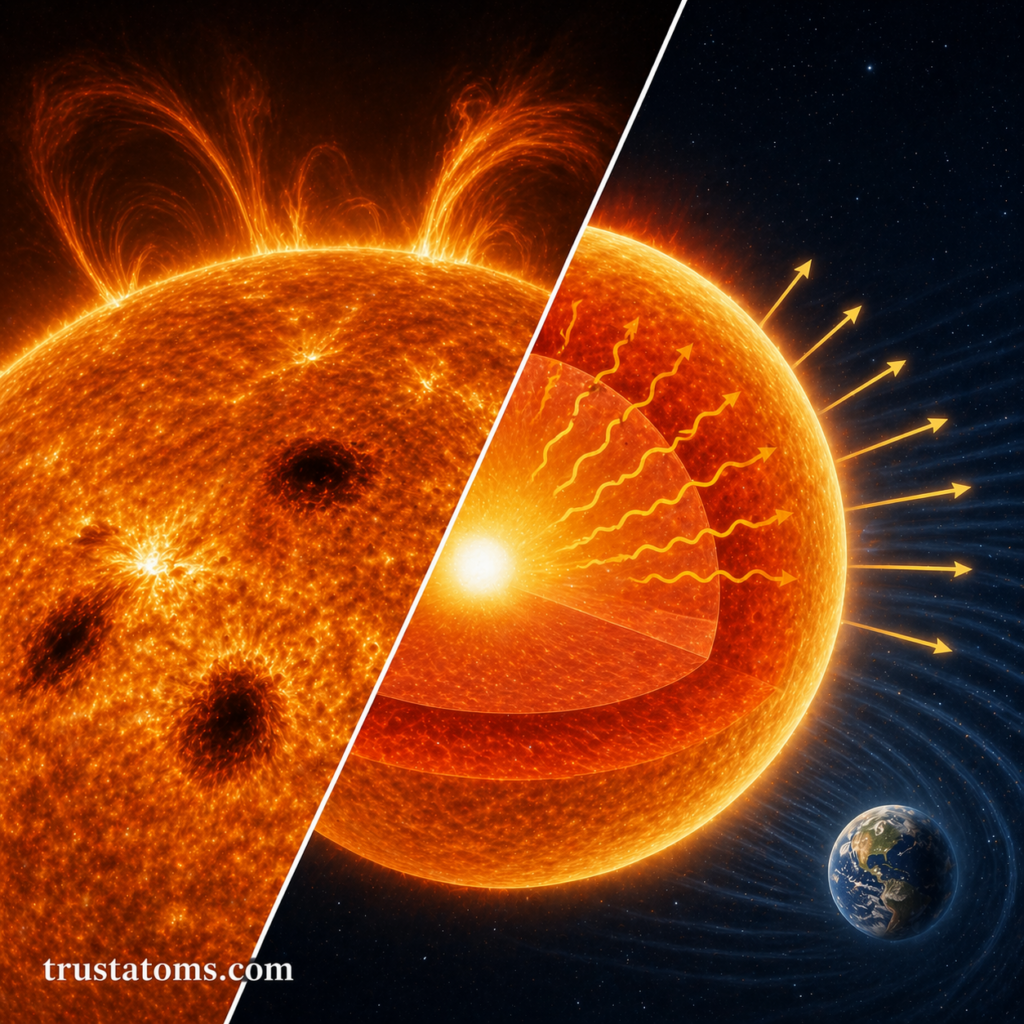
Energy created in the core doesn’t reach Earth instantly—it goes through a long journey.
Stages of Energy Travel
- Core: Energy is generated through fusion
- Radiative Zone: Energy moves slowly via radiation
- Convective Zone: Energy rises through plasma currents
- Photosphere: Energy is released as sunlight
Once it leaves the Sun, sunlight takes about 8 minutes to reach Earth.
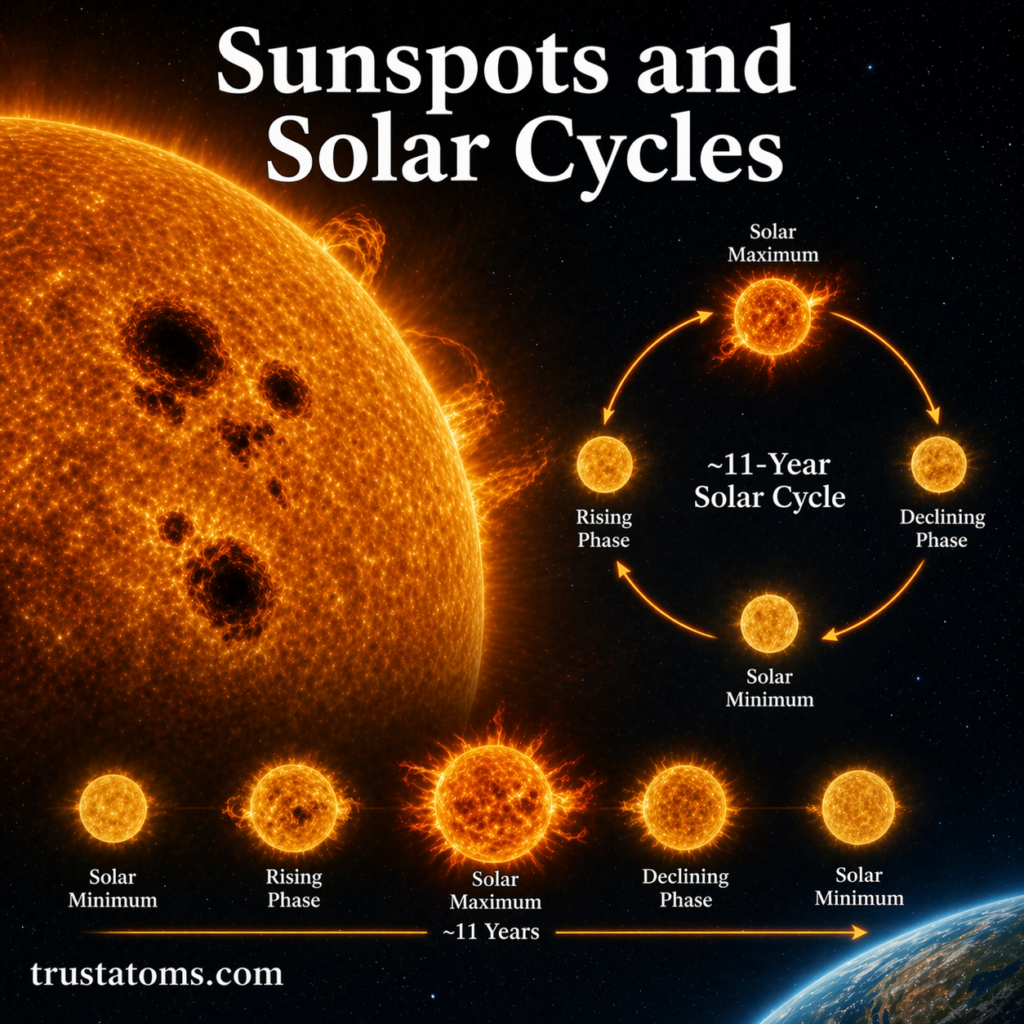
Solar Activity and Energy Output
The Sun isn’t constant—it experiences cycles and activity that affect its energy output.
Types of Solar Activity
- Sunspots: Cooler areas linked to magnetic activity
- Solar flares: Sudden bursts of energy
- Coronal mass ejections (CMEs): Massive plasma eruptions
These events can impact satellites, communications, and power grids on Earth.
Why the Sun’s Energy Matters
The Sun’s energy is essential for life and planetary systems.
Key Impacts
- Drives Earth’s climate and weather
- Enables photosynthesis in plants
- Powers the water cycle
- Supports renewable energy sources like solar power
Without the Sun, life as we know it would not exist.
Final Thoughts
The Sun is far more than a bright object in the sky—it’s a powerful, dynamic star with a complex internal structure and an incredible energy-producing engine at its core.
From nuclear fusion deep inside to sunlight reaching Earth in minutes, the Sun’s processes shape our environment and sustain life every day.
As science advances, we continue to learn more about how this star works—and how it influences everything in our Solar System.