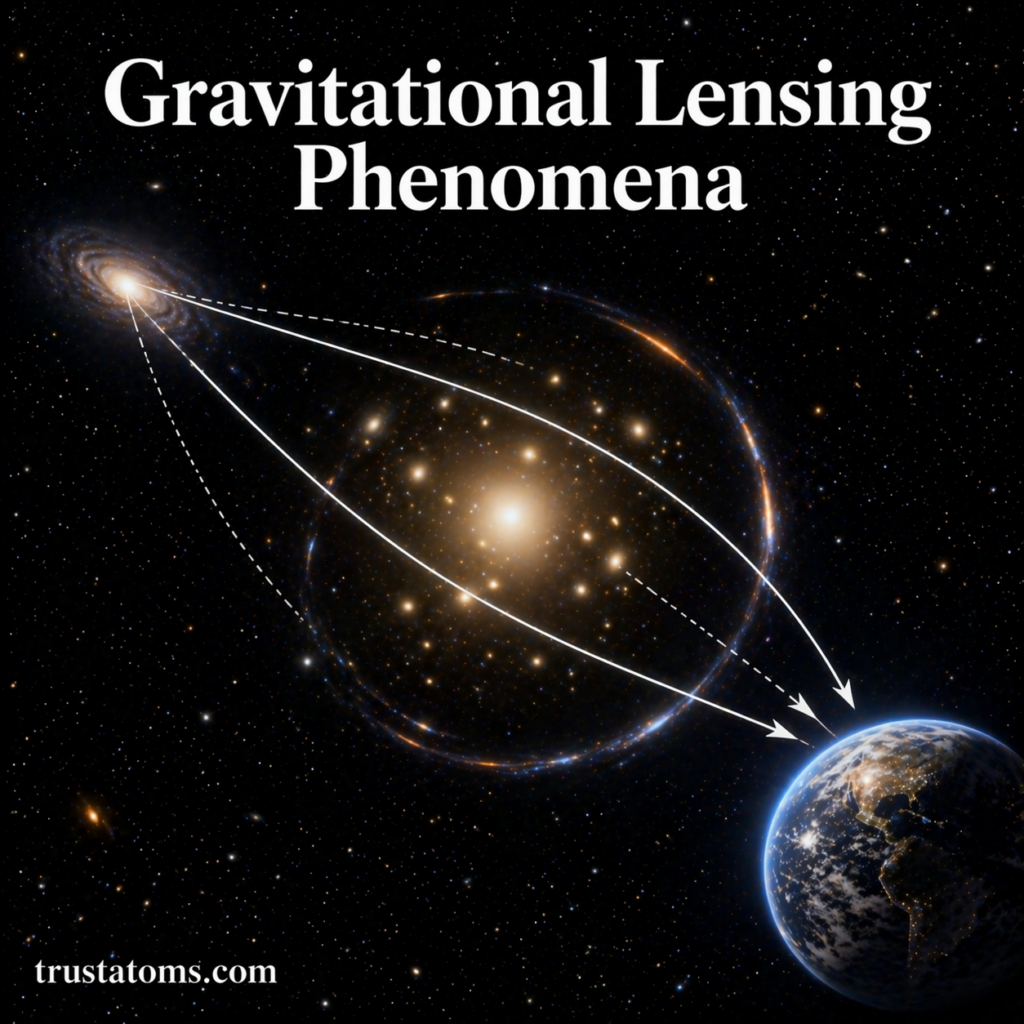
Gravitational lensing is one of the most fascinating effects predicted by modern physics. It occurs when a massive object—like a galaxy or black hole—bends the path of light traveling near it, acting like a cosmic lens.
First predicted by Albert Einstein as part of his theory of General Relativity, gravitational lensing has become a powerful tool in astronomy. It allows scientists to observe distant objects, detect invisible matter, and study the structure of the universe.
What Is Gravitational Lensing?
Gravitational lensing happens when gravity bends light as it passes near a massive object.
How it works:
- Light normally travels in straight lines
- Massive objects warp space-time
- Light follows this curved space-time
- The result is a distorted or magnified image
This effect can create multiple images, arcs, or even rings of the same distant object.
Types of Gravitational Lensing
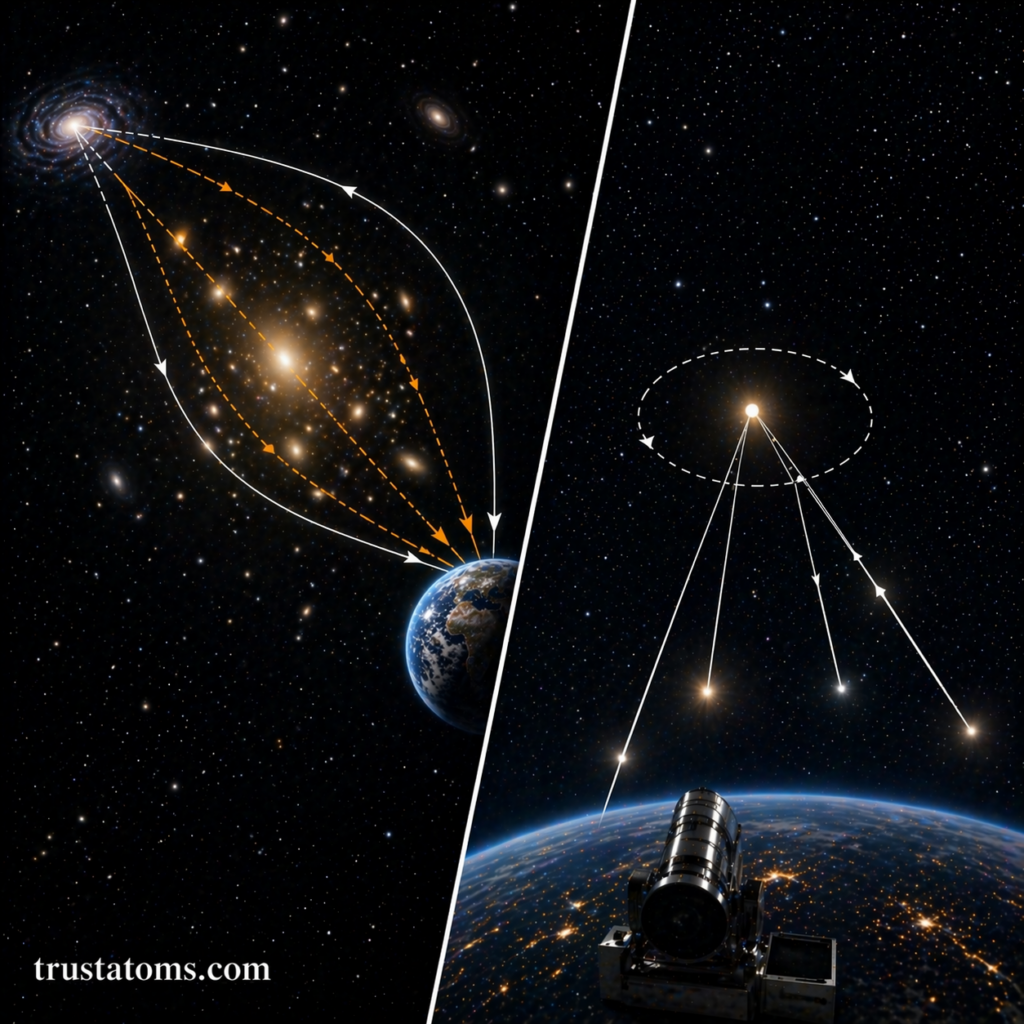
Gravitational lensing appears in different forms depending on the alignment and mass involved.
Strong Lensing
- Produces highly visible distortions
- Can create multiple images of a single object
- Often forms arcs or complete rings (Einstein Rings)
Weak Lensing
- Causes subtle distortions in background galaxies
- Requires statistical analysis to detect
- Used to map large-scale structures
Microlensing
- Occurs when a smaller object (like a star) passes in front of another
- Temporarily brightens the background object
- Useful for detecting exoplanets
Einstein Rings and Arcs
One of the most striking results of gravitational lensing is the formation of rings and arcs.
Einstein Rings
- Form when the source, lens, and observer are perfectly aligned
- Create a circular ring of light
- Named after Albert Einstein
Gravitational Arcs
- Occur when alignment is slightly off
- Appear as stretched or curved light structures
- Common in galaxy clusters
These shapes provide valuable information about the mass of the lensing object.
What Causes Gravitational Lensing?
The key factor behind lensing is mass.
Major lensing sources:
- Galaxies
- Galaxy clusters
- Black holes
- Dark matter concentrations
Even objects that do not emit light—like dark matter—can bend light, making gravitational lensing a critical tool for studying the unseen universe.
Why Gravitational Lensing Matters
Gravitational lensing is more than just a visual effect—it’s a powerful scientific tool.
Key uses:
- Observing distant galaxies that would otherwise be too faint
- Mapping dark matter distribution
- Measuring the mass of galaxy clusters
- Detecting exoplanets through microlensing
- Studying the expansion of the universe
It essentially turns massive objects into natural telescopes.
Discoveries Enabled by Gravitational Lensing
Lensing has led to major breakthroughs in astronomy.
Important discoveries:
- Evidence for dark matter in galaxy clusters
- Observation of extremely distant galaxies
- Measurement of cosmic structure formation
- Detection of planets beyond our solar system
These discoveries have deepened our understanding of how the universe is built.
How Astronomers Study Gravitational Lensing
Modern observations rely on advanced telescopes and data analysis.
Tools used:
- Space telescopes like Hubble Space Telescope
- Ground-based observatories
- Computer simulations
- Image processing algorithms
Observation process:
- Capture images of distant galaxies
- Identify distortions or unusual shapes
- Model the mass causing the lensing
- Reconstruct the original light source
This process helps scientists uncover hidden structures in space.
Gravitational Lensing and Dark Matter
One of the most important applications of lensing is studying dark matter.
Why it’s useful:
- Dark matter does not emit light
- It still has mass and affects gravity
- Lensing reveals where mass is located
By analyzing lensing patterns, astronomers can map dark matter across galaxies and clusters.
Challenges of Studying Gravitational Lensing
Despite its usefulness, gravitational lensing is complex to analyze.
Main challenges:
- Requires precise alignment of objects
- Distortions can be subtle and hard to detect
- Data interpretation depends on models
- Observations require powerful telescopes
Ongoing advancements are helping overcome these limitations.
The Future of Gravitational Lensing Research
New technologies are expanding what we can learn from lensing.
Future developments:
- More powerful space telescopes
- High-resolution sky surveys
- Improved computational models
- Deeper mapping of dark matter
Upcoming missions will allow astronomers to study lensing effects in greater detail than ever before.
Final Thoughts
Gravitational lensing reveals the invisible forces shaping the universe. By bending light, massive objects allow us to see deeper into space and uncover structures that would otherwise remain hidden.
From detecting dark matter to observing distant galaxies, gravitational lensing continues to transform our understanding of the cosmos.