Venus is often called Earth’s “sister planet” because of its similar size and composition—but that’s where the similarities end. Beneath its thick clouds lies one of the most extreme environments in the Solar System, driven by a powerful greenhouse effect.
Understanding Venus helps scientists study climate systems, atmospheric science, and even the future of planetary environments.
Overview of Venus
Venus is the second planet from the Sun and the hottest planet in the Solar System.
Key Facts About Venus
- Distance from the Sun: ~108 million km (67 million miles)
- Diameter: ~12,104 km (similar to Earth)
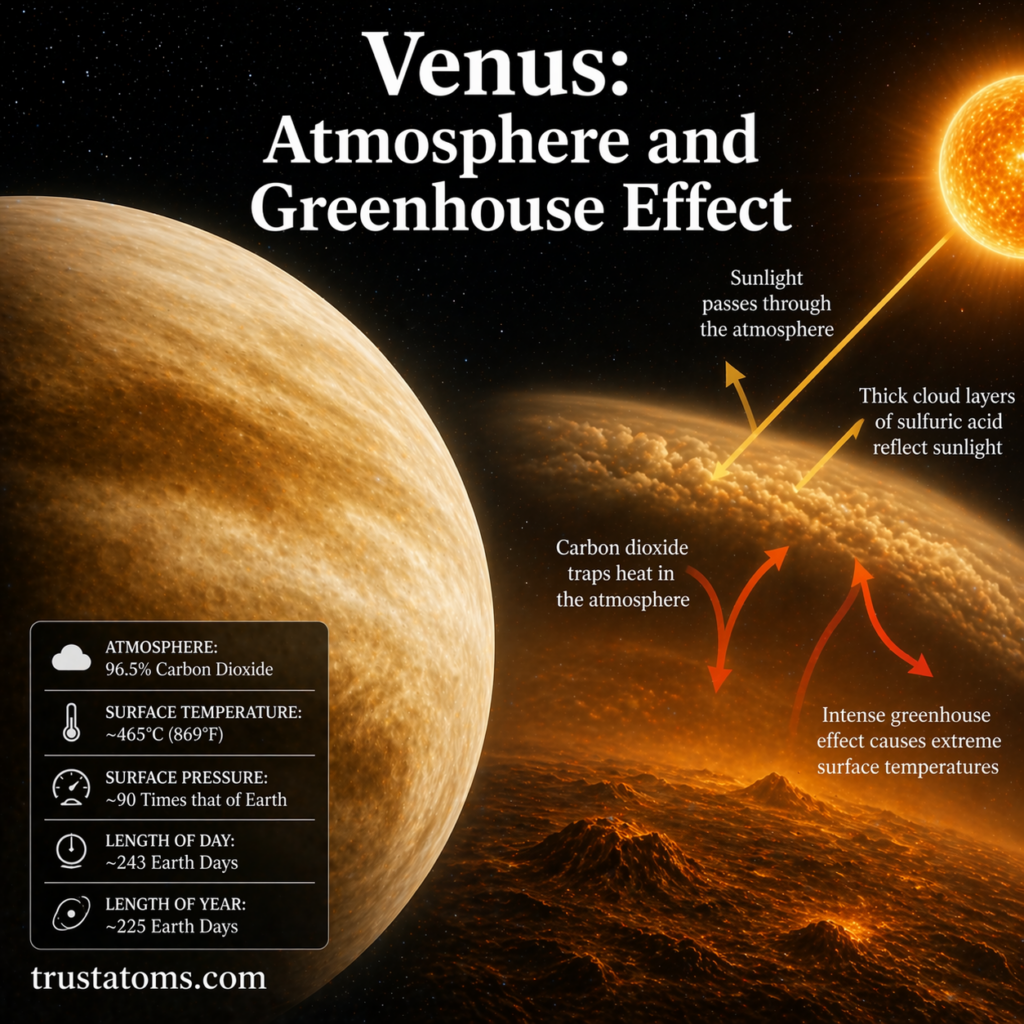
- Length of a day: ~243 Earth days (very slow rotation)
- Length of a year: ~225 Earth days
- Surface temperature: ~465°C (869°F)
Despite being farther from the Sun than Mercury, Venus is much hotter due to its dense atmosphere.
Venus’s Atmosphere: Thick and Toxic
Venus has an extremely dense atmosphere composed mostly of carbon dioxide.
Composition of the Atmosphere
- ~96.5% carbon dioxide (CO₂)
- ~3.5% nitrogen
- Trace amounts of sulfur dioxide and other gases
This thick blanket of gas traps heat very effectively.
Cloud Layers
Venus is covered in thick clouds made primarily of sulfuric acid droplets.
- Reflect about 70% of sunlight
- Give Venus its bright appearance in the sky
- Prevent direct observation of the surface
These clouds are highly reflective but also contribute to heat retention.
Atmospheric Pressure
The pressure at Venus’s surface is extremely high.
- About 90 times greater than Earth’s
- Equivalent to being nearly 1 km underwater on Earth
This crushing pressure adds to the planet’s harsh conditions.
The Greenhouse Effect on Venus
The extreme حرارة on Venus is caused by a runaway greenhouse effect.
What Is the Greenhouse Effect?
The greenhouse effect occurs when a planet’s atmosphere traps heat from the Sun.
Basic Process
- Sunlight enters the atmosphere
- The surface absorbs energy and heats up
- Heat radiates back toward space
- Greenhouse gases trap the heat
On Earth, this process helps maintain a livable temperature. On Venus, it has gone out of control.
Runaway Greenhouse Effect on Venus
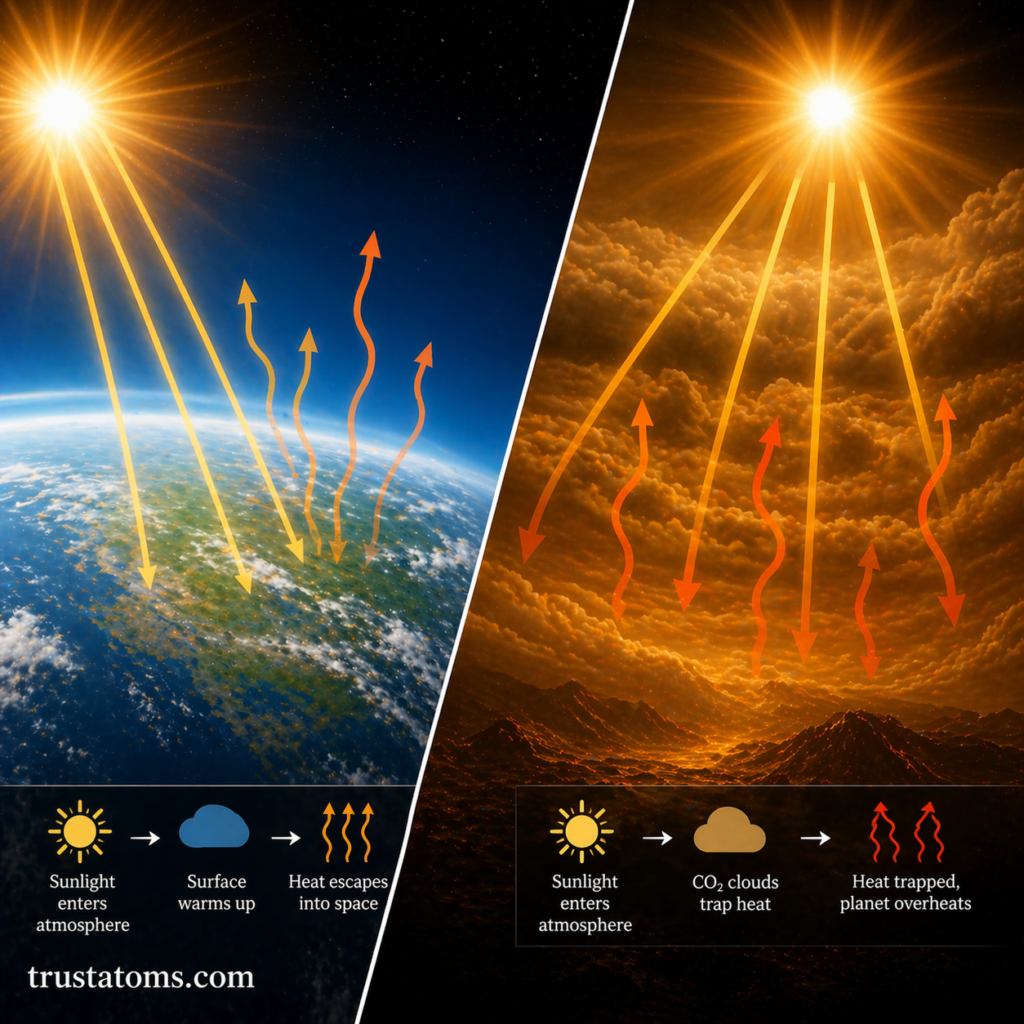
Venus experiences a runaway greenhouse effect, where heat becomes trapped continuously without escape.
Why It Happens on Venus
- Extremely high levels of carbon dioxide
- Thick atmosphere that prevents heat loss
- Lack of oceans to absorb carbon dioxide
- Intense solar radiation
Once the process began, it intensified over time, leading to the current extreme temperatures.
Resulting Conditions
- Surface temperature hot enough to melt lead
- No liquid water on the surface
- Permanent cloud cover
- Minimal temperature variation between day and night
Venus is now one of the most inhospitable places in the Solar System.
Surface Conditions on Venus
Although hidden beneath clouds, Venus’s surface has been studied using radar.
Key Surface Features
- Volcanic plains
- Large shield volcanoes
- Lava flows
- Impact craters
The surface shows evidence of past—and possibly ongoing—volcanic activity.
Slow and Retrograde Rotation
Venus rotates differently than most planets.
Unique Rotation Characteristics
- Rotates very slowly
- Spins in the opposite direction (retrograde rotation)
- The Sun appears to rise in the west and set in the east
This unusual rotation contributes to its long days and unique atmospheric dynamics.
Why Venus Is Hotter Than Mercury
It may seem surprising that Venus is hotter than Mercury, even though Mercury is closer to the Sun.
Key Reasons
- Mercury lacks a thick atmosphere
- Venus traps heat with dense CO₂ layers
- Heat cannot escape efficiently on Venus
This highlights the importance of atmospheric composition in determining planetary temperature.
Lessons from Venus
Venus provides important insights into climate science and planetary evolution.
What Scientists Learn
- Effects of greenhouse gases on temperature
- Atmospheric evolution over time
- Risks of runaway climate processes
- Comparisons with Earth’s climate system
Studying Venus helps researchers understand both other planets and our own.
Final Thoughts
Venus is a powerful example of how an atmosphere can dramatically shape a planet’s environment. Its thick clouds, crushing pressure, and extreme temperatures are all the result of an intense greenhouse effect.
While Earth remains habitable, Venus serves as a reminder of how delicate planetary balance can be—and why understanding climate systems is so important.