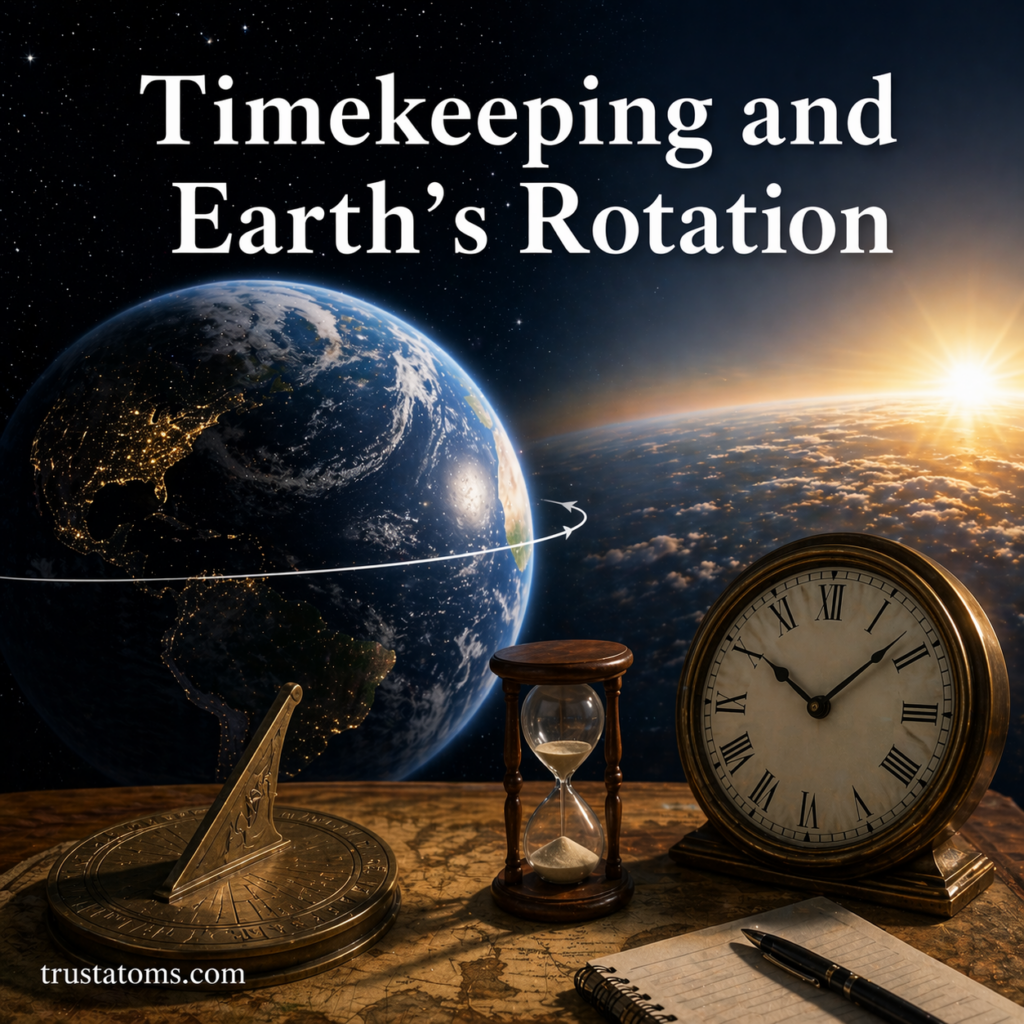
Time might feel constant and predictable, but it’s actually based on something dynamic—Earth’s rotation. Every day, our planet spins on its axis, creating the cycle of day and night that forms the foundation of how humans measure time.
From ancient sundials to modern atomic clocks, timekeeping has evolved alongside our understanding of Earth’s motion. In this guide, we’ll explore how Earth’s rotation defines time, why it isn’t perfectly consistent, and how scientists keep global time accurate.
What Is Earth’s Rotation?
Earth rotates on an imaginary line called its axis, which runs from the North Pole to the South Pole.
- One full rotation takes approximately 24 hours
- This rotation causes the cycle of day and night
- The Sun appears to rise in the east and set in the west due to this motion
This daily rotation is the basis for what we call a solar day.
Solar Time vs. Sidereal Time
Not all “days” are exactly the same. There are two key ways to measure Earth’s rotation:
Solar Time
- Based on the position of the Sun in the sky
- A solar day is about 24 hours
- Used for everyday clocks and calendars
Sidereal Time
- Based on Earth’s rotation relative to distant stars
- A sidereal day is about 23 hours, 56 minutes
- Used in astronomy for tracking celestial objects
The difference exists because Earth is also moving around the Sun while it rotates.
How Timekeeping Began
Before modern clocks, people relied on natural indicators of time.
Early methods included:
- Sundials – measured time using the Sun’s shadow
- Water clocks – tracked time by the flow of water
- Hourglasses – used sand to mark intervals
These systems were useful but limited by weather, accuracy, and consistency.
The Development of Modern Timekeeping
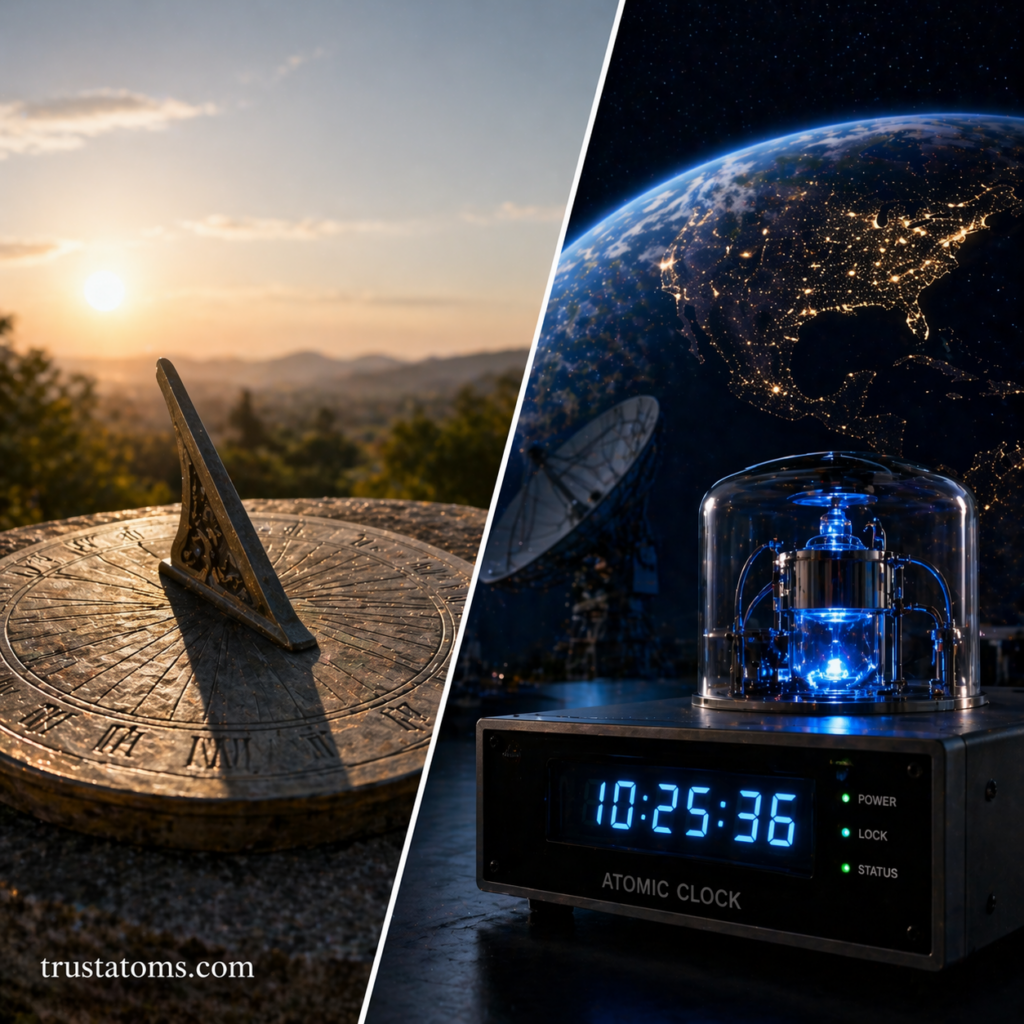
As societies advanced, more precise timekeeping methods were needed.
Key milestones:
- Mechanical clocks (1300s)
Introduced gears and escapements for more consistent time tracking - Pendulum clocks (1600s)
Improved accuracy significantly using swinging motion - Quartz clocks (1900s)
Used vibrating crystals for highly reliable time measurement - Atomic clocks (modern day)
Measure time based on atomic vibrations—extremely precise
Today’s global time system is based on atomic clocks, not Earth’s rotation alone.
Why Earth’s Rotation Isn’t Perfect
Although we treat a day as exactly 24 hours, Earth’s rotation is not perfectly constant.
Factors that affect rotation:
- Gravitational interactions with the Moon (tidal forces)
- Shifts in Earth’s mass (earthquakes, melting ice caps)
- Atmospheric and ocean movements
- Long-term slowing due to tidal friction
These variations are small but measurable, and they accumulate over time.
Leap Seconds: Keeping Time in Sync
Because Earth’s rotation can vary slightly, atomic time and solar time can drift apart.
To correct this, scientists use leap seconds.
What are leap seconds?
- A leap second is occasionally added to Coordinated Universal Time (UTC)
- It keeps clocks aligned with Earth’s actual rotation
- Typically added every few years when needed
Without leap seconds, our clocks would slowly drift away from the natural day-night cycle.
Time Zones and Earth’s Rotation
Earth’s rotation also explains why we have different time zones.
- Earth rotates 360 degrees in 24 hours
- This equals 15 degrees per hour
- Time zones divide the planet into regions with consistent local time
Why time zones matter:
- Align daily schedules with daylight hours
- Standardize time for communication and travel
- Support global coordination
Without time zones, local time would vary wildly from place to place.
The Role of Atomic Time
Modern timekeeping relies on atomic clocks, which are far more precise than Earth’s rotation.
Benefits of atomic time:
- Accuracy to within billionths of a second
- Essential for GPS systems and satellite communication
- Used to define Coordinated Universal Time (UTC)
Even though atomic time is more stable, it still needs occasional adjustment to stay aligned with Earth’s rotation.
Why Timekeeping Matters in Astronomy
Accurate timekeeping is critical for observing and understanding the universe.
Astronomical uses include:
- Tracking the motion of stars and planets
- Predicting eclipses and celestial events
- Coordinating telescope observations worldwide
Even small timing errors can affect astronomical measurements and research.
Everyday Impact of Earth’s Rotation
Earth’s rotation influences more than just science—it affects daily life.
- Determines sunrise and sunset times
- Regulates biological rhythms (circadian cycles)
- Impacts weather patterns and global systems
- Shapes calendars and scheduling worldwide
Our entire concept of time is built on the steady (but not perfect) rotation of our planet.
Final Thoughts
Timekeeping may seem simple, but it’s deeply connected to the complex motion of Earth. While our planet’s rotation provides the foundation for measuring time, modern science has refined and enhanced that system to achieve incredible precision.
By combining natural cycles with advanced technology, we’ve created a timekeeping system that keeps the world synchronized—down to the smallest fraction of a second.