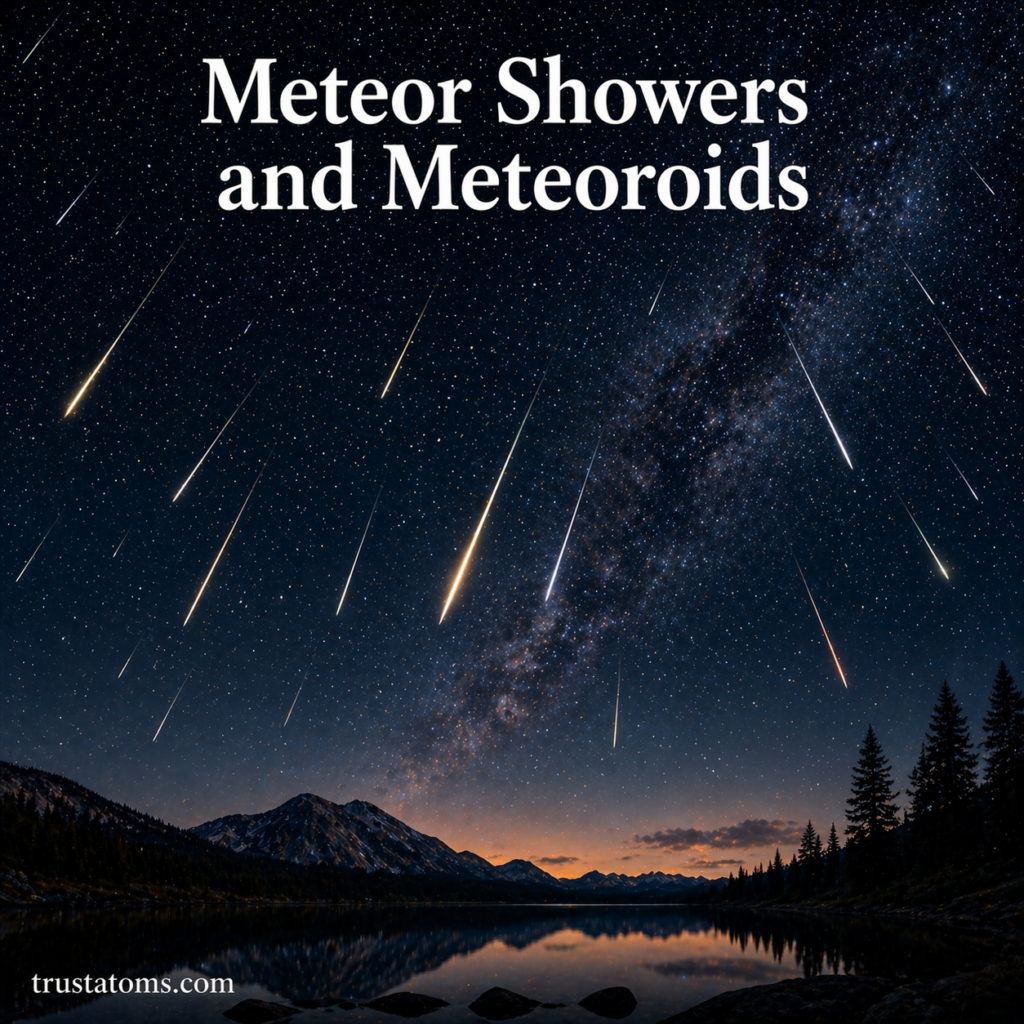
Few astronomical events are as accessible and awe-inspiring as meteor showers. These streaks of light—often called “shooting stars”—are caused by tiny space particles burning up in Earth’s atmosphere. Behind these brief flashes lies a fascinating process involving meteoroids, comets, and orbital paths.
This guide explains what meteor showers and meteoroids are, how they form, and when you can see them.
What Is a Meteoroid?
A meteoroid is a small piece of rock or metal traveling through space. These objects are much smaller than asteroids, ranging from dust-sized grains to chunks several meters wide.
Key characteristics:
- Originate from comets, asteroids, or collisions
- Travel at high speeds through space
- Found throughout the solar system
- Can enter Earth’s atmosphere
Meteoroids are essentially the raw material behind meteors and meteor showers.
Meteors vs. Meteoroids vs. Meteorites
These three terms are often confused but refer to different stages of the same object.
Definitions:
- Meteoroid
- A small object in space
- Meteor
- The streak of light produced when a meteoroid enters Earth’s atmosphere
- Meteorite
- A fragment that survives the journey and reaches Earth’s surface
Understanding these distinctions helps explain what we’re actually seeing during a meteor shower.
What Causes Meteor Showers?
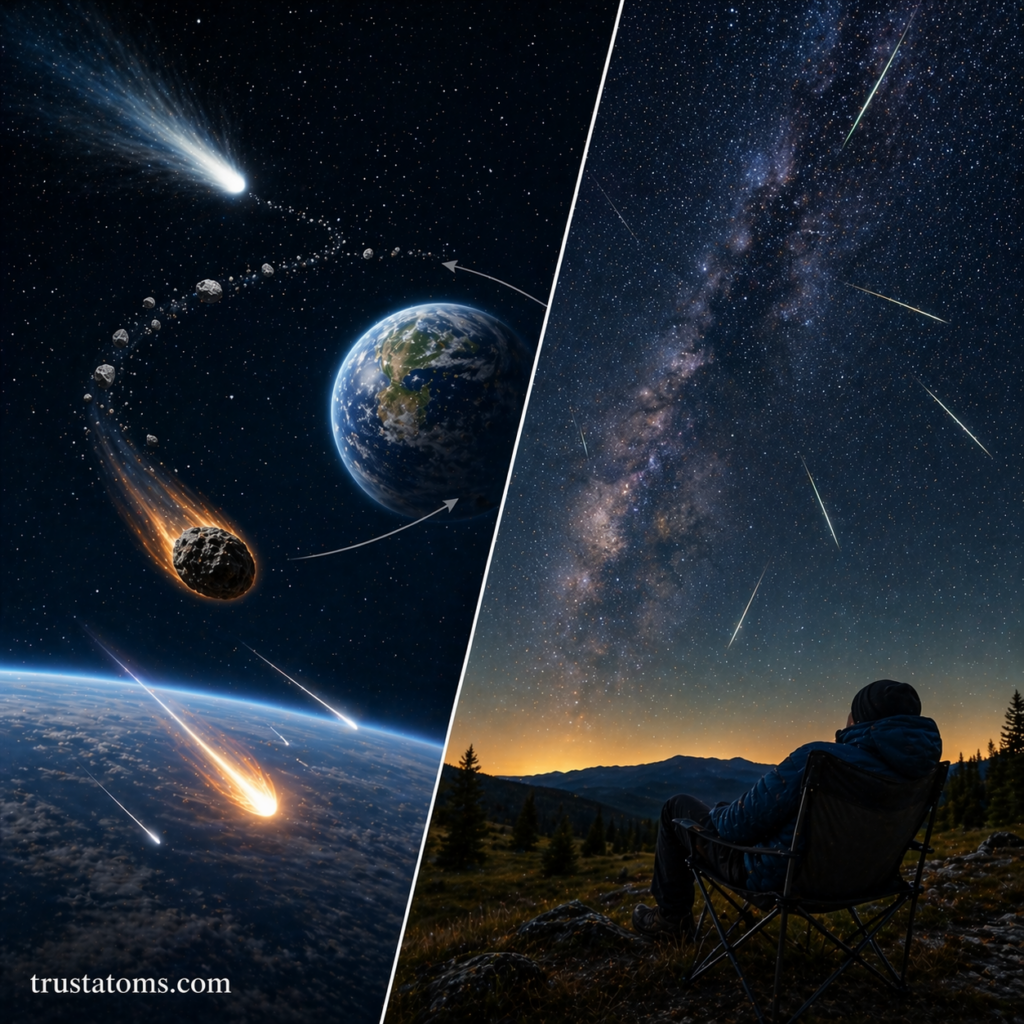
Meteor showers occur when Earth passes through a stream of debris left behind by a comet or, in some cases, an asteroid.
How meteor showers form:
- A comet travels close to the Sun
- Heat causes ice and dust to break off
- Debris spreads along the comet’s orbit
- Earth crosses this debris path annually
- Particles enter the atmosphere and burn up
As many particles enter the atmosphere at once, we see multiple meteors over a short period—creating a meteor shower.
Why Meteors Glow
When meteoroids enter Earth’s atmosphere, they travel at extremely high speeds—often tens of kilometers per second.
What creates the glow:
- Friction with atmospheric gases generates intense heat
- The meteoroid’s surface vaporizes
- Surrounding air becomes ionized
- Light is emitted as energy is released
This process creates the bright streaks we observe in the night sky.
Major Annual Meteor Showers
Several meteor showers occur each year, often at predictable times.
Notable meteor showers:
- Perseids (August)
- One of the brightest and most popular
- Geminids (December)
- Known for colorful and slow-moving meteors
- Quadrantids (January)
- Short but intense peak activity
- Leonids (November)
- Occasionally produce meteor storms
These events are tied to specific parent bodies, usually comets.
Where Do Meteor Showers Appear in the Sky?
Meteor showers appear to originate from a specific point in the sky called the radiant.
Key points:
- Named after the constellation where the radiant is located
- Meteors can appear anywhere in the sky, not just near the radiant
- Best viewed when the radiant is higher in the sky
For example, the Perseids appear to come from the constellation Perseus.
Best Conditions for Viewing Meteor Showers
You don’t need a telescope to enjoy a meteor shower, but conditions matter.
Tips for optimal viewing:
- Find a dark location away from city lights
- Check weather conditions for clear skies
- Avoid bright moonlight when possible
- Allow your eyes 20–30 minutes to adjust to darkness
- Look up and scan a wide area of the sky
Peak times are usually after midnight when your location faces into Earth’s direction of travel.
Are Meteor Showers Dangerous?
Most meteor showers are completely harmless.
Why they’re safe:
- Particles are usually very small (sand-sized or smaller)
- They burn up high in the atmosphere
- Rarely reach the ground
However, larger meteoroids—though uncommon—can survive and become meteorites.
Scientific Importance of Meteoroids
Meteoroids and meteor showers provide valuable scientific insights.
Why scientists study them:
- Learn about the composition of comets and asteroids
- Understand the early solar system
- Study atmospheric interactions
- Track debris streams in space
These tiny particles carry information from billions of years ago.
Final Thoughts
Meteor showers are one of the easiest and most enjoyable ways to experience astronomy. With no equipment required, they offer a direct connection to the dynamic processes happening in our solar system.
By understanding meteoroids and how meteor showers form, you gain a deeper appreciation for the science behind these fleeting but beautiful events in the night sky.