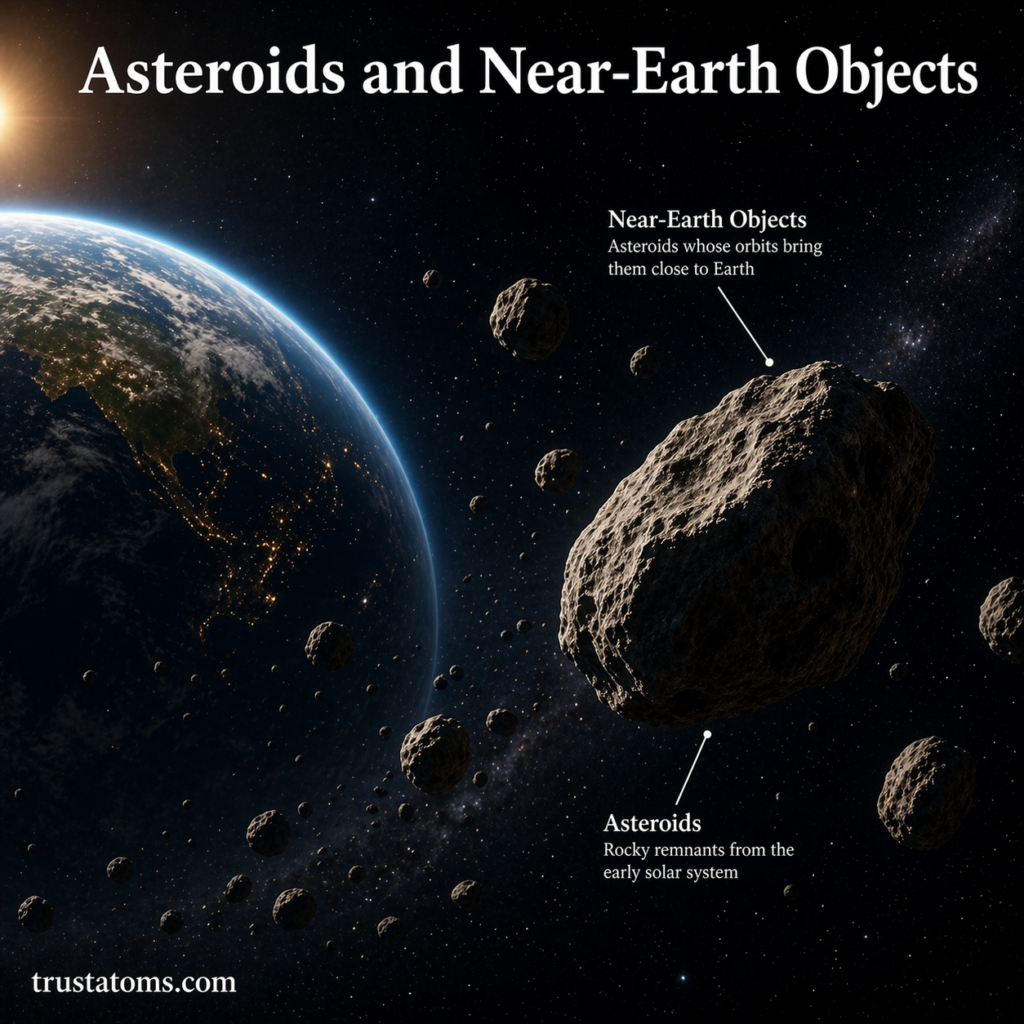
Asteroids and near-Earth objects (NEOs) are remnants from the early solar system, offering valuable clues about how planets formed. While most remain safely in space, some travel on paths that bring them relatively close to Earth—making them important objects of study for both science and planetary defense.
This guide explores what asteroids and NEOs are, where they come from, and why they matter.
What Are Asteroids?
Asteroids are rocky objects that orbit the Sun, primarily found in the region between Mars and Jupiter known as the asteroid belt.
Key characteristics:
- Made of rock, metal, or a combination of both
- Range in size from a few meters to hundreds of kilometers
- Irregular shapes due to low gravity
- Leftovers from planet formation billions of years ago
Some asteroids are rich in metals like iron and nickel, while others contain carbon-based materials and even water.
Types of Asteroids
Asteroids are classified based on their composition and appearance.
Main types:
- C-type (carbonaceous)
- Dark, rich in carbon, and the most common
- S-type (silicaceous)
- Made of rock and metal, brighter in appearance
- M-type (metallic)
- Composed mostly of iron and nickel
Each type provides insights into different regions and conditions of the early solar system.
What Are Near-Earth Objects (NEOs)?
Near-Earth objects are asteroids or comets whose orbits bring them close to Earth’s path around the Sun.
Definition of NEOs:
- Objects that come within 1.3 astronomical units (AU) of the Sun
- Includes both near-Earth asteroids (NEAs) and near-Earth comets
Categories of near-Earth asteroids:
- Atira group
- Orbits entirely within Earth’s orbit
- Aten group
- Orbits mostly inside Earth’s orbit
- Apollo group
- Orbits cross Earth’s path
- Amor group
- Orbits just outside Earth’s orbit
These categories help scientists track potential close approaches and study orbital behavior.
Potentially Hazardous Asteroids (PHAs)
Not all near-Earth objects pose a threat, but some are classified as potentially hazardous asteroids (PHAs).
Criteria for PHAs:
- Come within 0.05 AU (about 7.5 million km) of Earth
- Large enough (typically over 140 meters) to cause regional damage if they impact
It’s important to note that “potentially hazardous” does not mean an impact is expected—it simply means the object is monitored closely.
Where Do Asteroids Come From?
Asteroids formed over 4.5 billion years ago during the early stages of the solar system.
Origins:
- Leftover building material from planet formation
- Fragments from collisions between larger bodies
- Objects influenced by Jupiter’s strong gravity, preventing them from forming a planet
Some NEOs are believed to have been pushed out of the asteroid belt by gravitational interactions and collisions.
How Scientists Track Near-Earth Objects
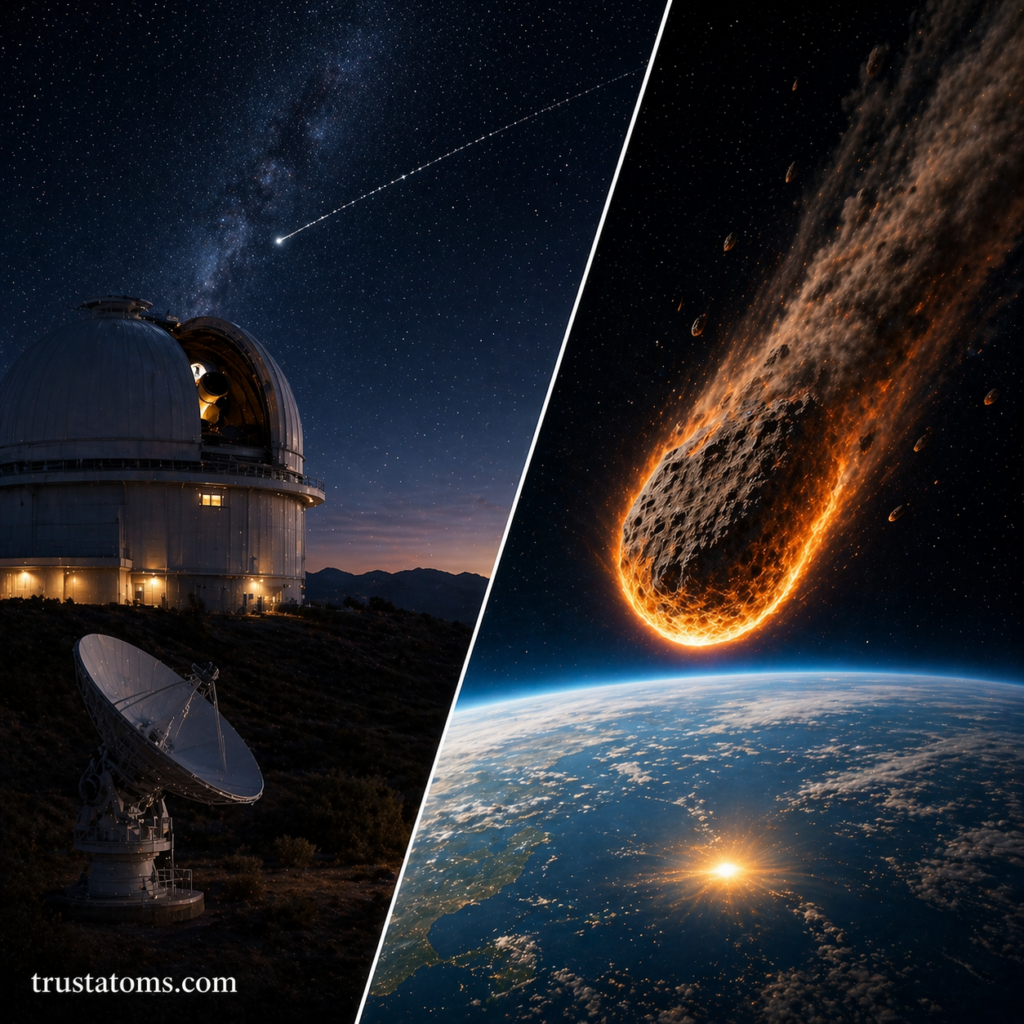
Tracking asteroids and NEOs is a global effort involving telescopes, space agencies, and automated detection systems.
Detection methods:
- Ground-based telescopes scanning the sky
- Space-based observatories for improved detection
- Radar observations to refine size and trajectory
- Computer models to predict future orbits
Organizations like NASA play a major role in monitoring these objects and assessing impact risk.
What Happens If an Asteroid Hits Earth?
Most asteroids burn up in Earth’s atmosphere, appearing as meteors. However, larger objects can reach the surface and cause significant damage.
Possible effects of an impact:
- Shockwaves and crater formation
- Heat and fire from atmospheric entry
- Tsunamis if impact occurs in oceans
- Climate effects from dust and debris
The scale of impact depends on the asteroid’s size, speed, and composition.
Planetary Defense and Prevention Strategies
Scientists are actively developing ways to prevent or reduce the impact of hazardous asteroids.
Current strategies:
- Early detection and tracking
- Deflection missions using spacecraft
- Kinetic impact techniques (changing asteroid trajectory)
- Gravity tractors (slowly altering orbit over time)
A key milestone was the Double Asteroid Redirection Test mission by NASA, which successfully changed the orbit of a small asteroid in 2022.
Why Studying Asteroids Matters
Asteroids are more than just potential threats—they are scientific treasures.
Key benefits:
- Reveal information about the early solar system
- Provide insight into planetary formation
- Contain valuable resources like metals and water
- Help improve our understanding of impact risks
Some future space missions may even focus on asteroid mining for materials.
Final Thoughts
Asteroids and near-Earth objects are a natural part of our solar system’s history and ongoing evolution. While some pose potential risks, advances in detection and planetary defense are helping ensure Earth remains protected.
By studying these space rocks, scientists not only safeguard our planet but also unlock secrets about the origins of the solar system and the building blocks of life.