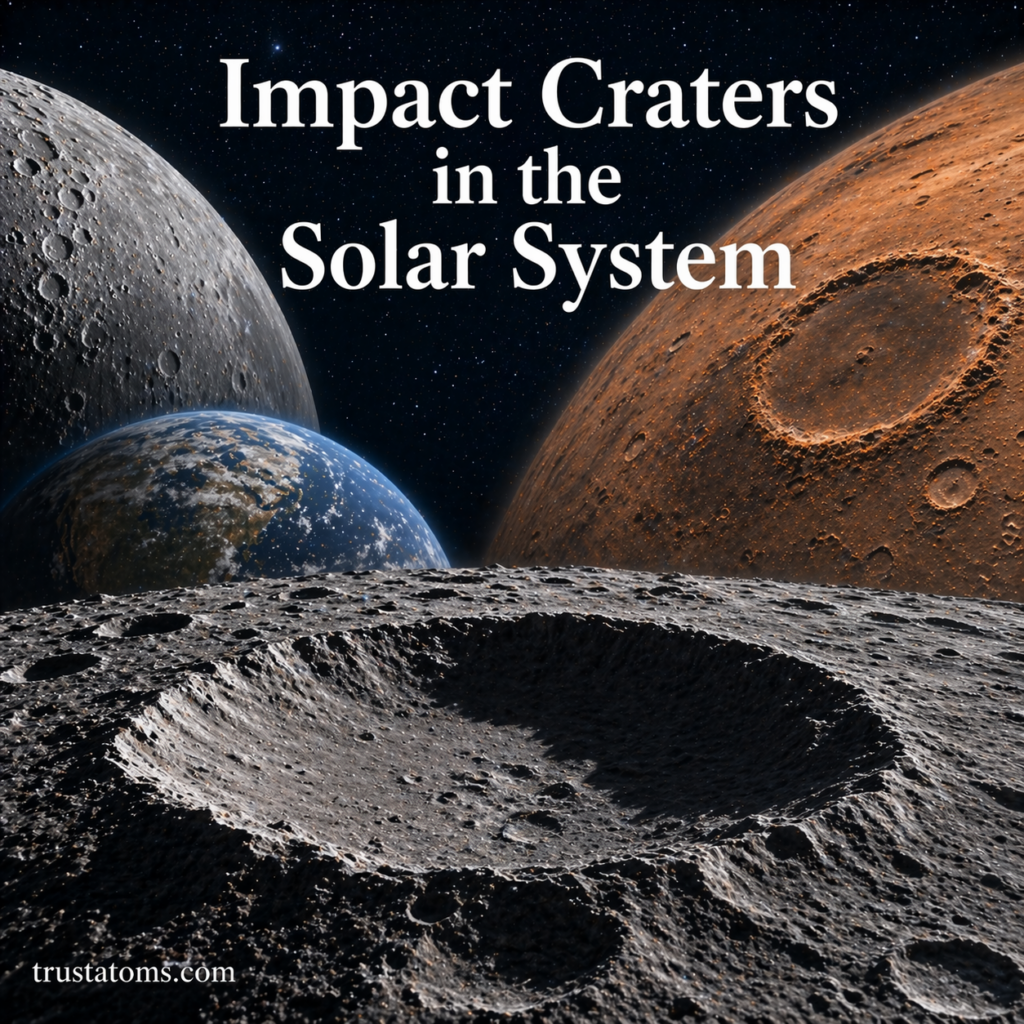
Impact craters are some of the most visible and dramatic features across the solar system. From the Moon’s heavily cratered surface to ancient scars on Mars and Mercury, these formations tell the story of billions of years of cosmic collisions.
By studying impact craters, scientists gain insight into planetary history, surface age, and the dynamic environment of space.
What Is an Impact Crater?
An impact crater forms when a meteoroid, asteroid, or comet collides with the surface of a planet, moon, or other solid body.
Key characteristics:
- Circular or bowl-shaped depressions
- Often surrounded by raised rims
- Can include central peaks or rings
- Vary widely in size—from small pits to massive basins
The energy released during an impact is enormous, often far exceeding that of volcanic eruptions or earthquakes.
How Impact Craters Form
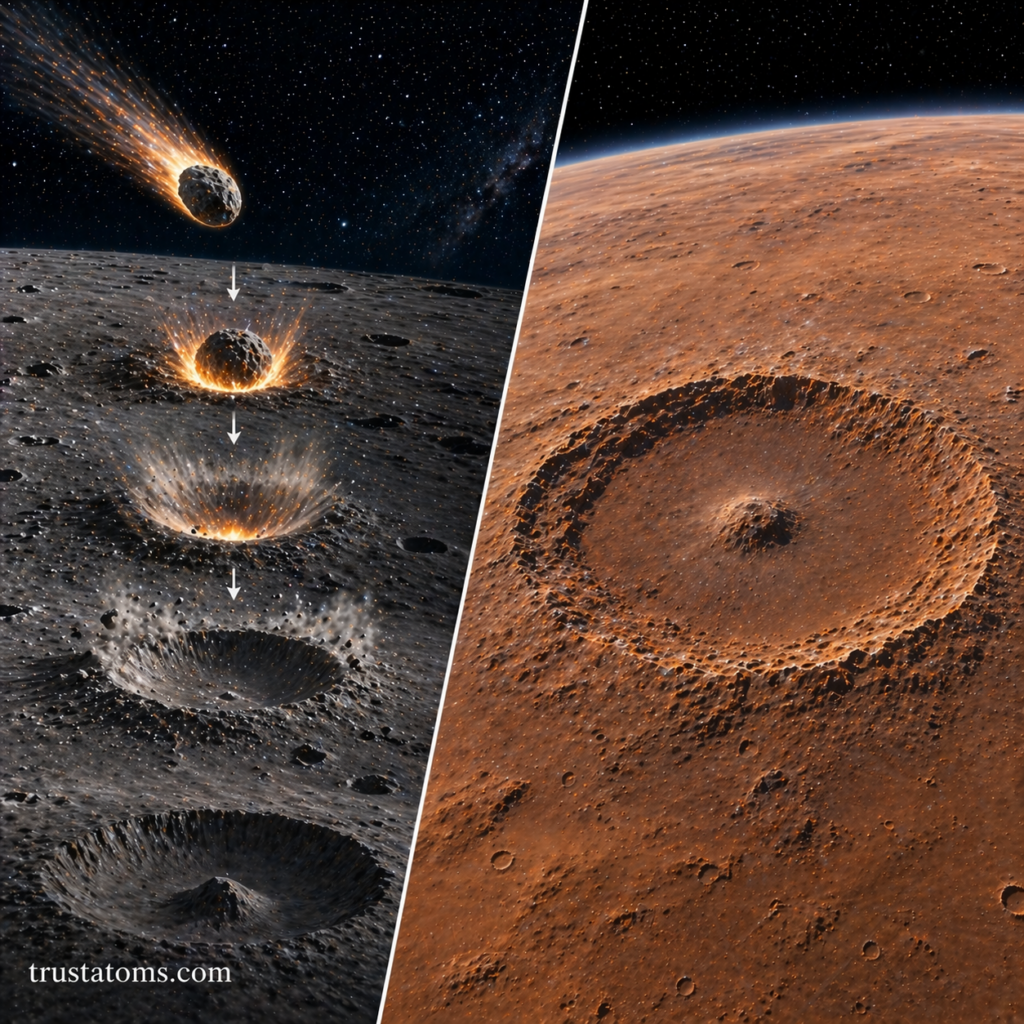
Crater formation happens in a matter of seconds but involves several distinct stages.
Stages of crater formation:
- Contact and compression
- The impactor strikes the surface at high speed
- Shock waves compress both the object and the ground
- Excavation
- Material is blasted outward
- A crater cavity forms rapidly
- Modification
- The crater stabilizes
- Walls may collapse, forming terraces or central peaks
This process occurs so quickly that the impactor is often completely vaporized.
Types of Impact Craters
Not all craters look the same. Their structure depends on the size of the impact and the surface being hit.
Main types:
- Simple craters
- Small, bowl-shaped, smooth edges
- Complex craters
- Larger, with central peaks and terraced walls
- Multi-ring basins
- Massive structures with multiple concentric rings
These categories help scientists understand the energy and scale of past impacts.
Where Are Impact Craters Found?
Impact craters exist throughout the solar system, especially on bodies without atmospheres or active geology.
Common locations:
- The Moon
- Covered in craters due to lack of atmosphere and erosion
- Mercury
- Heavily cratered surface similar to the Moon
- Mars
- Many preserved craters, though some eroded over time
- Asteroids and moons
- Surfaces often dominated by impact features
On Earth, craters are harder to find due to weathering, tectonic activity, and vegetation.
Why Earth Has Fewer Visible Craters
Despite frequent impacts in the past, Earth shows relatively few visible craters compared to other planetary bodies.
Reasons include:
- Atmospheric protection
- Smaller objects burn up before reaching the surface
- Erosion
- Wind, water, and ice gradually wear away craters
- Plate tectonics
- Earth’s surface is constantly reshaped
- Vegetation and oceans
- Many craters are hidden or submerged
Because of this, only a few well-preserved craters are easily identifiable today.
Famous Impact Craters
Some craters have played a major role in scientific discovery and history.
Notable examples:
- Chicxulub Crater
- Linked to the mass extinction of dinosaurs 66 million years ago
- Barringer Crater
- One of the best-preserved craters on Earth
- Tycho Crater
- A prominent lunar crater with bright ray patterns
These sites provide valuable evidence about impact processes and planetary history.
Impact Craters and Planetary History
Craters act like a timeline of events across the solar system.
What scientists learn from craters:
- Age of planetary surfaces (more craters = older surface)
- Frequency of impacts over time
- Geological activity levels
- Surface composition and structure
By counting and analyzing craters, researchers can estimate how long a surface has remained unchanged.
The Role of Impacts in Shaping Planets
Impacts have played a major role in shaping planets and moons.
Effects of large impacts:
- Alteration of planetary surfaces
- Creation of basins and mountain structures
- Changes in atmosphere and climate
- Possible delivery of water and organic materials
Some theories even suggest that early impacts contributed to the conditions necessary for life on Earth.
Are Large Impacts Still a Threat?
While large impacts are rare today, they are not impossible.
Current situation:
- Most small objects burn up in the atmosphere
- Larger objects are tracked by space agencies
- Planetary defense systems are being developed
Organizations like NASA monitor near-Earth objects to reduce potential risks.
Final Thoughts
Impact craters are more than just scars—they are records of the solar system’s history. Each crater tells a story of collision, energy, and transformation that has shaped planets over billions of years.
By studying these features, scientists continue to uncover the forces that have influenced planetary evolution and the ongoing dynamics of space.