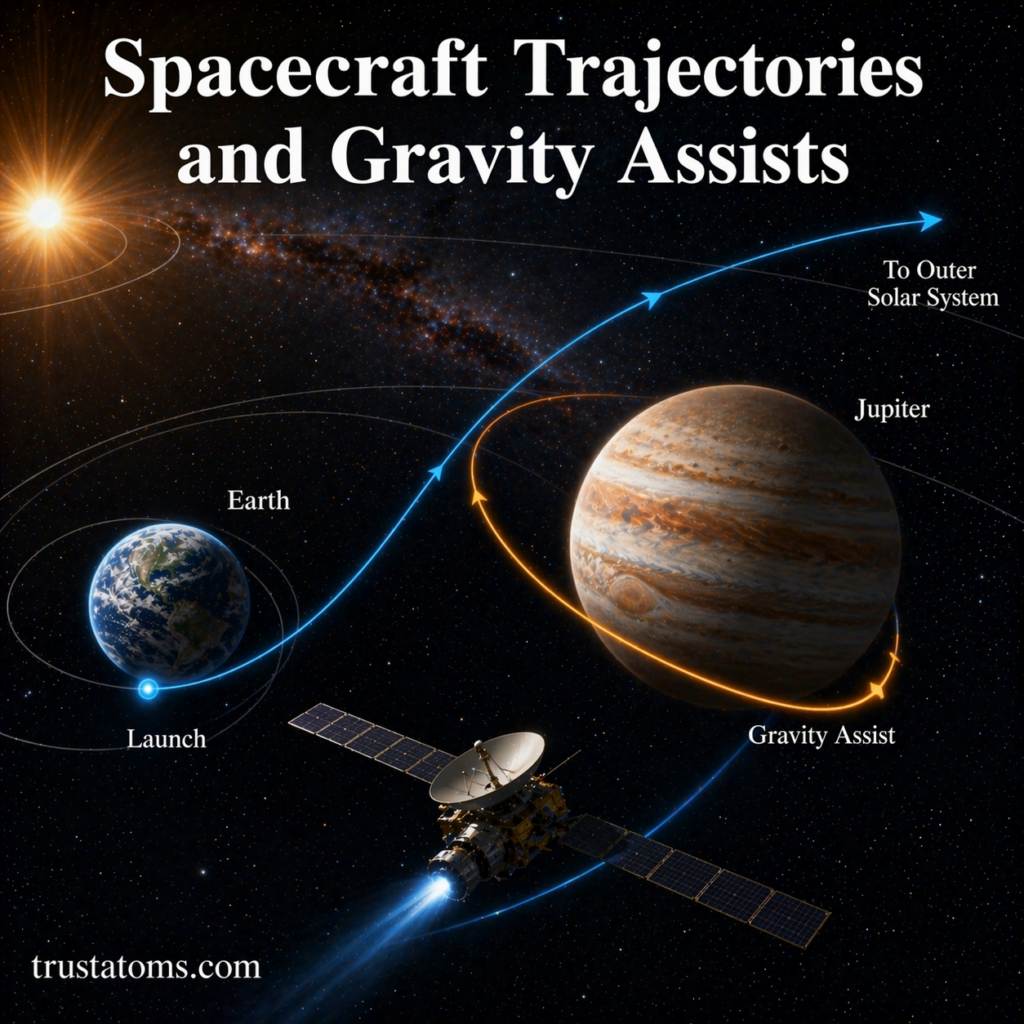
Sending a spacecraft across the solar system isn’t as simple as pointing it at a planet and firing engines. Space missions rely on carefully planned trajectories and the clever use of gravity to conserve fuel and increase speed.
By understanding how spacecraft move through space—and how they use planetary gravity—scientists can send missions to distant worlds like Jupiter and beyond with remarkable efficiency.
What Is a Spacecraft Trajectory?
A trajectory is the path a spacecraft follows through space, influenced by gravity, speed, and direction.
Key Factors That Shape a Trajectory
- Gravitational pull from planets and the Sun
- Initial launch speed and direction
- Orbital mechanics and timing
Unlike travel on Earth, spacecraft don’t move in straight lines—they follow curved paths determined by gravitational forces.
Why Trajectories Are So Complex
Space is constantly in motion. Planets orbit the Sun, and spacecraft must align with these movements.
Challenges in Planning
- Planets are rarely in the “right place” at the right time
- Launch windows are limited
- Small errors can lead to huge deviations over distance
Because of this, mission planners must calculate trajectories years in advance.
Understanding Orbital Mechanics
Orbital mechanics is the science of how objects move under the influence of gravity.
Basic Principles
- Objects in space follow elliptical orbits
- Gravity acts as a centripetal force, keeping objects in motion
- Speed and altitude determine orbit shape
These principles allow spacecraft to move efficiently without constant engine use.
What Is a Gravity Assist?
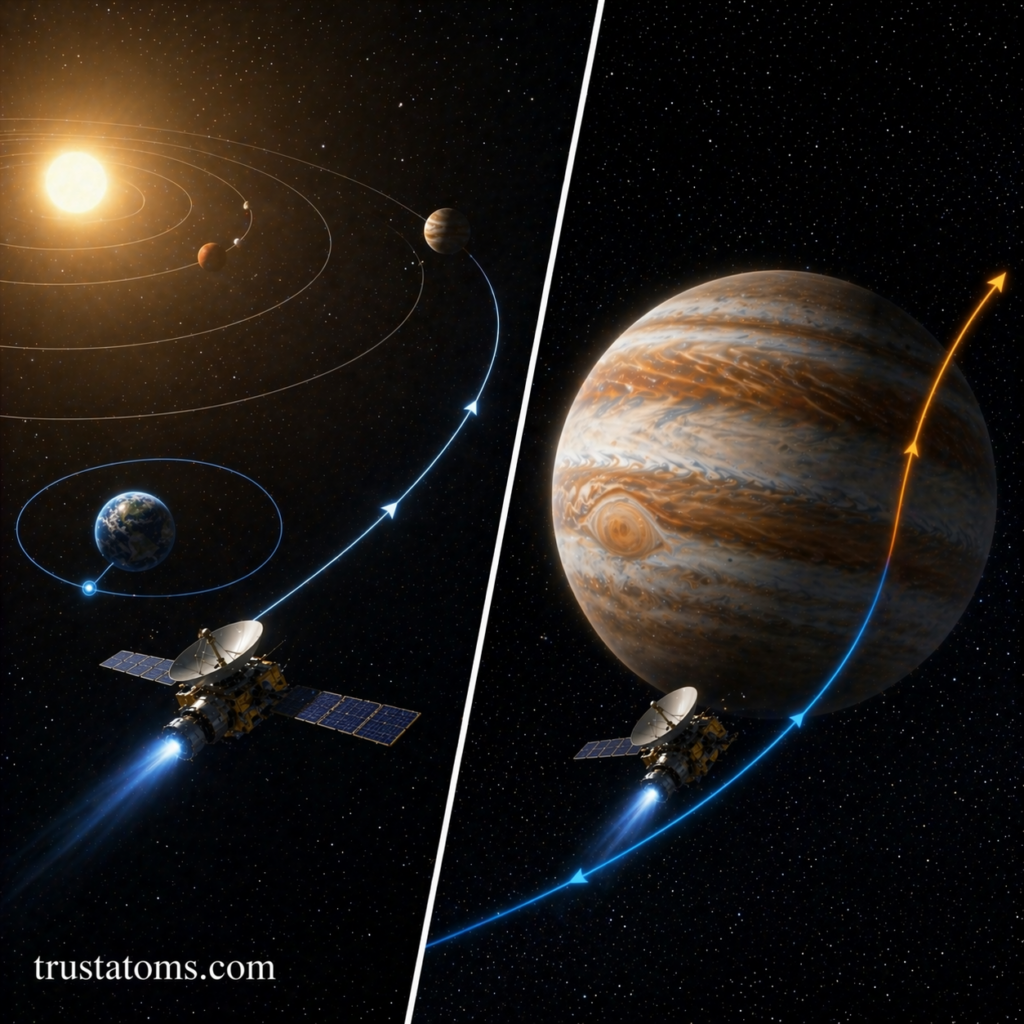
A gravity assist—also known as a slingshot maneuver—is a technique where a spacecraft uses a planet’s gravity to change speed and direction.
How It Works
- The spacecraft approaches a planet
- It falls into the planet’s gravitational field
- It swings around the planet
- It exits with increased speed and a new trajectory
This method allows spacecraft to gain energy without using extra fuel.
Benefits of Gravity Assists
Gravity assists are essential for deep space missions.
Key Advantages
- Saves fuel and reduces mission cost
- Increases spacecraft speed
- Enables missions to reach distant planets
Without gravity assists, many missions would be impossible with current technology.
Real Mission Examples
Some of the most famous space missions relied heavily on gravity assists.
Voyager 1 and Voyager 2
- Used multiple gravity assists from outer planets
- Traveled farther than any other spacecraft
- Took advantage of a rare planetary alignment
Cassini–Huygens
- Used flybys of Venus, Earth, and Jupiter
- Gained enough speed to reach Saturn
Juno
- Performed an Earth flyby to boost speed
- Reduced fuel requirements significantly
Types of Spacecraft Trajectories
Different missions use different trajectory designs depending on their goals.
Common Trajectory Types
- Hohmann Transfer Orbit
- The most fuel-efficient path between two orbits
- Often used for missions to nearby planets
- Direct Trajectory
- Faster but requires more fuel
- Used when time is critical
- Gravity Assist Trajectory
- Uses multiple planetary flybys
- Ideal for long-distance missions
Each trajectory type balances speed, fuel, and mission complexity.
Launch Windows and Timing
Timing is everything in space travel.
Why Launch Windows Matter
- Planets must be aligned properly
- Missing a window can delay a mission by months or years
- Optimal timing reduces fuel usage
For example, missions to Mars typically launch every 26 months when Earth and Mars are closest.
Navigation and Mid-Course Corrections
Even with precise planning, spacecraft need adjustments during flight.
Course Corrections
- Small engine burns refine trajectory
- Correct for minor deviations
- Ensure accurate arrival
Navigation teams constantly monitor spacecraft position and make necessary updates.
Challenges in Trajectory Design
Designing a trajectory is one of the most complex aspects of a space mission.
Key Challenges
- Balancing fuel efficiency and travel time
- Avoiding hazards like radiation zones
- Accounting for gravitational influences from multiple bodies
Advanced computer models and simulations are used to plan and test trajectories before launch.
The Future of Space Navigation
New technologies are improving how spacecraft travel through space.
Emerging Innovations
- Autonomous navigation systems
- AI-assisted trajectory optimization
- Advanced propulsion methods
These advancements will allow faster and more flexible missions in the future.
Why Gravity Assists Matter for Exploration
Gravity assists have made it possible to explore the outer solar system and beyond.
Key Contributions
- Enabled missions to reach distant planets
- Reduced mission costs
- Expanded the range of human exploration
They remain one of the most powerful tools in space mission design.
Final Thoughts
Spacecraft trajectories and gravity assists are at the heart of modern space exploration. By carefully planning paths and using the natural forces of gravity, scientists can send spacecraft across vast distances with incredible efficiency.
From missions to Mars to journeys beyond the outer planets, mastering these techniques allows humanity to explore deeper into space than ever before.