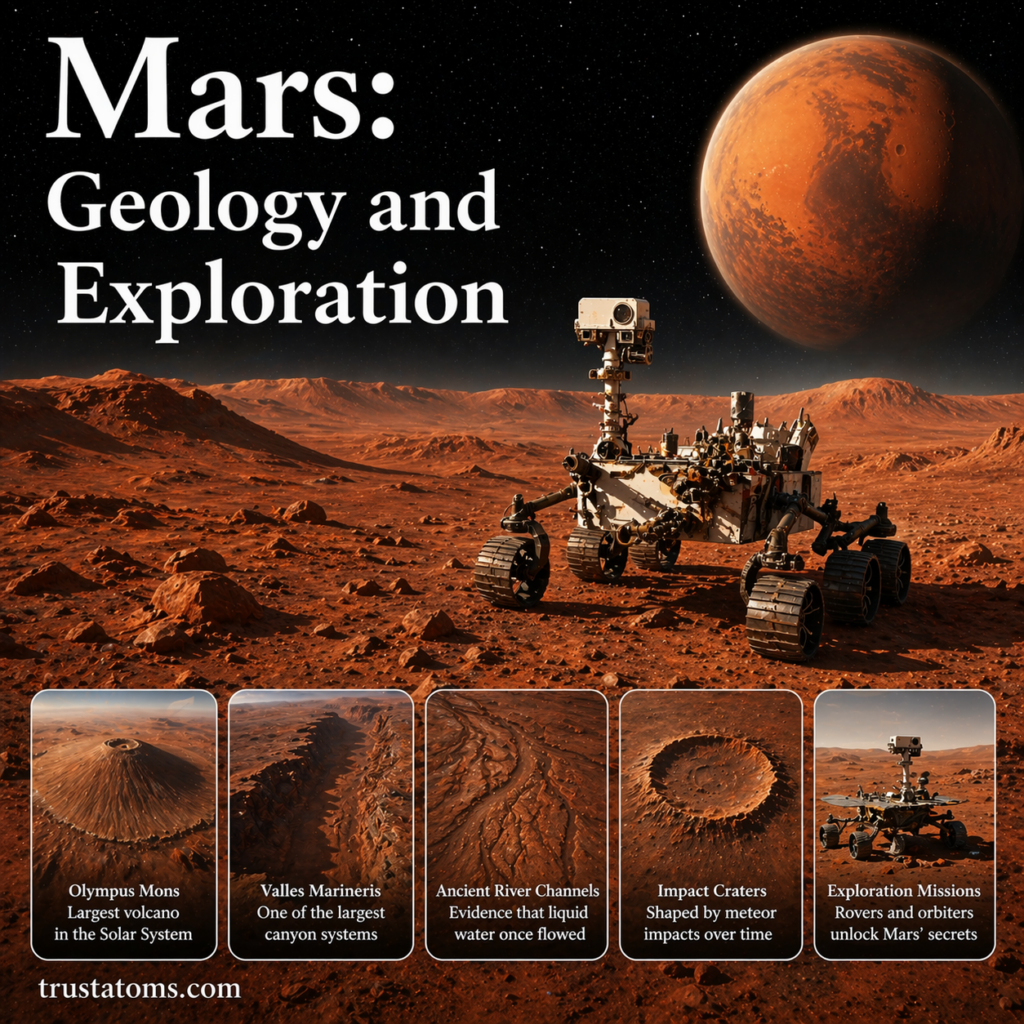
Mars—often called the Red Planet—is one of the most studied worlds in our Solar System. Its dusty surface, massive volcanoes, and evidence of ancient water make it a key focus in the search for past or present life beyond Earth.
In this guide, we’ll explore Mars’ geology and the missions that have helped scientists uncover its secrets.
Overview of Mars
Mars is the fourth planet from the Sun and is about half the size of Earth.
Key facts about Mars:
- Diameter: About 6,779 km
- Surface: Rocky and covered in iron oxide (rust), giving it a red color
- Day length: About 24.6 hours (similar to Earth)
- Year length: 687 Earth days
- Atmosphere: Thin, mostly carbon dioxide
Despite its harsh conditions, Mars shows strong evidence that it was once much wetter and potentially habitable.
The Geology of Mars
Mars has one of the most diverse and dramatic landscapes in the Solar System. Its surface reveals a long and complex geological history.
1. Volcanoes
Mars is home to the largest volcano in the Solar System: Olympus Mons.
- Height: About 22 km (nearly three times Mount Everest)
- Type: Shield volcano
- Formed by long-lasting volcanic activity
Mars also contains several other large volcanic regions, indicating a history of intense internal activity.
2. Valleys and Canyons
One of the most striking features on Mars is Valles Marineris.
- Length: Over 4,000 km
- Depth: Up to 7 km
- Likely formed by tectonic activity and erosion
This canyon system dwarfs Earth’s Grand Canyon and suggests a dynamic geological past.
3. Impact Craters
Mars is covered with craters formed by asteroid impacts.
- Some regions are heavily cratered (older surfaces)
- Others have fewer craters (younger surfaces)
- Craters help scientists estimate the age of the surface
These impact features provide clues about Mars’ history and its exposure to space debris.
4. Evidence of Water
One of the most important discoveries about Mars is evidence that liquid water once existed on its surface.
Key indicators:
- Dried river channels
- Delta formations
- Mineral deposits formed in water
- Polar ice caps made of water and carbon dioxide ice
While liquid water is not stable on the surface today, it may still exist underground.
5. Polar Ice Caps
Mars has two permanent ice caps at its poles.
- Made of water ice and frozen carbon dioxide (dry ice)
- Grow and shrink with the seasons
- Provide insight into Mars’ climate cycles
Mars’ Interior Structure
Although Mars is smaller than Earth, it still has a layered internal structure.
Main layers:
- Crust – thick and rocky
- Mantle – composed of silicate materials
- Core – likely made of iron, nickel, and sulfur
Unlike Earth, Mars does not have a strong global magnetic field, which has affected its atmospheric loss over time.
Exploration of Mars
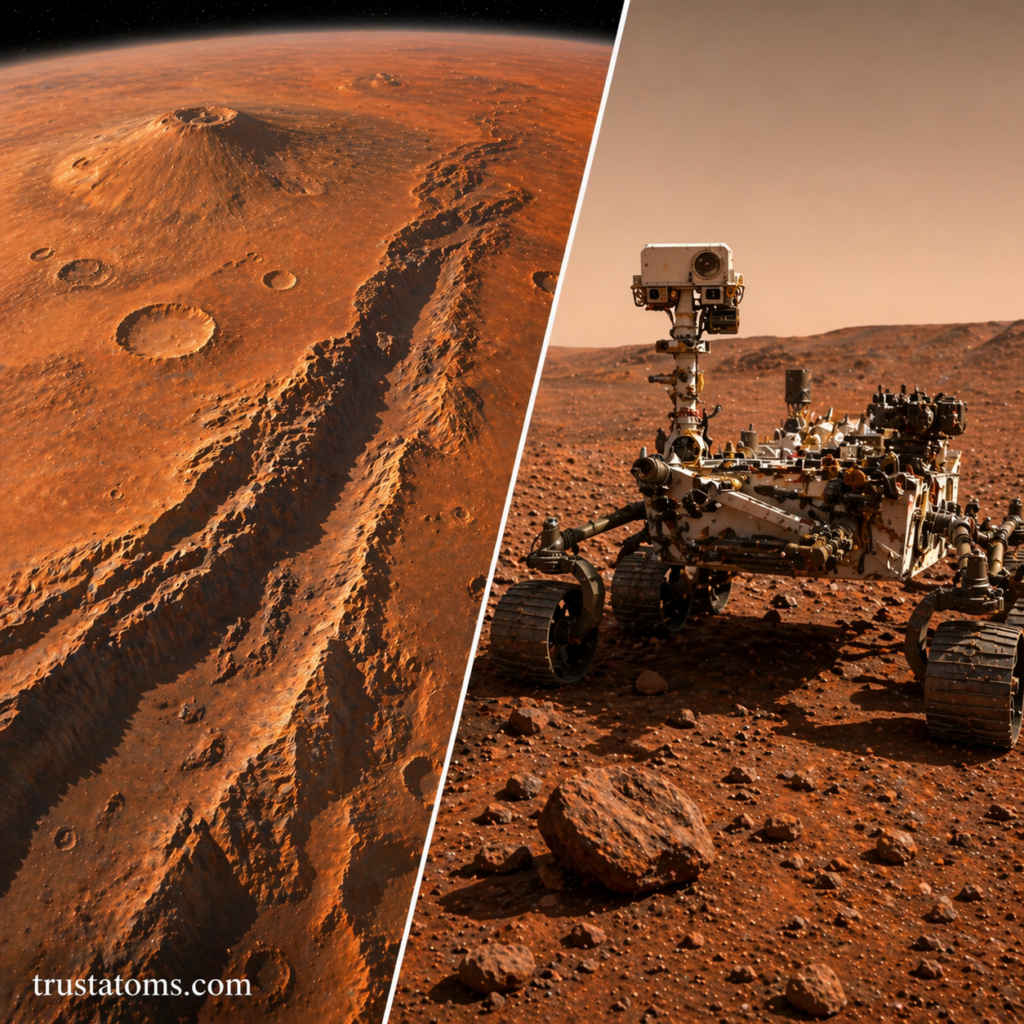
Mars has been the target of numerous robotic missions aimed at understanding its geology and potential for life.
Early Missions
The first successful missions to Mars were flybys and orbiters.
- Mariner 4 (1965): First close-up images
- Viking 1 (1976): First successful landing and experiments
These missions provided the first detailed look at the Martian surface.
Modern Rovers
Rovers have revolutionized our understanding of Mars by exploring its surface directly.
Notable rovers:
- Spirit and Opportunity: Found evidence of past water
- Curiosity: Studied habitability and climate
- Perseverance: Searching for signs of ancient life and collecting samples
Orbiters and Satellites
Orbiters continue to study Mars from above, mapping its surface and atmosphere.
- Analyze weather patterns
- Study seasonal changes
- Identify landing sites for future missions
Future Missions
Mars exploration is ongoing, with plans for:
- Sample return missions
- Human exploration
- Advanced robotic systems
Mars remains a key target in humanity’s efforts to explore and understand other worlds.
Why Mars Matters
Mars is one of the most Earth-like planets in the Solar System, making it a prime candidate for study.
Its importance includes:
- Understanding planetary evolution
- Searching for past or present life
- Preparing for human space exploration
- Learning how climates change over time
Final Thoughts
Mars offers a window into the past—both its own and potentially Earth’s. Its geological features tell the story of a once-active planet that may have supported life.
With ongoing missions and future exploration plans, Mars continues to be one of the most exciting and important destinations in space science.