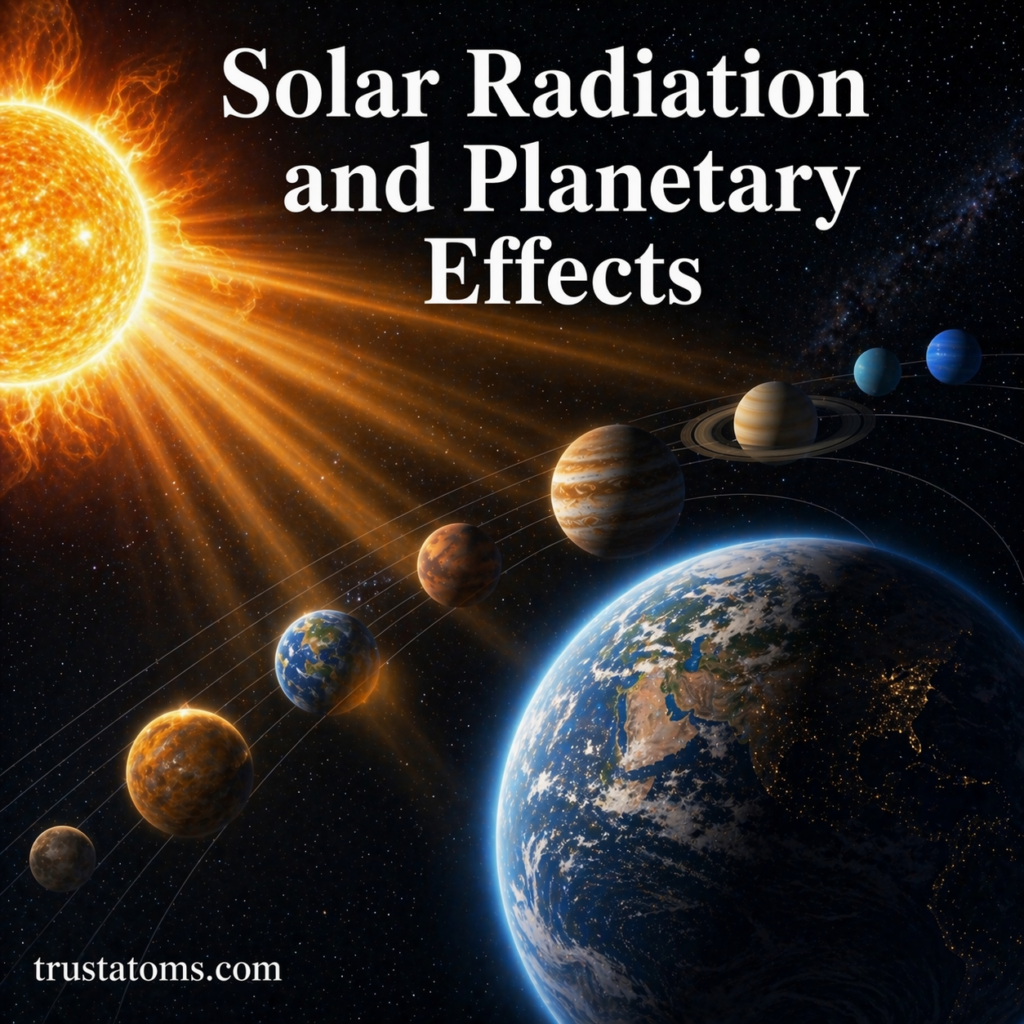
Solar radiation is the primary source of energy in our solar system, emitted by the Sun in the form of light, heat, and charged particles. This constant stream of energy plays a crucial role in shaping the climates, atmospheres, and surface conditions of planets.
Understanding how solar radiation affects different planets helps explain why some worlds are hot and barren, while others—like Earth—are capable of supporting life.
What Is Solar Radiation?
Solar radiation refers to the energy released by the Sun and transmitted through space.
Types of Solar Radiation
- Visible Light – The light we can see
- Infrared Radiation – Heat energy
- Ultraviolet (UV) Radiation – High-energy radiation that can damage biological systems
- Solar Wind – Streams of charged particles
Each type of radiation interacts differently with planetary atmospheres and surfaces.
How Solar Radiation Travels Through Space
Solar radiation spreads outward in all directions, decreasing in intensity with distance.
Key Concept
- Planets closer to the Sun receive more energy
- Planets farther away receive significantly less
For example:
- Mercury experiences extreme heat due to its proximity
- Neptune receives only a small fraction of the Sun’s energy
This variation is one of the main reasons for temperature differences across the solar system.
Effects on Planetary Temperature
Solar radiation is the main driver of planetary temperatures.
Factors That Influence Temperature
- Distance from the Sun
- Atmospheric composition
- Surface reflectivity (albedo)
- Presence of greenhouse gases
Examples Across the Solar System
- Mercury: Extremely hot during the day, very cold at night (no atmosphere)
- Venus: Traps heat due to a thick atmosphere, making it hotter than Mercury
- Earth: Balanced conditions due to atmosphere and water
- Mars: Cold and thin atmosphere, limited heat retention
The Greenhouse Effect
One of the most important ways solar radiation affects planets is through the greenhouse effect.
How It Works
- Solar radiation reaches a planet’s surface
- The surface absorbs and re-emits energy as heat
- Greenhouse gases trap some of this heat
Impact on Planets
- Strong greenhouse effect: Venus (runaway heating)
- Moderate greenhouse effect: Earth (supports life)
- Weak greenhouse effect: Mars (cold surface)
The greenhouse effect plays a key role in determining whether a planet can sustain liquid water.
Atmospheric Protection from Solar Radiation
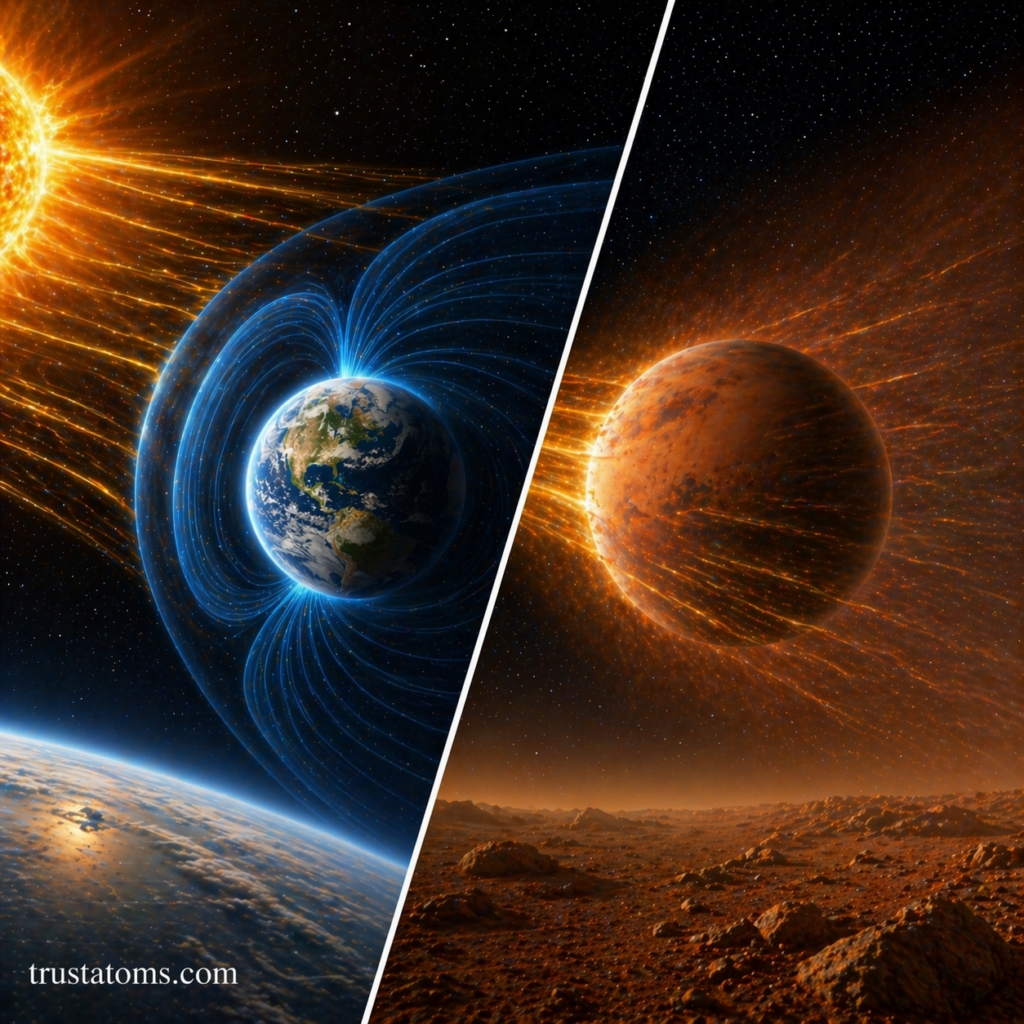
A planet’s atmosphere acts as a shield against harmful radiation.
Protective Functions
- Blocks or absorbs ultraviolet radiation
- Reduces surface temperature extremes
- Protects against solar wind
Magnetic Fields and Protection
Planets like Earth have magnetic fields that deflect charged particles from the solar wind.
- Earth’s magnetic field protects its atmosphere
- Mars lost much of its atmosphere due to weak magnetic protection
Solar Radiation and Weather Systems
Solar radiation drives weather and climate systems on planets.
How It Influences Weather
- Uneven heating creates winds
- Drives ocean currents (on Earth)
- Powers storms and atmospheric circulation
Planetary Examples
- Earth: Complex weather patterns and seasons
- Jupiter: Massive storms powered by internal and solar energy
- Saturn: Long-lasting atmospheric storms
Even gas giants like Jupiter are influenced by solar radiation, though internal heat also plays a role.
Effects on Planetary Surfaces
Solar radiation directly impacts planetary surfaces, especially those without atmospheres.
Surface Effects
- Temperature fluctuations
- Radiation exposure
- Surface erosion from solar wind
Examples
- Mercury’s surface is heavily affected by radiation
- The Moon experiences extreme temperature swings
- Mars shows signs of past atmospheric loss
Solar Radiation and Habitability
Solar radiation is a key factor in determining whether a planet can support life.
The Habitable Zone
The habitable zone is the region around a star where conditions may allow liquid water to exist.
- Too close: Water evaporates
- Too far: Water freezes
Earth lies within this zone, making it suitable for life.
Long-Term Effects on Planets
Over billions of years, solar radiation can significantly alter planets.
Long-Term Impacts
- Atmospheric loss
- Climate change
- Surface evolution
For example, Mars likely had a thicker atmosphere in the past but lost it over time due to solar wind exposure.
Why Solar Radiation Matters
Understanding solar radiation helps scientists:
- Predict planetary climates
- Study atmospheric evolution
- Search for habitable exoplanets
- Understand Earth’s changing climate
It is one of the most important forces shaping planets across the universe.
Final Thoughts
Solar radiation is the driving force behind many planetary processes, from temperature regulation to atmospheric dynamics. Its effects vary widely depending on a planet’s distance from the Sun, atmosphere, and magnetic field.
By studying how solar radiation interacts with different worlds, scientists gain valuable insights into the conditions that make planets habitable—and how those conditions can change over time.