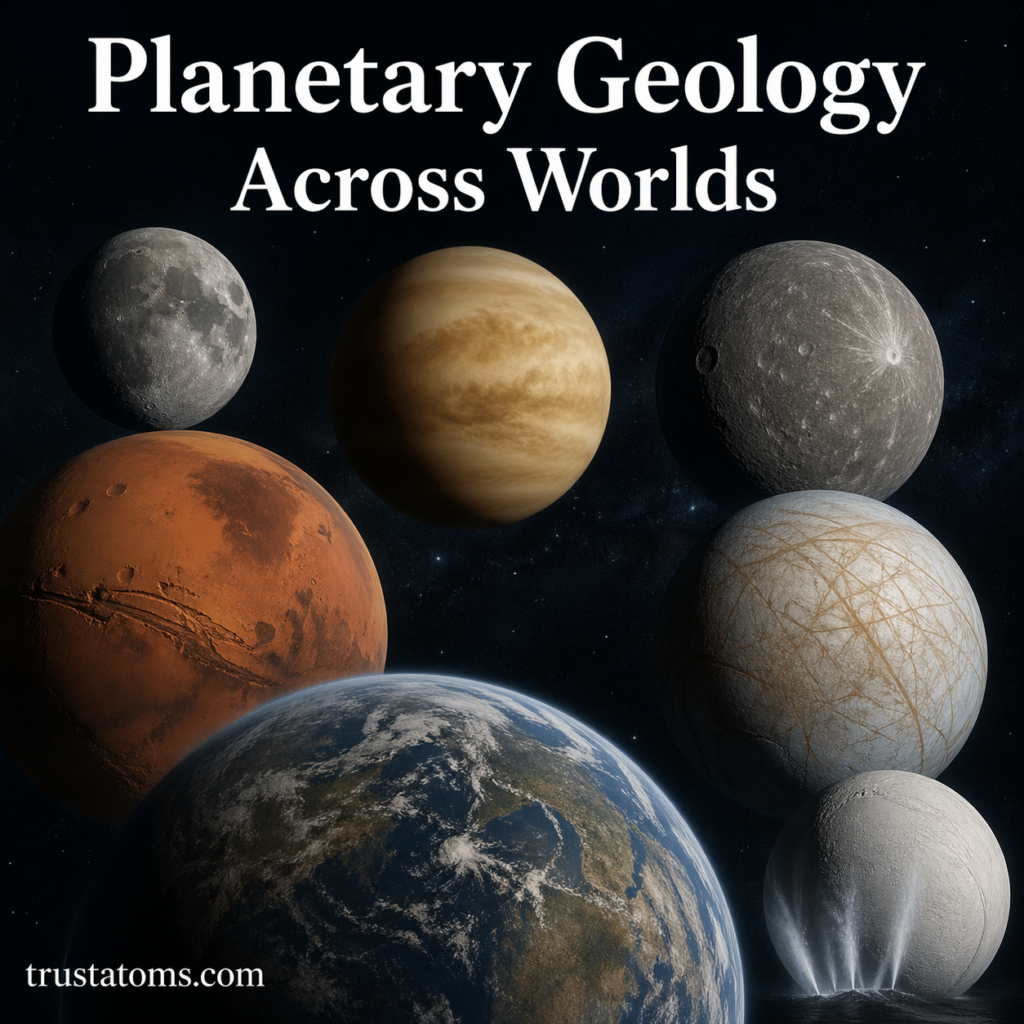
Planetary geology—also known as astrogeology—is the study of how planets, moons, asteroids, and other celestial bodies form and evolve over time. While Earth’s geology is shaped by plate tectonics, water, and life, other worlds reveal entirely different processes that sculpt their surfaces.
From volcanic plains on Venus to icy fractures on distant moons, planetary geology helps scientists understand not only our solar system’s past, but also the potential for life beyond Earth.
What Is Planetary Geology?
Planetary geology focuses on the physical features and processes that shape solid bodies in space. This includes:
- Surface features like mountains, valleys, craters, and plains
- Internal structures such as cores and mantles
- Geological activity like volcanism, tectonics, and erosion
- Impact events from asteroids and comets
By studying these elements, scientists can reconstruct the history of a planet or moon—even without direct exploration.
Key Geological Processes Across the Solar System
Different worlds experience different geological forces depending on their size, composition, and distance from the Sun.
Impact Cratering
Impact cratering is one of the most universal processes in planetary geology.
- Caused by collisions with meteoroids, asteroids, or comets
- Common on bodies without atmospheres (like Mercury and the Moon)
- Older surfaces tend to have more craters
Craters provide a timeline—more craters usually mean an older surface.
Volcanism
Volcanic activity shapes many planetary surfaces, but not always in the same way as on Earth.
- Earth: Lava flows and explosive eruptions
- Mars: Massive shield volcanoes like Olympus Mons
- Venus: Widespread lava plains and volcanic domes
- Io (a moon of Jupiter): The most volcanically active body in the solar system
Volcanism helps release internal heat and reshape planetary surfaces.
Tectonics
Tectonic activity involves the movement of a planet’s crust.
- Earth: Plate tectonics create mountains, earthquakes, and ocean basins
- Mars: Limited tectonic activity due to a smaller size
- Europa (moon of Jupiter): Cracked icy surface suggesting subsurface movement
Not all planets have plate tectonics, but many show evidence of surface shifting.
Erosion and Weathering
Erosion reshapes surfaces over time, but the mechanisms vary widely.
- Earth: Water, wind, and ice dominate
- Mars: Wind erosion creates dunes and dust storms
- Titan (moon of Saturn): Methane rain carves river channels
Even without liquid water, erosion still plays a major role.
Comparing Planetary Surfaces
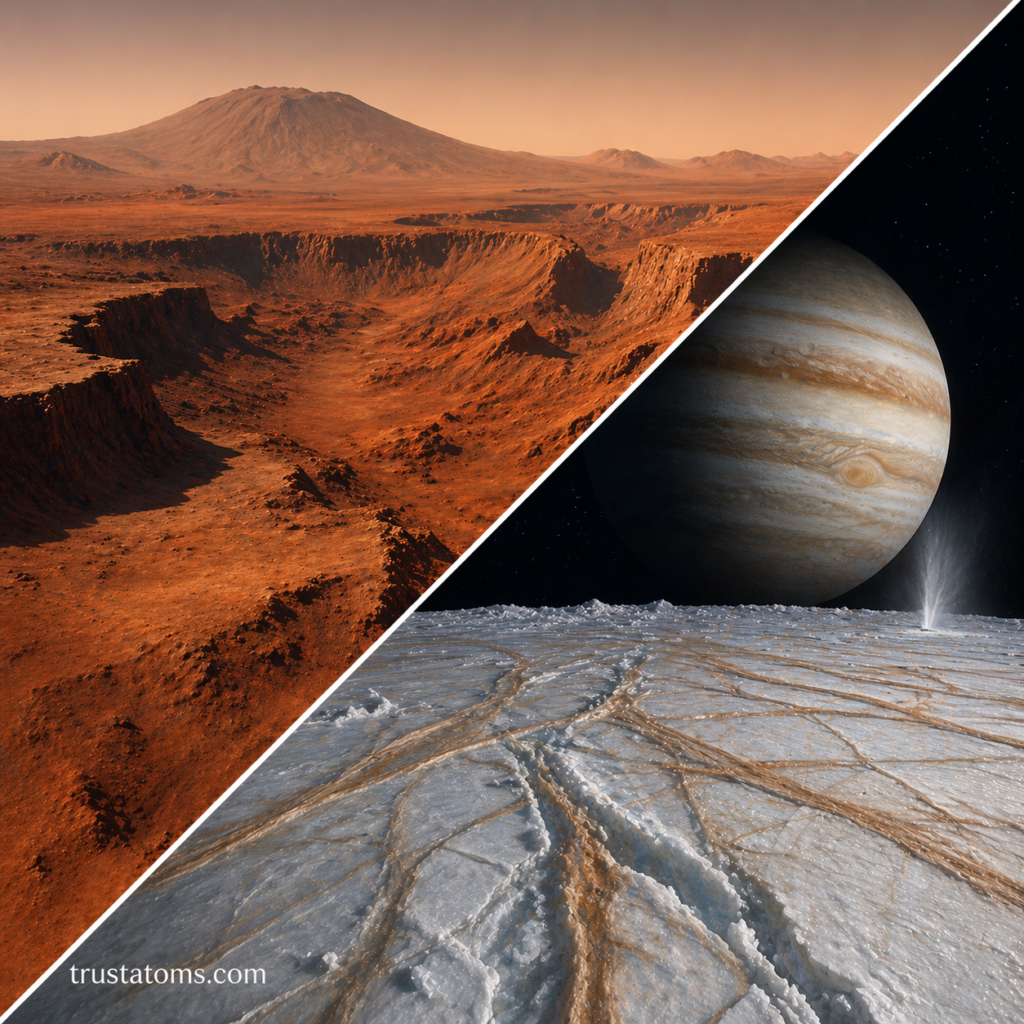
Each world tells a unique geological story.
Mercury
- Heavily cratered surface
- Large temperature swings
- Evidence of ancient volcanic activity
Mercury’s surface has remained largely unchanged for billions of years.
Venus
- Thick atmosphere traps heat (runaway greenhouse effect)
- Surface covered in volcanic plains
- Few impact craters due to atmospheric burn-up
Venus may still be volcanically active today.
Mars
- Largest volcano and canyon in the solar system
- Evidence of ancient rivers and lakes
- Dust storms reshape the surface
Mars offers strong clues that liquid water once existed.
The Moon
- Dark basalt plains (maria) from ancient lava flows
- Countless impact craters
- No atmosphere or active geology today
The Moon preserves a record of early solar system history.
Icy Moons
Moons like Europa and Enceladus reveal a different kind of geology:
- Ice-covered surfaces
- Subsurface oceans
- Geysers ejecting water vapor into space
These worlds are key targets in the search for extraterrestrial life.
What Planetary Geology Reveals About Time
Planetary surfaces act like historical records. By studying layers, craters, and formations, scientists can estimate:
- The age of a surface
- Past environmental conditions
- Geological activity over time
For example:
- A heavily cratered surface = very old
- Smooth, resurfaced terrain = more recent activity
This helps build timelines for each world’s evolution.
Tools and Methods Used by Scientists
Planetary geologists rely on a combination of remote sensing and direct exploration.
Spacecraft and Orbiters
- Capture high-resolution images
- Map surface composition
- Measure gravitational and magnetic fields
Landers and Rovers
- Analyze soil and rock samples
- Study local geology up close
- Search for signs of past water or life
Meteorite Analysis
- Provides physical samples from other worlds
- Helps confirm theories about planetary composition
Why Planetary Geology Matters
Understanding planetary geology goes far beyond curiosity. It helps answer fundamental questions:
- How did the solar system form?
- Why is Earth uniquely habitable?
- Could life exist elsewhere?
It also supports future exploration, including:
- Human missions to Mars
- Resource utilization on the Moon
- Identifying habitable environments on distant moons
Common Mistakes When Learning Planetary Geology
- Assuming all planets have Earth-like processes
- Overlooking the role of atmospheres in shaping surfaces
- Ignoring smaller bodies like asteroids and comets
- Thinking geological activity requires water
Each world operates under its own conditions, leading to surprising differences.
Final Thoughts
Planetary geology reveals a dynamic and diverse solar system where each world evolves in its own way. From fiery volcanoes to frozen oceans, the surfaces of planets and moons tell stories of formation, destruction, and transformation.
As exploration continues, planetary geology will remain a key tool in uncovering the mysteries of our cosmic neighborhood—and perhaps even discovering life beyond Earth.