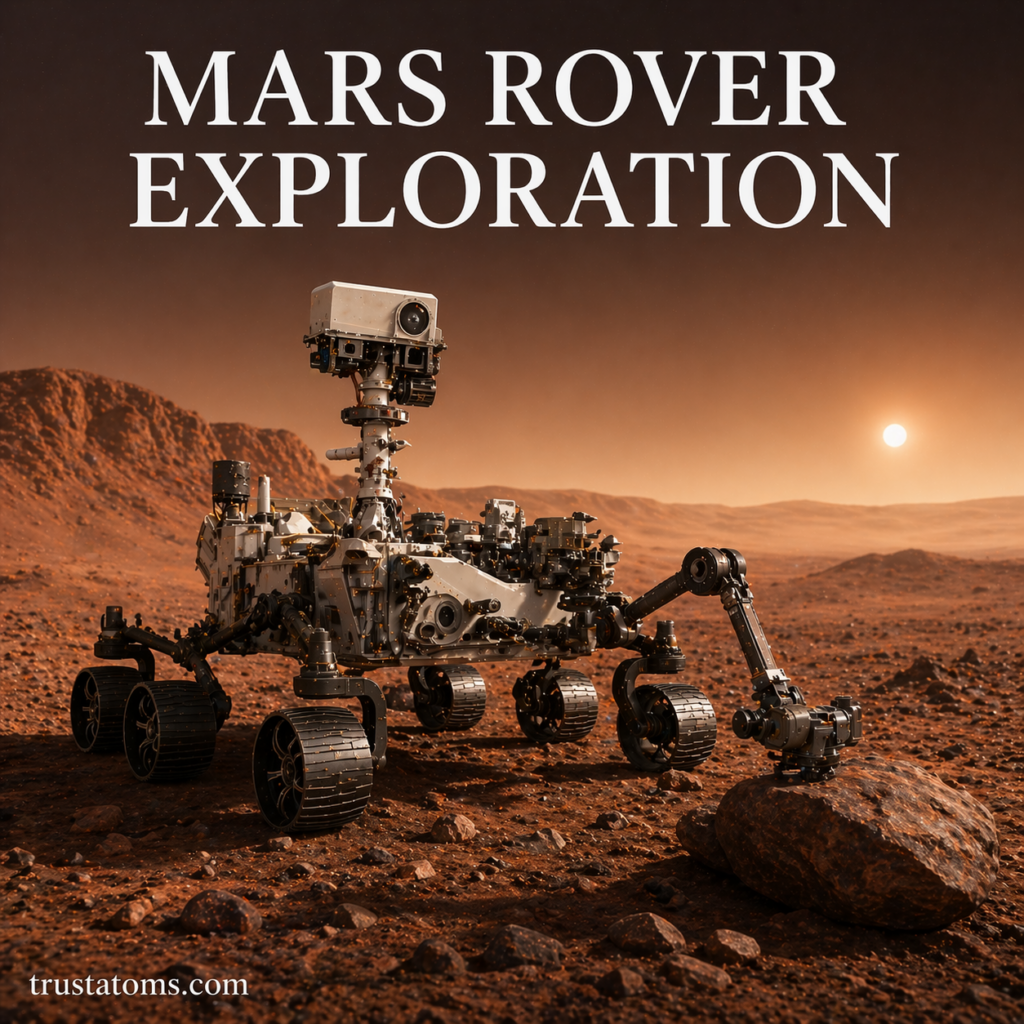
Mars rover exploration has transformed our understanding of the Red Planet. These robotic explorers travel across the Martian surface, analyzing rocks, soil, and atmosphere while sending valuable data back to Earth.
Over the past few decades, rovers have revealed that Mars was once a far more dynamic world—possibly with conditions suitable for life.
What Is a Mars Rover?
A Mars rover is a robotic vehicle designed to move across the surface of Mars and conduct scientific experiments.
Unlike stationary landers, rovers can:
- Travel across terrain
- Investigate multiple locations
- Drill into rocks and soil
- Capture high-resolution images
They are essentially mobile laboratories built to explore Mars in detail.
Why Explore Mars with Rovers?
Mars is one of the most studied planets because it shares similarities with Earth.
Key reasons for rover exploration:
- Evidence of past water
- Potential for ancient microbial life
- Geological diversity
- Future human exploration potential
Rovers allow scientists to study Mars up close without the risks of human missions.
Major Mars Rover Missions
NASA has sent several rovers to Mars, each building on the success of previous missions.
Sojourner (1997)
- First successful Mars rover
- Part of the Pathfinder mission
- Demonstrated that rovers could operate on Mars
Spirit and Opportunity (2004)
- Twin rovers exploring different regions
- Found strong evidence of past water
- Opportunity operated for nearly 15 years
Curiosity Rover (2012–Present)
- Large, advanced rover still active today
- Studies climate and geology
- Confirmed ancient environments that could support life
Perseverance Rover (2021–Present)
- Most advanced Mars rover to date
- Searching for signs of ancient life
- Collecting samples for future return to Earth
How Mars Rovers Work
Mars rovers are highly complex machines designed to operate in extreme conditions.
Key systems include:
- Mobility system – wheels designed for rocky terrain
- Power source – solar panels or nuclear batteries
- Communication system – sends data via orbiters to Earth
- Scientific instruments – cameras, drills, spectrometers
Because of communication delays, rovers must operate semi-autonomously.
Scientific Instruments on Rovers
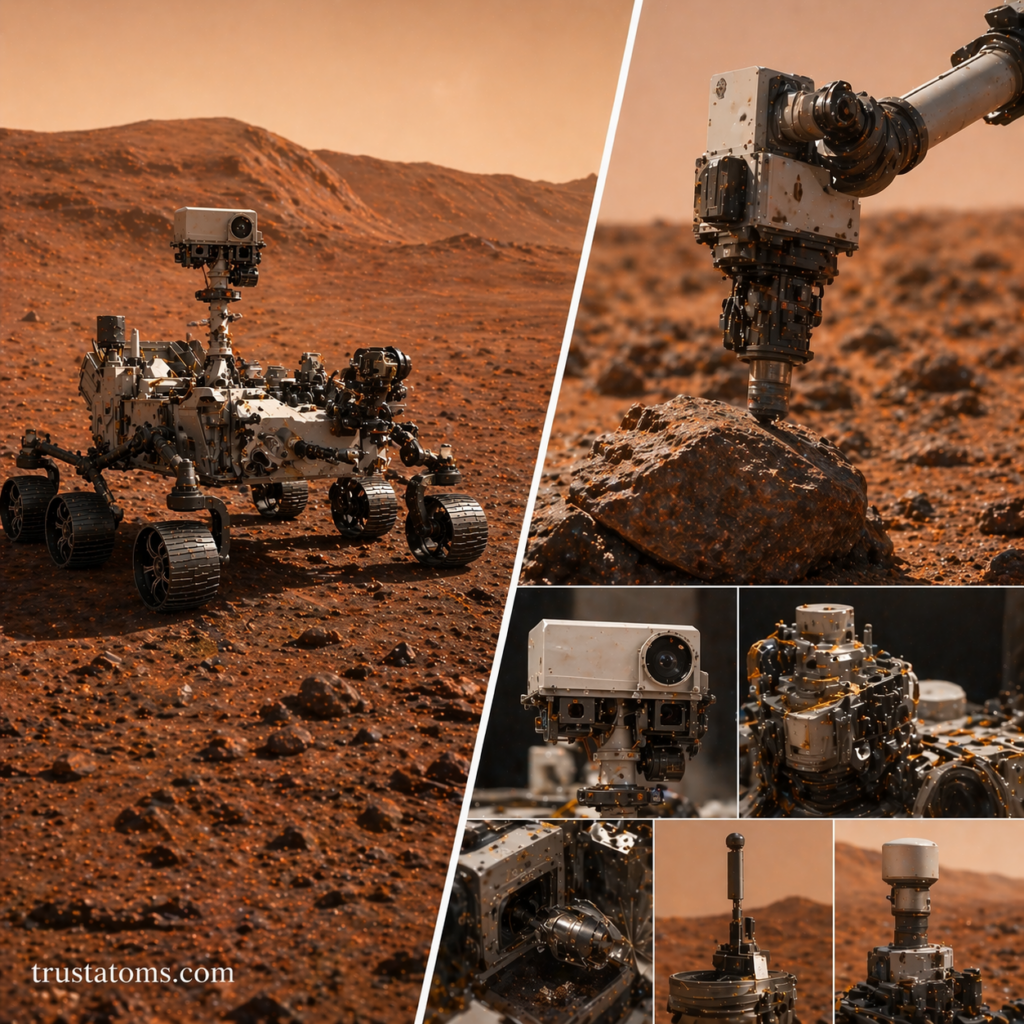
Rovers carry a wide range of tools to study Mars.
Common instruments include:
- Cameras for imaging and navigation
- Spectrometers to analyze chemical composition
- Drills to collect rock samples
- Weather sensors to study climate
These tools help scientists understand Mars at both surface and microscopic levels.
Key Discoveries from Mars Rovers
Mars rovers have made groundbreaking discoveries over the years.
Major findings include:
- Evidence of ancient rivers and lakes
- Detection of organic molecules
- Identification of habitable past environments
- Insights into Martian weather and climate
These discoveries suggest that Mars once had conditions that may have supported life.
Challenges of Exploring Mars
Mars is a harsh and unforgiving environment.
Key challenges include:
- Extreme cold temperatures
- Dust storms that can cover solar panels
- Rough terrain
- Communication delays (5–20 minutes each way)
Engineers must design rovers to survive and operate under these conditions for years.
Communication with Earth
Mars rovers communicate with Earth using a relay system.
How it works:
- Rover sends data to Mars orbiters
- Orbiters transmit data back to Earth
- Scientists analyze the information
Because signals take time to travel, commands are carefully planned in advance.
The Future of Mars Rover Exploration
Mars exploration continues to evolve with new missions and technologies.
Future goals include:
- Returning collected samples to Earth
- Exploring deeper underground
- Searching for definitive signs of past life
- Preparing for human missions
Rovers will remain essential tools for exploring Mars safely and efficiently.
Why Mars Rovers Matter
Mars rovers play a crucial role in space exploration.
They help us:
- Understand planetary evolution
- Search for life beyond Earth
- Test technologies for future missions
- Inspire scientific discovery
Each mission brings us closer to answering one of humanity’s biggest questions: Has life ever existed on Mars?
Final Thoughts
Mars rover exploration has opened a new chapter in planetary science. These robotic explorers continue to uncover the history of Mars, revealing a world that was once warmer, wetter, and potentially habitable.
As technology advances, future rovers will dig deeper, travel farther, and provide even greater insight into the mysteries of the Red Planet.